
Network and security have rarely ever been separate domains. In 2026.
The way they intertwine makes older perimeter based models feel almost quaint. If you’ve been working in IT infrastructure, you’ll know the nagging feeling. The (at least based on current observations) old rulebooks don’t apply anymore. Attackers aren’t breaking down the firewall with brute force.
They’re logging in, with stolen credentials. They’re doing it faster than most teams can respond.
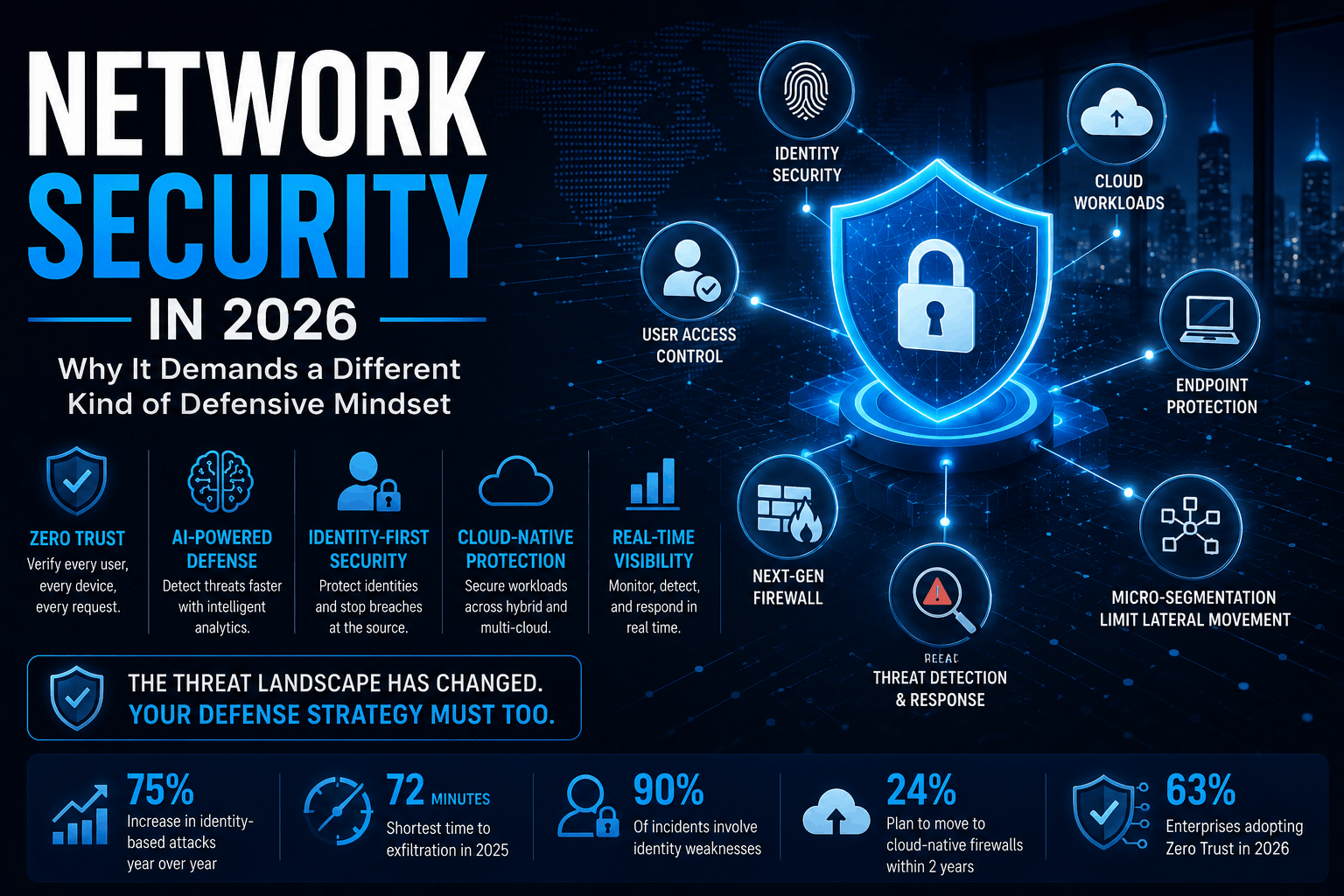
The numbers confirm it. Let me tell you, identity based attacks surged 75% year-over-year.
Those numbers tell a story. 82% of all detections are now malware-free. Hard to ignore those numbers. It stands out. Relying entirely on valid credentials, according to recent reports. That shift forces a complete rethink of what it means to secure a network. ” That’s exactly. Where this article will take you.
Key Point
- Zero Trust isn’t a buzzword anymore — adoption is projected to climb from 41% of enterprises to 63% in 2026, making continuous verification the default architecture for network and security.
- The quickest exfiltration in 2025 dropped to 72 minutes, down from 285 minutes the year before.
- 90% of incident response investigations involve identity weaknesses, according to Unit 42 data. You can’t patch people, but you can remove implicit trust.
- AI-driven threat hunting blends analytics with human expertise, cutting breach costs and detection windows substantially.
- Cloud-native firewall migration is accelerating, with 24% of organizations planning a primary shift within two years, showing that network and security controls are moving away from on-prem appliances.
Table of Contents
- What Is Network Security? A 2026 Definition
- Why the Rules of Engagement Have Completely Changed
- Threats That Exploit the Modern Infrastructure
- How Zero Trust Is Becoming the Operational Norm
- Practical Moves That Strengthen Your Security Posture Now
- People Also Ask
- Why This Shift Matters for Every IT Professional
What Is Network Security? A 2026 Definition
Within this context, network security is the set of policies, controls, and technologies designed to (at least based on current observations) protect the integrity. From a practical standpoint, confidentiality, and availability of data as it moves across or lives on your infrastructure.Network and security now coveres identity governance. Cloud-native access controls, micro-segmentation, and AI-powered analytics that scrutinize every packet and (and the data generally agrees) login give it a go as. Read that again if you need to.
The goal has shifted from building a digital moat to ensuring that even when, not if, an attacker gets inside, they find nothing to exploit without stepping through continuous verification checkpoints.
Actually, let’s rephrase that. The older definitions still hold technically, but they don’t prepare anyone for what’s happening on the frontlines.
I’ve watched incident response reports pile up. Where the breach didn’t takes a single piece of malware.
The attacker logged in with a valid account. Moved laterally through poorly segmented internal networks, and exfiltrated data within a lunch break. That’s not a failure of firewalls.
It’s a failure to treat internal traffic as untrusted.
If you think about it, this has become the core of modern network, and security — acknowledging that the inside is just as dangerous as the outside. ” They’re baseline.
Why the Rules of Engagement Have Completely Changed
On the surface, then again, attackers aren’t merely evolving, they’re weaponizing organizational complexity. The traditional model of securing a perimeter with a VPN and a stack of on-prem appliances is collapsing under the weight (at least based on current observations) of hybrid work. Multi-cloud sprawl.Network and security teams are now defending an estate where users, devices.
One of the most sobering shifts is the acceleration of exfiltration speed. In 2024, the fastest recorded intrusion to data theft was 285 minutes. Those numbers tell a story. Let that sink in for a second.
By 2025, that dropped to 72 minutes. That’s less time than a run-of-the-mill lunch break.
If your detection and response playbook relies on a human analyst noticing an alert within the next morning. The game is already over. You’ll have no data left to protect.
In most scenarios, naturally, that’s not even the scariest part. The real story is credential abuse, and according to Unit 42 research, identity weaknesses played a material role in about 90% of incident response investigations in 2025.
Those numbers tell a story. Attackers are no longer hacking in.
In reality, they’re simply logging in. As quite a few threat intel analysts put it. Stolen tokens, tough-coded API keys.
Weak MFA set upations give them all the keys they need. Once inside, they don’t need malware; they use native fixes and live-off-the-land techniques to blend into normal network traffic.
This reality is pushing network, and security professionals to adopt a much more adversarial mindset.
Threats That Exploit the Modern Infrastructure
How are identity-based attacks overtaking malware?
Identity-based attacks now make up most incidents because obtaining, and abusing valid credentials is simply more reliable than deploying malware.
With 82% of detections being malware-free. Those numbers tell a story.
The focus is on privilege escalation rather than code execution. Attackers use phishing, credential stuffing, or buying first access to valid accounts, then quietly escalate privileges within the network. Since no malicious binary lands on disk, traditional endpoint detection often sees nothing.
What’s driving the explosion in supply chain risk?
Supply chain security risks have expanded fourfold since 2020. Puts things in perspective.Network and security teams now face adversaries who compromise a trusted vendor. Digital Bills of Materials (DBOMs) are becoming mandatory to map every dependency, but implementing them across sprawling software stacks is a monumental task.
From a broader view. More often than not, nation-state actors now use AI agents to probe APIs for weaknesses invisible to human reviewers. They automate persona-person infiltration, crafting synthetic identities that pass trust checks. A something like 89% increase in AI-enabled attacks was reported this year. That’s a significant gap.
Funny enough, security teams relying on static rule sets are ill-equipped to detect these active, AI-generated intrusion patterns.
Is cloud migration making things worse before it gets better?
State-sponsored intrusions via cloud security gaps jumped by 266%. Let that sink in for a second. Hard to ignore those numbers. That’s staggering. As organizations rush to cloud-native firewalls and services, they often misconfigure identity access management or leave storage buckets exposed.
The cloud isn’t inherently less secure, but the sheer speed of migration build a vast attack surface that on-prem security tools can’t monitor effectively.
Network and security controls must be re-architected from the cloud up. Not bolted on afterward.
How Zero Trust Is Becoming the Operational Norm
Across the board, zero Trust isn’t a product you buy. ”, and in 2026. That principle is shifting from aspiration to active deployment. Hard to ignore those numbers. With adoption climbing from somewhere around 41% to a projected 63% of enterprises this year.
Basically, what that means is: blocksep matters. The practical set upation of Zero; wait, let me rephrase, Trust means a few things are non-negotiable, but there’s a catch, so where does that leave us?
First, micro-segmentation. You cordon off every asset, so an attacker who; wait. Let me rephrase, compromises one application can’t simply hop to the database server.
Second, continuous verification. Every single ask for is authenticated, yet to be determined, and authorized, even between internal servers. Then you’ve, least privilege access that’s granted just-in-time and automatically revoked.
“Zero Trust in 2026 means verifying every single access request as if it came from an open web.”
That quote captures the essence. it’s debatable. If you treat your internal network like a hostile coffee shop Wi-Fi, you’ll start making totally different design decisions.
In most scenarios, many practitioners I’ve spoken with find this shift liberating. It removes the false sense of security that a firewall provided.
The transition isn’t trivial. Legacy applications that assume a flat trust model break, which means operational technology in manufacturing environments doesn’t support modern authentication protocols.
That’s where the rubber meets the road. The organizations succeeding are those that accept the 80/20 rule — successfully segmenting high-value assets first, and gradually (and that implies quite a bit) bringing everything else along.
Will Zero Trust adoption eliminate the need for other security controls?
Not even close. Zero Trust reduces the blast radius bigly, but you still need detection, response.
Threat intelligence, and it’s complimentary, not a replacement. In fact, a well-set uped Zero Trust environment makes SIEM and XDR resources more dependable. Because the data they ingest is already contextualized through identity and micro-segmentation policies.
Practical Moves That Strengthen Your Security Posture Now
How do you actually begin implementing micro-segmentation without breaking everything?
Start with a thorough inventory of your application dependencies; the biggest mistake is attempting to segment the entire network at once; instead, identify the crown jewels, such as customer databases or payment systems, and enforce granular policies there first. Use an identity-aware proxy to control traffic.
You’re not relying on IP gets at alone, and test in monitor-only mode for at least a week before enforcing, or you’ll flood the SOC with false positives.
Automate Where Human Bottlenecks Slow Response
With the median exfiltration time now at 72 minutes, human-dependent triage isn’t speedy enough. Automated patch management addresses unpatched vulnerabilities across operating systems, third-party apps, and IoT devices, which remain a major root cause of breaches.
Alert fatigue in SOCs is at an all-time high. You need SOAR (Security Orchestration, Automation and Response) playbooks that can isolate (which completely makes sense logically) a compromised endpoint.
- Deploy identity threat detection — monitor for impossible travel, unusual credential usage, and token replay attacks across on-prem and cloud.
- Enforce just-in-time privileged access — revoke standing admin privileges and require approval workflows for sensitive operations.
- Micro-segment high-value assets — begin with databases and finance systems, implementing layer-7 policies that bind to identity, not network addresses.
- Automate patch management for IoT and legacy systems — these are often the weakest entry points, and manual patching cycles can’t keep pace.
- Shift to cloud-native firewalls — if you haven’t started planning the migration, create a roadmap now. As of 2026, 24% of organizations are making this their primary architecture within two years.
Yet, sure enough, for teams that are overwhelmed with alerts. Integrating AI-based analytics becomes the force multiplier. Quite unexpected. AI-powered threat hunting blends pattern recognition with human-led investigation, slashing detection windows and saving millions in potential breach costs, yet it’s not a silver bullet.
Consider this: the best results come when AI auto-flags suspicious patterns, and your senior analysts get to focus on sophisticated infiltration tries, so actually, in a lot of incident reviews I’ve seen, the AI catches the anomaly, but the human analyst contextualizes it and spots the connection to a previous low-level alert. That combination is where the real magic happens.
If you’re just starting to think about network and security modernization. I’d recommend first reading a Cybersecurity Roadmap for Beginners that outlines the foundational skills and steps. Even if you’re not a beginner. The structure it gives can help you organize a team-level upskilling plan. And while you’re at it, digging into how AI in cybersecurity detects threats will give you a practical look at what’s possible right now with minimal custom development.
People Also Ask
How is network security different from cybersecurity?
Under normal conditions, network security focuses on protecting data in transit and preventing unauthorized access to infrastructure — which is why cybersecurity is the broader umbrella that includes network — endpoint, application, cloud, and information security. In 2026, the two terms overlap heavily mostly since identity-based threats blur the lines.
Why is Zero Trust critical now?
Because 82% of detections are malware-free. Proving that perimeter-based trust is obsolete. Plus, zero Trust enforces continuous verification of every user and device, reducing the attack surface even after a credential theft.
What are the biggest network security threats in 2026?
Now, credential theft and identity abuse lead, followed by supply chain compromises, AI-enabled attacks, and cloud security misconfigurations. Quick exfiltration times (72 minutes) make early detection top.
Can AI replace human security analysts?
No. AI accelerates threat detection by flagging anomalies. But human expertise is still required for context, investigation, and choosing. Ultimately, the combination reduces breach costs and detection windows bigly.
Is a cloud firewall enough to secure a hybrid network?
It’s a key piece, but not enough alone. You still need identity management, micro-segmentation, and continuous monitoring, and cloud firewalls gives centralized control across hybrid environments, but they must be integrated with a broader Zero Trust architecture.
Why This Shift Matters for Every IT Professional
The old model of network and security is done. Accepting that reality is the first step toward building a defensible posture. Attackers are faster, smarter — and already inside.
Truly, they’ve stopped breaking glass to get in; they’re using the front door. And the apps to fight back exist, from advanced identity analytics to cloud-native controls. Technology alone won’t save you. It’s the mindset shift, treating every packet.
And login as untrusted, that makes the difference.
For organizations that move quickly, the upsides are concrete: bigly reduced, or at least, breach impact, faster investigation cycles, and more efficient use of security budgets. For those that stall. The consequences are gradually public and costly.
To further ground your team, explore what cybersecurity software actually encompasses in 2026 and then layer in practical daily cybersecurity tips that keep the human element hardened. What this means is because When it comes down to it. Network and security success isn’t about a single tool. It’s about consistent, layered defense.
FAQs
How often should I review network segmentation policies?
Quarterly at minimum. Changes in application dependencies and cloud migrations happen fast. And stale segmentation rules create blind spots. Pair reviews with automated policy enforcement tools to catch drift in real time.
Is a VPN still necessary with Zero Trust?
In some legacy scenarios, yes, but it’s being phased out. Zero Trust Network Access (ZTNA) replaces VPNs by granting application-level access without exposing the entire network. Worth considering. VPNs have become a prime entry vector for ransomware.
What’s the role of AI in network security today?
Branching off from that, aI detects anomalies in traffic. And identity behavior that rules miss. It reduces alert noise and automates low-level responses. However, AI also arms attackers, so it’s a tricky situation that takes constant adaptation.
How do I convince leadership to invest in Zero Trust?
Present the numbers: 90% of incidents involve, actually. That’s not quite right, identity weaknesses, and average breach costs are escalating. Frame Zero Trust as risk reduction that; or. Better put, lowers insurance premiums and prevents business-crippling downtime. Start with a pilot on your highest risk asset to prove effectiveness.
🔍 Research Sources
Verified high-authority references used for this article
Share This Network Security Guide
Help IT professionals, network engineers, and students strengthen their cyber defense.
Zubayer Hasan
LinkedIn Profile →Md Zubayer AL Hasan is the lead cybersecurity platform architect and security researcher at SafeNetworkHub. Dedicated to zero-knowledge cryptography, infrastructure vulnerability auditing, and building accessible privacy tools.
0 Comments
No comments yet
Have a question or insight about this network security guide? Be the first to share your thoughts!
Write the first comment →