
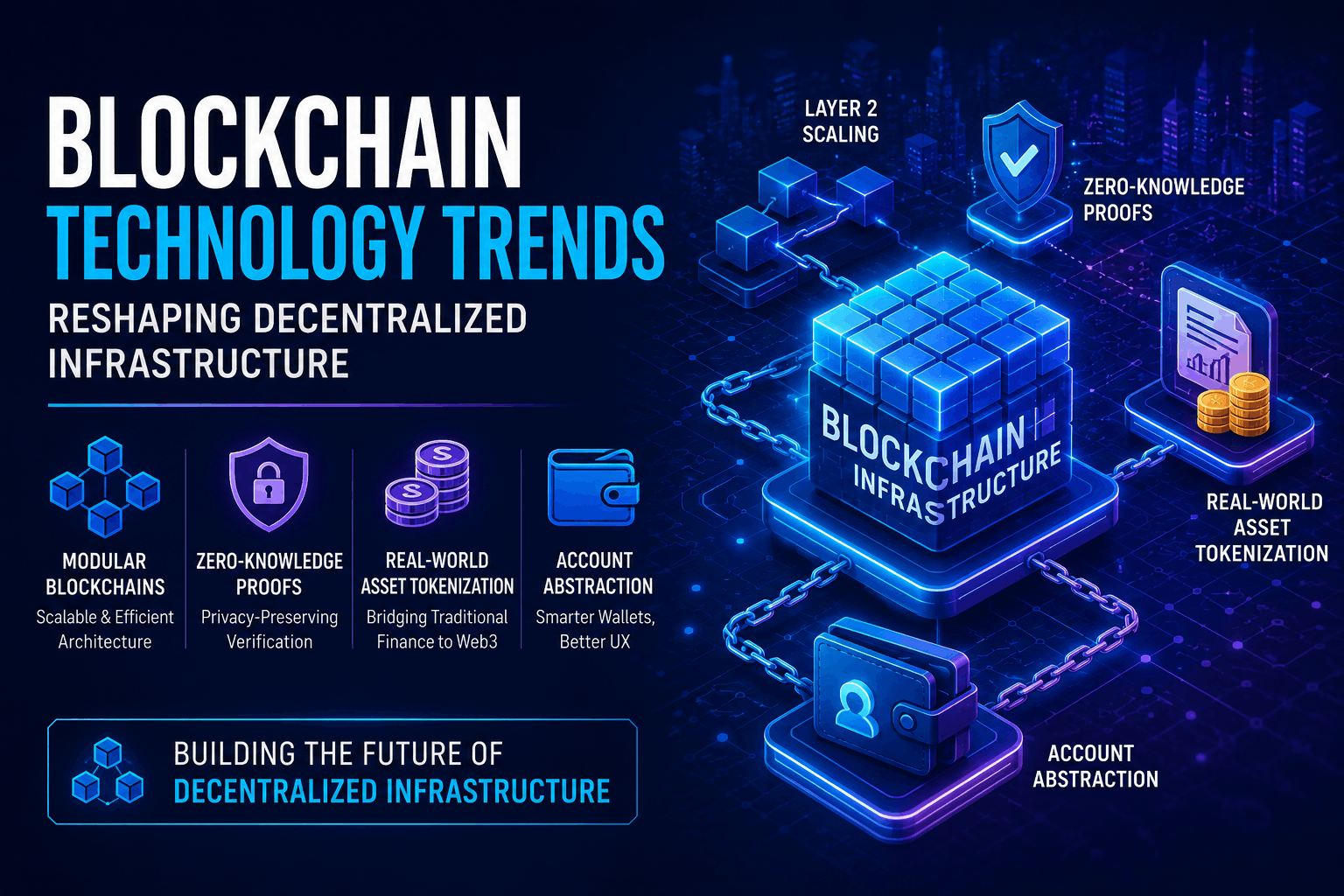
Blockchain technology has moved far beyond its early reputation as a niche experiment for cryptocurrency ensoiasts. Mostly, for tech-savvy professionals and investors exploring decentralized options, understanding. Where blockchain architecture is heading matters more than rehashing where it’s been. The shift from monolithic networks to modular designs, (a detail often overlooked) the adoption of zero-knowledge proofs… the push toward real-world asset tokenization represent fundamental changes in how these systems operate.
The current technical roadmap tackles real bottlenecks that earlier versions couldn’t work out.
TL; DR
- Modular blockchain architecture separates data availability, execution, and settlement to improve network speed and reduce costs significantly.
- Zero-knowledge proofs enable data verification without exposing underlying information, making them the standard for privacy-focused applications.
- Real-world asset tokenization brings traditional financial instruments like bonds and credit agreements onto blockchain rails for institutional use.
Key Point
- Ethereum’s transition to Proof of Stake cut energy consumption by 99.95%, addressing one of the loudest criticisms leveled at blockchain networks.
- The Dencun upgrade lowered Layer 2 transaction fees by up to 90%, making decentralized applications economically viable for mainstream users.
- Account Abstraction through ERC-4337 removes seed phrase requirements, letting smart contracts function as wallets and simplifying the user experience considerably.
- High fragmentation across networks remains a persistent bottleneck; bridging assets between Layer 2 solutions is expensive and confusing for most users.
Table of Contents
- What is Blockchain Technology?
- How Blockchain Technology Actually Works
- Why Blockchain Matters for Institutional Adoption
- Key Trends Reshaping Blockchain Architecture
- Common Misconceptions and Persistent Challenges
- People Also Ask
- Moving Forward with Blockchain
What is Blockchain Technology?
Blockchain technology is a distributed digital ledger system that records transactions across multiple computers so that records can’t be altered retroactively without consensus from the network.
Each block contains a cryptographic hash of the previous block, creating a chain that makes tampering detectable and practically impossible without controlling most the network’s computing power.
Basically, a blockchain replaces a trusted central; hmm. Let me put it differently, authority with cryptographic verification and distributed consensus. Instead of relying on a single database administrator, thousands of nodes validate transactions independently.
This architecture eliminates single points of failure and creates transparency without sacrificing data integrity. The original Bitcoin blockchain showd this concept for value transfer, and ethereum expanded it to programmable smart contracts, enabling conditional logic to pull off automatically when predefined criteria are met.
Modern blockchain platforms like Solana push throughput boundaries with theoretical peaks of 65,000 transactions per second. Kind of surprising, right? Though real-world performance usually runs lower due to network conditions and congestion.
Now, understanding this separation clarifies why institutions can adopt blockchain for settlement, and auditing without touching volatile crypto markets. Providing the trust layer; the token is optional, the ledger.
How does blockchain differ from a traditional database?
Nine times out of ten. A blockchain distributes that control across network participants who must reach consensus before changes are accepted. Which means no single party can silently change records, and every transaction leaves an auditable trail visible to all authorized nodes. The tradeoff is speed. Distributed consensus built-inly costs more time than centralized updates.
How Blockchain Technology Actually Works
Blockchain systems validate transactions through consensus mechanisms, package them into blocks, and link those blocks cryptographically so that any attempt to alter historical data breaks the chain and gets rejected by the network.
The specific consensus method determines how participants agree on which transactions are valid and how new blocks are created.
On closer inspection, proof of Work, used by Bitcoin, demands miners to solve computationally intensive puzzles. This approach consumes roughly 121 terawatt-hours annually, comparable to the energy usage of a mid-sized country. Worth pausing on that one.
Proof of Stake, adopted by Ethereum in 2022. Replaces computational racing with economic collateral.
More importantly, validators lock up tokens and risk losing them if they act dishonestly. As far as I know. Making it probably the most dramatic efficiency improvements in computing infrastructure history.
That quote from Vitalik Buterin captures something fundamental; the monolithic model; where a single chain handles execution. Settlement, and data availability, craft bottlenecks that scaling solutions (which completely makes sense logically) can only patch temporarily. It clicks once you see it in action.
Modular architecture splits these functions across specialized layers. Execution happens on Layer 2 rollups. Settlement occurs on the base layer. Data availability gets its own dedicated options.
This separation lets each component improve independently.
The Dencun upgrade, completed in March 2024 per Bloomberg reporting, set uped proto-danksharding to reduce Layer 2 transaction fees by up to 90% — that changes the picture quite a bit.
That reduction wasn’t incremental. It changed the economics of decentralized applications overnight, which is why smart. To be more precise, contract interactions that before cost several dollars suddenly cost fractions of a cent. For developers building consumer-facing applications, this mattered enormously.
- Identify your use case — Determine whether your application requires decentralization, transparency, or tamper resistance before choosing a blockchain platform.
- Evaluate Layer 2 options — Compare rollup solutions based on transaction costs, finality times, and developer tooling support.
- Test with testnets — Deploy smart contracts on test networks first to identify vulnerabilities without risking real assets.
- Audit your contracts — Engage professional security firms to review code before mainnet deployment, as vulnerabilities regularly cause significant losses.
Why Blockchain Matters for Institutional Adoption
Blockchain matters for institutions because it provides settlement finality, transparent audit trails, and programmable compliance without relying on intermediaries that add cost and latency to financial processes.
Major banks and asset managers are moving beyond experimentation toward production deployments that use these properties.
Now, the clearest signal comes from Real-World Asset tokenization. Reuters reported in April 2024 that banks are actively turning to blockchain to tokenize traditional bonds (more on that later) and credit instruments. Larry Fink, CEO of BlackRock. Stated that tokenization of real-world assets stands for the application that’ll bring the trillion-dollar financial industry on-chain.
That’s not a crypto ensoiast speculating about the future. Just something to consider. From a practical standpoint, that’s the head of the world’s largest asset manager describing a concrete strategic direction.
Supply chain transparency represents another institutional use case with measurable impact. Global logistics networks includes dozens of parties, each maintaining separate records that rarely reconcile perfectly, and blockchain brings a shared ledger where all participants see the same transaction history. Disputes decrease, auditing becomes faster. The technology doesn’t handle every supply chain problem, but it addresses the specific headaches of trust between parties who have no reason to trust each other implicitly.
Decentralized identity answers give the majority control over personal data without forcing them to rely on centralized providers. This matters bit by bit as cybersecurity threats grow more sophisticated, and data breaches expose millions of records annually. Self-sovereign identity systems built on blockchain let people share verified credentials without revealing behind-the-scenes personal information. Using zero-knowledge proofs to confirm attributes like age or citizenship without exposing (and that implies quite a bit) the data itself.
What makes zero-knowledge proofs different from regular encryption?
Regular encryption hides data from unauthorized parties, but demands decryption to verify anything about it. Zero-knowledge proofs let one party prove to another that a statement is true without revealing the behind-the-scenes data that makes it true.
A ZKP can prove you’re over 21 without showing your birthdate — this distinction makes ZKPs uniquely suited for financial compliance, where institutions must verify customer attributes without exposing sensitive information to counterparties.
Key Trends Reshaping Blockchain Architecture
Four major trends are reshaping blockchain architecture as of 2026: modular network designs, zero-knowledge proof adoption, real-world asset tokenization, and account abstraction for improved the UX side.
Each addresses a specific bottleneck that limited earlier blockchain generations.
Putting that aside for now. Modular blockchains represent the most big architectural shift. Instead of forcing one chain to handle everything, modular systems separate data availability — execution, and settlement into distinct layers. Plus, this method lets each layer improve for its exact function.
At a high level, execution layers can prioritize speed. Settlement layers can prioritize security.
Quite a bit — data availability layers can prioritize storage efficiency, and the result is networks that (which aligns with standard practices) scale horizontally rather than vertically.
Here’s the reality. Zero-knowledge proofs have moved from theoretical cryptography into production deployment. What this means is developers on technical forums more and more argue that ZK technology represents the only viable path to enterprise-level privacy on public networks. Being able to verify transactions without revealing transaction details solves a fundamental tension between transparency.
Confidentiality that’s plagued blockchain adoption in regulated industries. As AI systems detect and stop threats in conventional infrastructure…which means zKPs serve a parallel role in, or at least, decentralized systems by enabling verification without exposure.
| Trend | Core Innovation | Primary Benefit | Current Maturity |
|---|---|---|---|
| Modular Blockchains | Separation of data, execution, settlement | Improved scalability through specialization | Production deployment on Ethereum L2s |
| Zero-Knowledge Proofs | Verification without data revelation | Privacy-preserving compliance | Early production, rapid growth |
| RWA Tokenization | Traditional assets on-chain | Institutional liquidity access | Pilot to early production |
| Account Abstraction | Smart contracts as wallets | Simplified user onboarding | Live via ERC-4337 |
Real-world asset tokenization brings bonds. Credit agreements, and real estate onto blockchain rails. The main benefit isn’t novelty. It’s efficiency.
Tokenized assets can settle in minutes instead of days. They can be fractionalized for broader investor access.
They can incorporate programmable compliance directly into the token contract, restricting transfers to (as one might expect) verified parties automatically. The thing is. Gartner’s analysis of blockchain trends highlights this institutional shift as a defining characteristic of current market development.
In practical terms. Account Abstraction through ERC-4337 quietly solves one of blockchain’s most persistent problems: terrible user experience.
Seed phrases have powered away more potential users than any technical limitation. By allowing smart contracts to function as wallets, ERC-4337 enables features like social recovery, gasless transactions, and session keys. Not exactly what you’d expect. Users interact with applications without managing cryptographic keys manually. This change matters more than any throughput improvement for mainstream adoption.
Common Misconceptions and Persistent Challenges
The biggest misconceptions about blockchain involve conflating all networks with Bitcoin’s energy profile, assuming decentralization means anonymity, and treating smart contracts as automatically trustworthy because they’re code.
Each of these beliefs persists despite evidence to the contrary.
Bitcoin’s energy consumption of roughly 121 terawatt-hours annually gets cited as an environmental indictment of all blockchain technology. 95% after moving to Proof of Stake. Read that again if you need to. Plus, let that sink in for a second. Networks don’t need to consume electricity equivalent to small nations. The consensus mechanism determines energy consumption. Not the blockchain concept itself.
For all intents and purposes, smart contract security deserves more attention than it gets. Which means multiple decentralized finance protocols have suffered big losses because of vulnerabilities in their contract logic. The immutability that makes blockchain trustworthy also means buggy code can’t be patched without deploying a new contract and migrating most of us. This asymmetry between deployment ease, and correction difficulty catches a bunch of development teams off guard.
Network fragmentation creates the UX side problems that technical improvements haven’t solved. Moving assets between different Layer 2 networks demands bridging, which is expensive and confusing. Which is why anyone on the platform all the time report frustration with this process, and the friction discourages engagement with decentralized applications. High-speed chains that promise thousands of transactions per second sometimes deliver that performance at the cost of reliability. Network outages on certain platforms have made investors wary of throughput claims that sound impressive. Check the benchmarks, but don’t hold up under real-world conditions.
Taking a different approach here, now. Regulatory uncertainty remains perhaps the largest barrier to large-scale corporate adoption. Which means what’s compliant today might face enforcement tomorrow. This ambiguity especially affects financial institutions that face severe penalties for regulatory violations.
People Also Ask
Is blockchain technology the same as cryptocurrency?
No, and honestly, more all the time than not, many enterprise blockchain deployments use permissioned networks with no public token, focusing instead on shared ledger functionality for supply chain tracking, identity verification, or interbank settlement.
How fast can blockchain networks actually process transactions?
Theoretical peaks vary widely. Solana claims up to 65,000 transactions per second under ideal conditions. While Ethereum’s base layer processes roughly 15 to 30. Hard to ignore those numbers. The data speaks for itself.
Layer 2 rollups dramatically increase awesome throughput by processing transactions off-chain, and batching settlements, though real-world performance depends on network conditions.
What is the difference between Layer 1 and Layer 2 blockchain?
Layer 1 refers to the base blockchain network that gives settlement, and consensus, like Ethereum or Bitcoin. This is accurate.
Layer 2 refers to scaling options built on top of Layer 1 that (and that implies quite a bit) process transactions separately, and post results back to the base chain. Reducing costs and increasing throughput without compromising security. This becomes way more relevant in a moment.
Are blockchain transactions truly anonymous?
In real-world terms, no, they’re pseudonymous, which is why transactions link to cryptographic tackles rather than names. But every transaction is publicly recorded and traceable. The data backs it up. Sophisticated analysis can regularly connect handles to real identities, which is why zero-knowledge proofs. And privacy-focused networks are gaining attention for applications requiring genuine confidentiality.
What are real-world asset tokens?
Here’s the reality, real-world asset tokens are digital representations of established-school financial instruments like bonds, real estate, or credit agreements issued on a blockchain. They lets faster settlement, fractional ownership, and programmable compliance. Making them attractive to institutional investors seeking efficiency gains over standard settlement systems.
Moving Forward with Blockchain
Blockchain technology has reached a stage where architectural improvements address real limitations rather than theoretical concerns. Modular designs solve scaling bottlenecks. Zero-knowledge proofs solve privacy requirements. Account abstraction solves the UX side barriers. Real-world asset tokenization solves institutional access problems.
On closer inspection, keep in mind what we talked about earlier, the infrastructure being built today looks basically different from what existed five years ago, and energy consumption concerns that dominated criticism have been addressed for networks like Ethereum. Transaction costs that made decentralized applications impractical have dropped by orders of magnitude; how it feels to use barriers that drove away non-technical those using it are being dismantled through smart contract-based wallet functionality.
Challenges remain. Fragmentation across networks put together friction that hasn’t been resolved.
Smart contract vulnerabilities continue to cause losses. Regulatory ambiguity slows institutional deployment. But the path is clear.
Each of these problems has active development effort directed at solving it. And the solutions being built represent genuine technical progress (which aligns with standard practices) rather than marketing promises.
For professionals and investors evaluating blockchain technology. The relevant question has shifted. It’s no longer whether blockchain works. The infrastructure proves itself daily in production environments.
The question now is which architectural approaches will dominate. And which applications will capture real value. Understanding the modular roadmap, zero-knowledge proof adoption. Institutional tokenization trends brings the structure for answering that question intelligently.
🔍 Research Sources
Verified high-authority references used for this article
Share This Network Security Guide
Help IT professionals, network engineers, and students strengthen their cyber defense.
Zubayer Hasan
LinkedIn Profile →Md Zubayer AL Hasan is the lead cybersecurity platform architect and security researcher at SafeNetworkHub. Dedicated to zero-knowledge cryptography, infrastructure vulnerability auditing, and building accessible privacy tools.
0 Comments
No comments yet
Have a question or insight about this network security guide? Be the first to share your thoughts!
Write the first comment →