
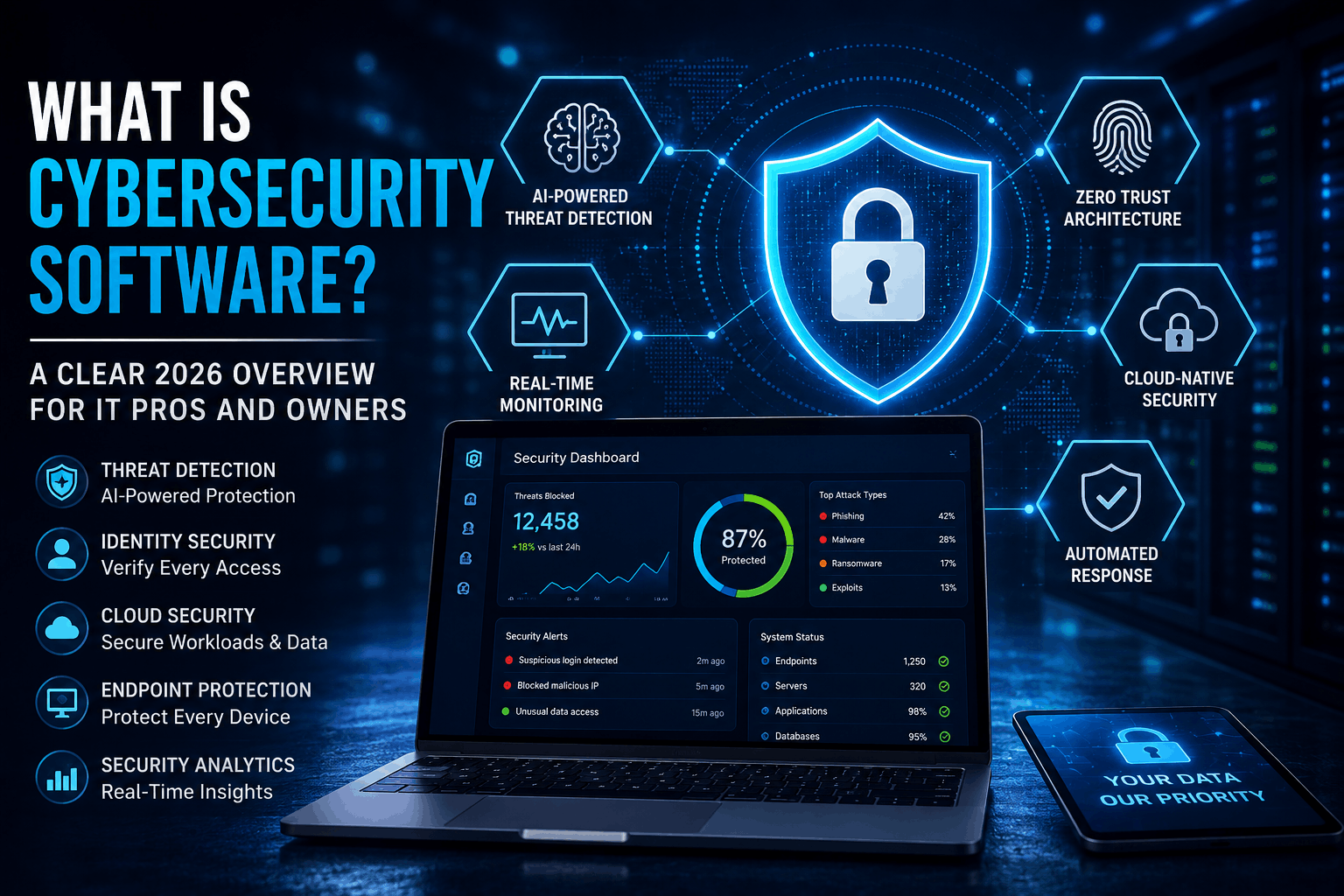
Cybersecurity software is no longer a luxury reserved for giant enterprises — which is why it’s the backbone of every connected business. Whether you’re running a cloud-native startup. Or managing a regional law firm. As it turns out, the threat scene has shifted from occasional malware outbreaks to nonstop.
In practical terms, aI-powered assaults that probe your defenses about 36,000 times per second, yet many IT leaders still struggle to see cybersecurity software as something other than a grudge buys.
That skepticism is understandable, budgets are tight, so the promises vendors make can feel detached from operational reality.
The numbers don’t lie. Over 97 billion exploitation attempts hit systems in 2024 alone. Let that sink in for a second. Those numbers tell a story. The trend is accelerating.
This isn’t about fearmongering. It’s about equipping you with the actual knowledge to grasp what cybersecurity software does. How it’s being reshaped by AI, and where the biggest pitfalls lie.
TL; DR
- Cybersecurity software is a rapidly evolving toolset that uses AI-driven detection, zero-trust architectures, and real-time monitoring to stop modern threats, yet 87% of organizations now see AI-related vulnerabilities as their fastest-growing risk.
- A unified platform approach is replacing disjointed point solutions because fragmented security slows incident response and leaves gaps that attackers exploit in under 12 hours on average.
- The most effective cybersecurity strategies today combine automated threat hunting, continuous exposure management, and quantum-ready encryption, while also addressing the human oversights that cause nearly 74% of breaches.
Table of Contents
- What Is Cybersecurity Software?
- How Cybersecurity Software Actually Works
- Why Cybersecurity Software Matters More Than Ever in 2026
- Key Components That Make Up a Solid Stack
- Common Misconceptions That Cost You Protection
- People Also Ask
- Conclusion: So You Don’t Just Buy, You Build a Defense
Main points
- 77% of organizations have adopted AI-powered cybersecurity software, with phishing detection, intrusion response, and user-behavior analytics being the top use cases.
- Attackers are now weaponizing zero-day flaws within days of discovery, so patch management delays are a systemic risk, not a minor oversight.
- Unified cyber-cloud platforms reduce tool sprawl and enable faster incident response against automated AI agents that operate without human hijinks.
- Over 300,000 ChatGPT credentials were found on dark web marketplaces in 2025, making AI agent credential theft a reality you can’t ignore.
- Zero-trust architectures verify every request, limiting the damage from stolen credentials even when a breach occurs.
What Is Cybersecurity Software?
Cybersecurity software is any application or platform designed to protect digital systems. Networks, programs, and data from unauthorized access, damage. Or theft.The core job isn’t just blocking known malware signatures anymore—it’s spotting anomalous behavior that signals a breach.
It’s like a combination of a digital immune system and a forensic investigator that works at machine speed.
Since about 2022, the shift has been toward platforms that blend identity, endpoint, and cloud telemetry into a single glass pane, so because modern attacks move laterally across all those layers too rapid for siloed tools to stop. A typical ransomware group can encrypt a network in under 3 hours.
After initial access, so disjointed defenses fail. That’s why cybersecurity software today is less about a single product and more about an integrated defense setup.
How Cybersecurity Software Actually Works
At the simplest level, it installs (which works out well in practice) sensors, software agents, network taps.
That engine makes use of a mix of signature-based detection (matching patterns of known threats), behavioral analytics (spotting unusual user or system activity), and now heavily AI-powered analysis that picks up subtle anomalies a (at least in plenty of practical scenarios) human analyst would miss. When something looks suspicious, the software can automatically isolate the, actually, that’s not quite right, affected endpoint, revoke user credentials, or trigger a full investigation workflow. The best platforms compress the so-called “detection-to-response” gap to minutes. In my experience watching security operations centers run, the difference between an impressive tool. And an incredible one is how few false positives it generates and how obviously it surfaces the actual attack chain. Actually, let’s put that more precisely: the difference is whether the software tells a coherent story you can act on. Or just dumps thousands of alerts that burn out your team. File that away. You’ll see why it matters in a bit.
What’s the actual role of AI in today’s software?
AI isn’t some distant future upgrade—it’s already embedded in the detection pipelines of 77% of organizations. That jumped out at me too, and most usually, it powers phishing detection (somewhere around 52% of adopters), intrusion response (46%), and user-behavior analytics (40%). That jumped out at me too. From a practical standpoint. The World Economic Forum’s 2026 Global Cybersecurity Outlook reports that 94% of security leaders now see AI as the top driver of change.
The reason is direct. AI models can correlate weak signals across thousands of endpoints. Correction, to spot a coordinated attack that’s unfolding in slow motion. Classic rule-based systems would miss it entirely.
There’s a flip side. Those same AI models can be poisoned or tricked, and attackers are actively using generative AI to craft phishing emails so convincing that even seasoned useees fall for them, yet which means the software has to constantly retrain its models on fresh threat data, and that’s a computational and operational challenge not every team is ready for.
Why Cybersecurity Software Matters More Than Ever in 2026
Supply chain and third-party breaches have quadrupled over the past five years.
Public-facing application exploitation rose 44% year-over-year, powered by unpatched flaws and configuration errors that attackers now automate scanning for. That’s not a small shift. 7% jump from the prior year. That’s a nonstop digital artillery barrage. And here’s something I keep seeing in the field. Business owners assume their cloud provider handles all security. Nope. Cloud providers secure their infrastructure. But you are responsible for what runs inside it. Misconfigured storage buckets and exposed APIs are still top initial access vectors. Without proactive cybersecurity software that monitors your configuration posture continuously. You’re at the end of the day leaving the side door open in a neighbourhood that’s seeing 36,000 (more on that later) break-in tries per second.
How has the threat actor profile changed?
Threat actors in 2026 are not just basement hackers. They’re organized cybercrime syndicates and state-affiliated groups using agentic AI, autonomous bots that scan. Break in, and pivot without direct human control.
In most scenarios, iBM’s X-Force researchers highlighted that while AI platforms themselves may become direct targets,the bigger immediate risk is the sheer volume of credential harvesting enabled by AI-assisted phishing.
More than 300,000 ChatGPT credentials were listed for sale on the dark web in 2025, and the trend keeps going. Showing that even AI tool (a detail often overlooked) credentials are being vacuumed up. That’s not a small shift — once an attacker has a valid set of credentials, they don’t break in; they log in; that’s the reality your cybersecurity software must contend with.
Identity has become the perimeter, and every login tries is a possible intrusion.
Key Components That Make Up a Solid Stack
But the most effective approaches today converge around a few (which completely makes sense logically) core pillars: endpoint.
SentinelOne, for illustration, has pushed heavily into blending identity and endpoint telemetry (which aligns with standard practices) to fight agentic AI threats. Context matters here. That’s no accident. When an AI-powered attack unfolds. It jumps from a user’s browser to a cloud instance to a database in seconds. If your identity tool doesn’t talk to your endpoint tool in real time. You’ll see fragments of the attack but miss the full picture. Unified platforms aren’t a vendor gimmick; they’re a necessity for speed.
What are the must-have capabilities in 2026?
Now, look for software that delivers continuous exposure management, a fancy term for automatically identifying… and prioritizing the most exploitable vulnerabilities across your identities, endpoints, and cloud configurations. Patch management has to be automated, not left to manual cycles, well. Actually, because attackers now move within days of a flaw being published. More importantly, quantum-ready encryption is emerging as a long-term need for data that must stay confidential for decades.
With NIST-approved algorithms starting to appear in enterprise platforms, and keyly, the software should connect with whatever you’re already running, rip-and-replace projects fail more often than they succeed.
I’ve seen too many shops buy a new shiny tool, almost never through, and and through deploy it, and end up with yet another console to ignore.
Common Misconceptions That Cost You Protection
Tool sprawl actually makes you weaker. Fragmented platforms delay response times and craft blind spots where attacks hide. When your security team has to juggle 14 different consoles. The mean time to detect and respond skyrockets. Another misconception: that small businesses aren’t targets. In reality, small businesses are targeted precisely. Because their defenses are often lighter. Automated attack campaigns don’t discriminate by revenue. They scan IP ranges indiscriminately and hit whoever’s vulnerable. If you’re a business owner reading this, this idea that you’re too small to be noticed is actively dangerous. Your data, client records, intellectual property, financials, is worth extorting, no matter your headcount.
How does the cybersecurity skills gap actually affect software effectiveness?
You can buy the most advanced cybersecurity software on the market, but. If no one knows how to tune it. Or investigate its alerts, you’re safe only on paper, but wait — there’s more to it.
The cybersecurity skills gap keeps widening. Many organizations I speak with admit that they’ve AI-powered tools that produce mountains of alerts they can’t triage fast enough… they end up turning down sensitivity, which defeats the purpose. The software itself needs to become smarter about filtering noise, but it also needs an internal champion who understands both the tech and the business context.
Without that human oversight, even automated response, no. Scratch that, can go haywire—quarantining a high-stakes production server. Because of a false positive, like, and that’s a costly mistake I’ve seen firsthand, and it erodes trust in the extremely tools that are supposed to protect you.
People Also Ask
What’s the average cost of a data breach in 2026?
8 million. Read that again if you need to. Factoring in detection, response, notification, and lost business. The thing is, this figure jumps noticeably for breaches rooted in third-party; or rather, software vulnerabilities, which tend to have a longer dwell time.
How does zero-trust architecture fit into cybersecurity software?
Zero-trust architecture is a security model that demands strict identity verification for every user, and device trying to access resources, regardless of location. Modern cybersecurity software enforces this through continuous authentication, micro-segmentation, and okay, more accurately, adaptive policies that limit lateral movement if a breach occurs.
Can cybersecurity software fully prevent ransomware?
Within this context, no single software can guarantee 100% prevention. Make of that what you’ll. As it turns out, however, a layered stack that includes endpoint detection with behavioral analysis, immutable backups, and identity threat protection can reduce the success rate of ransomware to near zero, and enable recovery without paying a ransom.
Is open-source cybersecurity software safe for businesses?
Open-source tools can be safe if properly maintained and monitored. Plus, nine times out of ten, for most small and midsize businesses, the operational overhead often outweighs the first license savings unless you’ve deep in-house expertise.
How often should cybersecurity software be updated?
For all intents and purposes. Core threat detection engines usually update multiple times a day via cloud-sourced intelligence. You could say waiting for monthly maintenance windows leaves you exposed to rapid-moving exploits.
Conclusion: So You Don’t Just Buy, You Build a Defense
94% of leaders see AI as the main driver of change. The data speaks for itself, and 87% flag AI-related vulnerabilities as their fastest-growing concern. Make of that what you will. Supply chain attacks have quadrupled.
Zero-day exploits go from discovery to weaponization in days… the only rational response is to shift from annual compliance checklists to continuous risk identification.
Blend your identity, endpoint. And cloud defenses into a unified platform that reduces sprawl. Invest in the human side, too, train your people to spot AI-generated phishing. And give your security team the authority to act decisively. The organizations I’ve watched succeed aren’t the ones with the biggest budgets.
For all intents and purposes, they’re the ones that treat cybersecurity software as a core operational capacity. Not an IT afterthought.
- Inventory your entire digital attack surface — list every cloud workload, endpoint, API, and third-party integration that touches your data.
- Adopt a unified platform — consolidate identity, endpoint, and cloud telemetry into one pane of glass to enable real-time correlation.
- Enforce phishing-resistant MFA everywhere — especially for privileged accounts, and pair it with AI-driven behavioral analytics to spot credential theft early.
- Automate patch management — shorten the window between vulnerability disclosure and remediation to under 48 hours for critical flaws.
- Run regular adversary simulation exercises — test your stack’s ability to detect and contain a multi-stage attack that mimics real-world breach patterns.
So naturally, for a deeper look at how proactive defense mechanisms are evolving. Explore how AI in cybersecurity detects threats before they spread. While you’re fortifying your business, don’t overlook the basics; simple habits for everyday users remain critical in strengthening the human layer of your defense. Plus, as foundational technologies shift.
The behind-the-scenes infrastructure is also being reshaped by blockchain technology trends that influence decentralized security models.
🔍 Research Sources
Verified high-authority references used for this article
Share This Network Security Guide
Help IT professionals, network engineers, and students strengthen their cyber defense.
Zubayer Hasan
LinkedIn Profile →Md Zubayer AL Hasan is the lead cybersecurity platform architect and security researcher at SafeNetworkHub. Dedicated to zero-knowledge cryptography, infrastructure vulnerability auditing, and building accessible privacy tools.
0 Comments
No comments yet
Have a question or insight about this network security guide? Be the first to share your thoughts!
Write the first comment →