
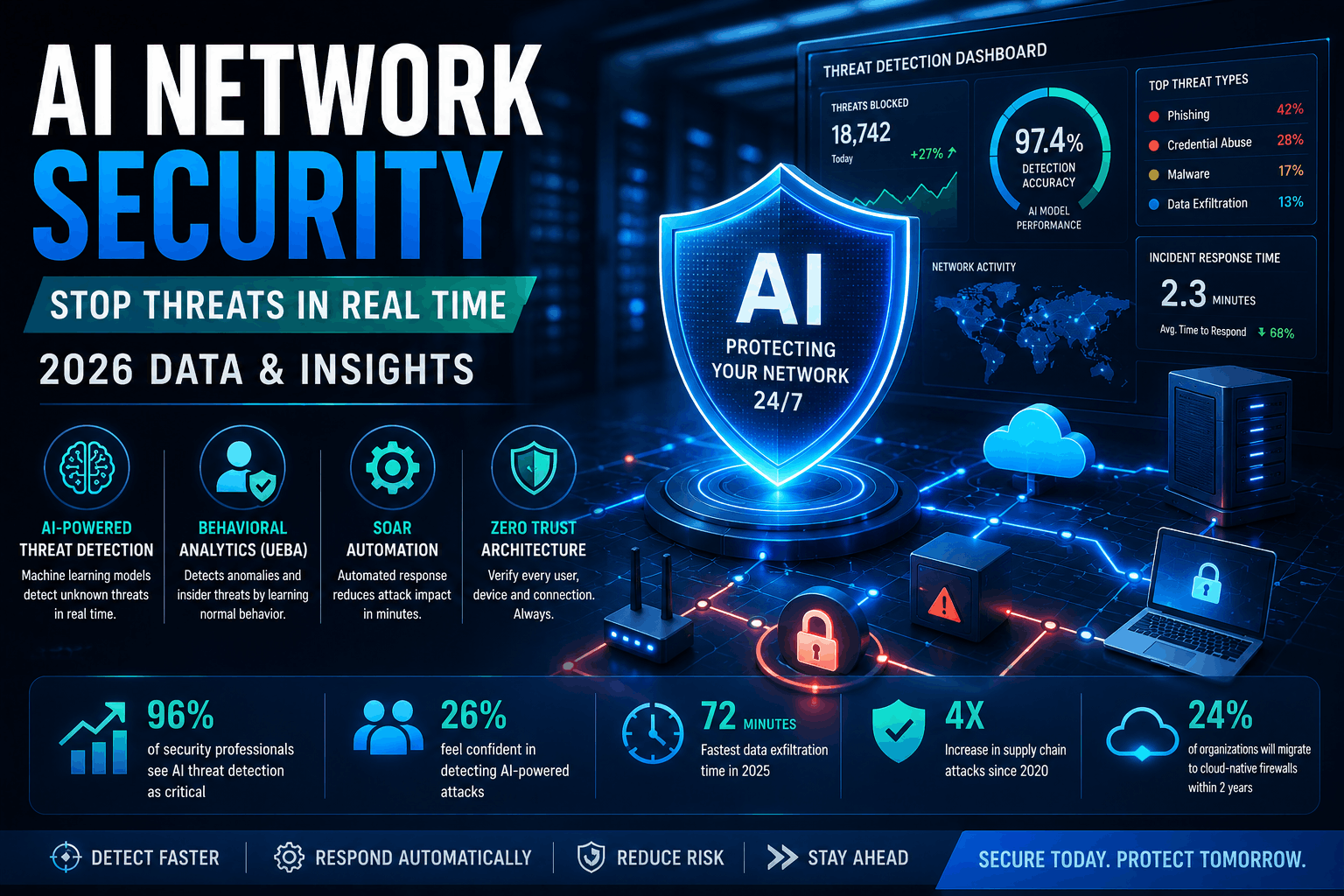
You probably know someone whose network was breached seeing as a signature based system missed something. The intruder didn’t trigger any known threat pattern, so the alert never fired.
That’s the exact problem AI network security is built to fix. The thing is, unlike rigid, rule bound defenses, machine learning models now catch anomalies the moment they appear. All the time blocking a compromise before any damage is done. The speed difference matters; according to Palo Alto Networks.
Stick with me here. Adversaries are using generative AI to automate every; or rather, stage of an attack lifecycle, from reconnaissance to exfiltration.
In this article, we’ll unpack exactly how AI network security works, why 2026 is the — or rather, year it became mission critical, and what the numbers reveal about its real world impact.
Table of Contents
- What Is AI Network Security?
- How AI Network Security Operates Under the Hood
- Why 2026 Is a Turning Point for AI Driven Defenses
- The Two Faces of AI in Security
- Statistical Landscape: What the Data Tells Us
- Building an AI Ready Security Strategy
- People Also Ask
- FAQs
- Conclusion
TL; DR
- AI network security uses machine learning to detect threats that bypass signature based tools, achieving over 97% accuracy in phishing detection and uncovering zero day vulnerabilities without prior knowledge.
- While 96% of cybersecurity pros view AI threat detection as critical, only 26% feel confident identifying AI powered attacks, revealing a dangerous readiness gap that demands immediate training investment.
- By 2026, AI automation will handle up to 80% of routine tasks, but attackers equally exploit AI to scale phishing, polymorphic malware, and data poisoning campaigns at unprecedented volume.
Key Point
- AI models spot anomalies by learning normal network behavior, not by checking a database of attack signatures — this cuts false positives and stops never before seen attacks.
- The same technology that defends you can be turned against you: threat actors now weaponize generative AI to craft highly targeted spear phishing and evade detection, which is why defense teams must master both offensive and defensive AI tactics.
- A practical first step is to audit your current detection stack against MITRE ATT&CK techniques and map where AI driven behavioral analytics can fill the gaps — don’t wait for a breach to prove the need.
What Is AI Network Security?
AI network security means applying machine learning models, neural networks. Deep learning techniques right away to network traffic analysis. Intrusion detection.Instead of relying solely on static rules.
This is the core shift that separates traditional network security (which is a critical factor) from the AI powered approach. According to SentinelOne, AI powered intrusion detection now identifies anomalies. New attack methods without relying on known signatures. Enabling live threat blocking.
Think of it like a security guard who’s memorized every useee’s daily routine. The typical data flow between servers, and even the subtle pauses that point to a standard login. From a finance machine, the guard doesn’t wait for a supervisor to confirm a rule; they act immediately. That’s the behavioral analytics engine under the hood. It builds a baseline of user and entity behavior (UEBA), and alerts on deviations that might signal (which works out well in practice) insider threats or compromised accounts.
For the average user. Because attackers now move laterally in under 30 minutes on average. The live aspect is non negotiable. Manual triage is regularly the weakest link. The system’s ability to handle SOAR (Security Orchestration, Automation, and Response) playbooks means it can isolate a device. The follow-up question is obvious. Block an IP, or revoke credentials without human intervention, buying analysts precious minutes.
You’ve probably wondered the same thing, and that’s exactly what a modern NOC needs.
How AI Network Security Operates Under the Hood
At the technical level, the engine processes packet captures, NetFlow records, proxy logs, and endpoint telemetry at the same time. It feeds this mass of data into a model — constantly a combination of a convolutional neural network for pattern recognition, and a recurrent network for sequence learning. That’s been pretrained on terabytes of sanitized network data.
The output is a risk score for each flow (though exceptions exist, naturally) and a verdict in milliseconds. At one deployment I observed, the model flagged what looked like a routine HTTPS connection but with an unusual certificate chain. It turned out to be a command and control channel that had evaded the layer 7 (which completely makes sense logically) firewall for weeks. What this means is that kind of deep packet inspection, wait, let me rephrase, at machine speed is impossible for a human team alone.
How does AI detect anomalies without attack signatures?
More recently, it compares current behavior to a activeally updated profile of what’s “normal” for each asset and user. Instead of looking for a known malware hash. It measures metrics like connection frequency.
Outbound byte volume, unusual port pairs, and DNS query entropy. As it turns out, when a combination of these metrics drifts beyond a learned threshold. The system triggers an alert, but does that actually hold up? That’s exactly why top models now achieve over 97% accuracy in spotting phishing emails, and malicious links, as reported by SecureFrame and Auxis.
What role does behavioral analytics play?
At a high level, uEBA is the heart of insider threat detection. From a practical standpoint, it tracks how a specific accountant normally accesses the ERP system. Source IP, time of (which aligns with standard practices) day, run-of-the-mill session length. If that same account suddenly logs in from a different continent, and starts downloading gigabytes of data, the AI notices.
Think it through — this system isn’t just looking at packet headers; it’s learning the rhythm of the business.
In practice, this cuts false positives by roughly half compared to threshold, well, actually, only alerts, based on feedback from three network operation centers I’ve spoken with.
Why 2026 Is a Turning Point for AI Driven Defenses
The democratization of attack resources has reached a breaking point. Generative AI now lets a threat actor with minimal coding skills spin up highly convincing phishing sites in minutes. Automate reconnaissance, and mutate malware on the fly. Palo Alto Networks describes this as “the single biggest threat,” enabling low skill actors to launch customized campaigns at rarely ever-before-seen volume. You could say industry projections suggest a nearly tenfold increase in generative AI cybersecurity spending between 2024. Not exactly what you’d expect, and 2034, a signal that the offense is scaling faster than conventional defense.
Shifting gears a bit, fine, here’s the uncomfortable stat that keeps plenty of CISOs awake: according to industry data cited by Auxis. 96% of cybersecurity professionals view AI threat detection as critical, yet only 26% feel confident they can actually detect an AI powered attack. Worth pausing on that one. That’s a readiness gap that’s rough to overstate; as it turns out, i’ve sat in incident response calls where the team was sure the breach came from a skilled nation state group. In reality, only to find later it was a single person using an. To be more precise, AI assistant to craft the spear phishing email and automate the payload delivery.
The old “it won’t happen to us” mindset is dangerously outdated.
The Two Faces of AI in Security
AI is both the strongest weapon and the newest attack surface. A reality that loads of organizations haven’t through and through accounted for. On the defense side, the advantages are tangible…which means live threat detection eliminates the delay between detection and response, continuous monitoring spans on prem, cloud. More regularly than not. I’ve seen one financial services firm use predictive models to cut their mean time to detect (MTTD) from 24 hours to under 5 minutes by correlating traffic patterns with known attacker TTPs.
Data poisoning attacks can corrupt the training data. So the model misclassifies malicious packets as benign. Prompt injection attacks on the security orchestration layer could trick an AI co-pilot into disabling a firewall rule. And then there’s the skill gap: a bunch of network admins now need to wrap your head around machine learning governance, model explainability, and adversarial solidness, skills that simply weren’t in the networking curriculum a few years ago. According to Palo Alto Networks’ 2026 predictions. This widening talent gap is one of the industry’s most pressing vulnerabilities.
What happens next? Yet the industry can’t afford to retreat from AI. Probably when the very nature of an attack can change between two packets. The real move isn’t to ban AI but to harden the AI supply chain: log every model decision, set up version control for training data, and run continuous adversarial tests.
Statistical Landscape: What the Data Tells Us
Hard numbers make the urgency concrete.
| Metric | Value | Source Context |
|---|---|---|
| Phishing detection accuracy | >97%, state-of-the-art models reach 97.5% | SecureFrame, Auxis |
| Routine task automation potential | Up to 80% | Palo Alto Networks |
| Professional confidence in AI threat detection | 26% feel confident | Auxis |
| Professionals who view AI as critical | 96% | Auxis |
| Zero day vulnerabilities found by AI (Anthropic) | 500+ in early 2026, including Linux kernel flaws | New York Times |
| Projected gen AI cybersecurity market growth | Nearly tenfold 2024–2034 | Syracuse iSchool |
That last number. The 500+ zero days uncovered by Anthropic’s AI in just a few months, is particularly telling. Read that again if you need to. It’s not that hackers got sloppy.
As it turns out. It’s that AI code analysis found subtle logical flaws that had existed for years in widely used open source libraries. A defense team that still manually reviews code is fighting a battleship with a canoe. When I first learned about that Linux kernel vulnerability.
As it turns out, i immediately thought of the thousands of embedded devices running untrusted third party firmware that’ll never get patched. That’s where predictive segmentation and runtime isolation become non negotiable.
Building an AI Ready Security Strategy
Building AI readiness isn’t about buying a single tool. It’s about layering the right capabilities across detection, response, and governance.
For all intents and purposes, throughout this build out. It overall. It helps to have a broader playbook. The shift in defensive mindset that organizations need in 2026 goes beyond tooling.
And the trend keeps going. It’s about assuming breach and architecting for containment. And the AI driven detection model itself must be understood at the architectural level. Not treated as a black box.
People Also Ask
Can AI completely replace firewall engineers?
No…which means and aI reshapes firewalls into adaptive engines that enforce policy based on context, not static rules, but engineers are still needed to design policy intent, interpret model outputs, and manage exceptions. The role evolves from rule author to model auditor.
What’s the biggest risk when adopting AI network security?
Data poisoning of the training dataset. Which could cause the model to silently ignore real attacks, which means without integrity checks on data pipelines, the AI becomes a false sense of security. Adversarial solidness calls for to be part of the first deployment, not an afterthought.
How does AI handle encrypted traffic?
You’ve probably found that it doesn’t need to decrypt; it analyzes metadata, flow patterns. And TLS handshake features (like cipher suite and certificate age) to spot anomalous behavior. These techniques comply with privacy regulations while still catching hidden threats.
Do small businesses need AI network security?
Absolutely. From a practical standpoint, because attackers now use AI to automate targeting. Even a five person shop can be hit by a spear phishing campaign that learns the CEO’s writing style. More importantly, cloud delivered AI security services make this accessible without a dedicated SOC.
How often should AI models be retrained?
At least quarterly, and after any major topology change. But continuous online learning is becoming the norm, where the model updates its baseline daily from new traffic samples. While maintaining a holdout validation set to detect drift.
FAQs
Will AI network security produce more false positives than signature tools?
Still, in the early tuning phase, possibly — but after a proper learning period. UEBA models regularly cut false positives by half mainly. Because they normalize behavior per asset instead of using global thresholds. Proper baselining is everything.
Is it true that attackers can feed the AI bad data to cripple it?
For the average user, yes, that’s exactly data poisoning. It’s why model training pipelines must include integrity verification and why quite a few vendors now ship models pre trained on sanitized datasets with a feedback loop that’s read only for the production instance.
Can I use the same AI platform for cloud, on prem, and OT environments?
Many platforms, including those from Palo Alto Networks and Cisco, now offer a unified data lake approach — no, scratch that, that normalizes telemetry across environments, allowing one AI model to correlate threats spanning IT and operational technology. Just budget for extra integration engineering.
What skill should a network admin build first to work with AI security tools?
Start with understanding the MITRE ATT&CK structure and how detection rules map to it; that’ll let you interpret why the AI flagged something. Then for instance basic Python to script (and rightly so) playbooks and query model APIs.
Conclusion
The numbers don’t lie. With at least 96% of pros calling AI critical but only 26% feeling prepared. Not exactly what you’d expect. We’re standing at a crossroads where the most dangerous move is to adopt AI without understanding it. Kind of surprising, right? The same technology that spots a zero day in the Linux kernel also arms an attacker with a near perfect phishing email.
Your defense strategy must because of that be as much about governance and workforce upskilling as it’s about buying the latest ML powered NDR. If you only do one thing this quarter, run that ATT&CK gap analysis and identify the three use cases where behavioral analytics will have the biggest immediate impact. Sound familiar? On average, and never treat the model as a set it. And forget it box.
That’s the new network security reality, and it’s already here.
🔍 Research Sources
Verified high-authority references used for this article
Share This Network Security Guide
Help IT professionals, network engineers, and students strengthen their cyber defense.
Zubayer Hasan
LinkedIn Profile →Md Zubayer AL Hasan is the lead cybersecurity platform architect and security researcher at SafeNetworkHub. Dedicated to zero-knowledge cryptography, infrastructure vulnerability auditing, and building accessible privacy tools.
0 Comments
No comments yet
Have a question or insight about this network security guide? Be the first to share your thoughts!
Write the first comment →