
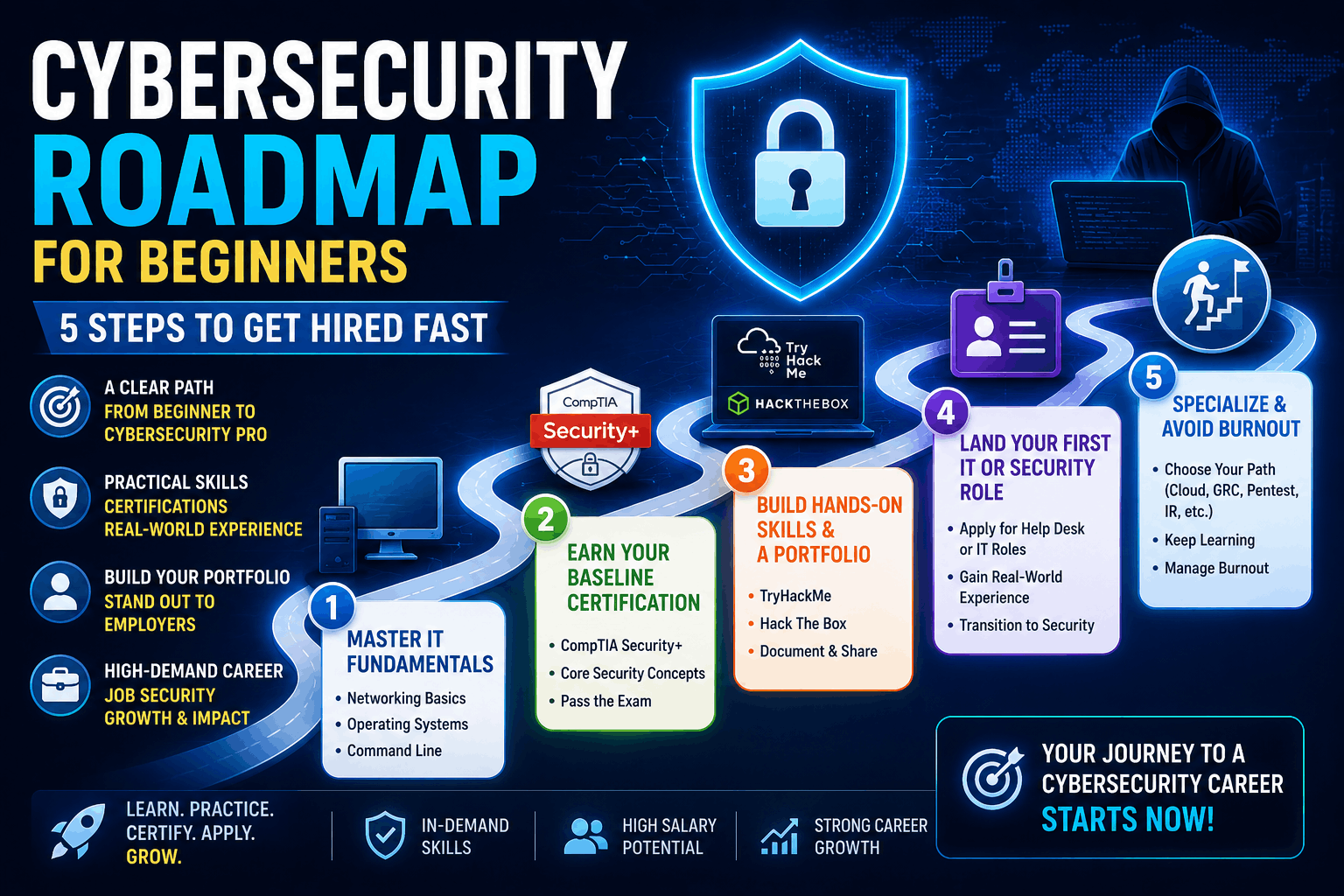
You want to break into cybersecurity. It’s the classic Catch-22 that frustrated beginners on Reddit complain about constantly. Plus, how do you acquire experience.
When nobody will hire you without it? That frustration is real and valid. Plus, the solid news is that a well-structured cybersecurity roadmap solves this problem by giving you a concrete sequence of steps (a detail often overlooked) that build real, demonstrable skills. Instead of wandering through random tutorials.
You follow a path that mirrors what hiring managers actually look for. The industry desperately demands the majority.
According to ISC2. There’re roughly 4 million unfilled cybersecurity positions globally.
Companies want to hire you. They just need proof you can do the work.
This tutorial walks you through building that proof, step by step.
TL; DR
- A cybersecurity roadmap is a structured learning path that takes you from zero IT knowledge to a hireable security professional in about 12 to 18 months.
- You must master networking and operating system basics before pursuing certifications like CompTIA Security+, which costs around $404.
- Hands-on practice on platforms like TryHackMe and HackTheBox matters more than theory because it builds a portfolio that compensates for lack of professional experience.
Table of Contents
- What You’ll Build
- Prerequisites
- Step 1: Master IT Fundamentals First
- Step 2: Earn Your Baseline Certification
- Step 3: Build Hands-On Skills and a Portfolio
- Step 4: Land Your First IT or Security Role
- Step 5: Specialize and Avoid Burnout
- People Also Ask
- Next Steps
Key Point
- Start with fundamentals, not hacking tools. Learning how a packet moves across a network is the foundation everything else stands on.
- The CompTIA Security+ certification is the baseline requirement for most entry-level security roles, including Department of Defense positions. Do not skip it.
- Hands-on lab platforms like HackTheBox provide more real-world value than theoretical university degrees, according to experienced professionals on specialized forums.
- GRC (Governance, Risk, and Compliance) is currently one of the fastest-growing niches because it bridges the gap between technical skills and business needs.
- SOC Analyst roles can feel like digital factory work and lead to fast burnout if you do not manage your career trajectory carefully.
What You’ll Build
By following this cybersecurity roadmap. You will build a complete professional profile that makes you a competitive candidate for entry-level security roles. That includes a recognized baseline certification, a portfolio of solved lab challenges, a working knowledge of networking, and operating systems, and enough practical deal with to answer technical interview questions with confidence. Think of it like building a house. You start with the foundation, add the framing. Then install the systems that make it livable.
Skip the foundation and the whole structure collapses under pressure.
Prerequisites
You need a computer with internet access and the willingness to study (which completely makes sense logically) consistently for about a year. No prior IT run into is required. That said, basic computer literacy helps.
If you can install software, work (which aligns with standard practices) through file systems. You should also budget roughly $400 for the Security+ exam fee. Let that sink in for a second, and about $10 to $15 per month for a hands-on lab platform subscription. Hard to ignore those numbers. A notebook or digital note-taking app will help you retain what you learn across each step.
Step 1: Master IT Fundamentals First
The single biggest mistake beginners make is skipping the fundamentals of how networks and operating systems actually work. Before you touch a single security tool. You need to get how data travels from one computer to another, and how operating systems manage files, permissions, and processes. This isn’t glamorous work, but it’s non-negotiable.
Start with networking basics. Learn what an IP address is, how subnetting works — and; wait, let me rephrase, what happens when you type a URL into a browser. The OSI model (a seven-layer structure that explains how data moves through a network) is (which completely makes sense logically) your best friend here.
Then move to operating systems. Spend time with both Windows and Linux, so learn how to work through the command line in each, and honestly, get file permissions, user accounts.
Basic process management.
Why do fundamentals matter more than security tools?
From a practical standpoint, fundamentals matter. Because every security concept is built on top of basic IT knowledge. You can’t secure a network you don’t understand. You can’t investigate a breach if you don’t know how operating systems log events.
A senior security architect quoted in the NIST NICE Structure put it bluntly. The biggest mistake beginners make is skipping the fundamentals of how a packet moves across a network. Take that advice seriously.
Expected Result:
You can explain the OSI model, describe how DNS works, work through both Windows and Linux command lines, and understand basic file permissions.
Step 2: Earn Your Baseline Certification
Once you understand the fundamentals, target the. I mean, CompTIA Security+ certification as your baseline credential. It’s often the minimum need for Department of Defense roles. That’s not a small shift.
A lot of private sector security positions. Without it, your resume a lot gets filtered out by automated systems. Before a human ever sees it.
Study using a combination of video courses. To some extent. You could say dedicate about six to eight weeks to preparation if you already have IT go through, or three months if you’re starting fresh. As it turns out, focus on understanding the concepts rather than memorizing answers. The exam covers threats, vulnerabilities, architecture, operations, and security program management.
Is Security+ worth the money for beginners?
Circling back for a moment, in the industry, yes, Security+ is worth it. Or, better put, because it’s the single most recognized entry-level certification. It gets you past automated resume filters and proves you’ve a baseline understanding of security concepts. Which means without it; you’re competing against candidates who already have it, and most hiring managers won’t thinks about you.
Expected Result:
You hold an active CompTIA Security+ certification and can discuss core security concepts confidently in an interview setting.
Step 3: Build Hands-On Skills and a Portfolio
Certifications prove you know the theory. Hands-on practice proves you can apply it.
Across the board, that’s where most aspiring professionals lose momentum — from a practical standpoint, because lab work is harder and less structured than watching video courses, but this step is what separates candidates who land hired from those who keep applying.
What we’ve covered: blocksep matters. Nine times out of ten, both platforms supplies virtual environments where you can practice offensive and defensive skills safely, and honestly, tryHackMe is more beginner-friendly with guided learning paths. Most people feel the same way about it. HackTheBox is more challenging.
Gives what experienced forum those using it call real-world value compared to theoretical university degrees. Start with TryHackMe, then transition to HackTheBox once you feel comfortable.
Document everything. Arguably write a short summary of what you did. What you learned, and how you’d apply it.
Post these writeups on a blog or GitHub repository. This portfolio becomes your proof of run into during interviews. When a hiring manager asks about your background. You can point to specific challenges you solved and explain your thought process.
What’s the catch with hands-on lab platforms?
The catch is that lab work is frustrating. That’s normal and actually valuable.
Wait — there’s more to it. The struggle is where real learning happens. The key is consistency. Spend at least three to five hours per week solving hurdles.
How does that play out? Your skills will compound over a few months.
**Expected Result:**you’ve a public portfolio with at least 10 to 15 documented lab challenges showing both offensive and defensive security skills.
Step 4: Land Your First IT or Security Role
Here is the hard truth that Reddit users complain about constantly. Plus, entry-level security jobs a lot calls for three to five years of prior go through. Creating a frustrating loop for new graduates, this. It’s worth noting that plus, in a Help Desk role, okay, more accurately, To start, that solution that a bunch of experienced professionals recommend is starting.
A Help Desk position teaches you how businesses actually function. You learn how everyone interact with systems, how common problems manifest, and how IT teams touch base internally.
Now, this go through is incredibly valuable when you later pivot to security. Precisely.
Because you grasp the human side of technology. It’s about people and processes.
Spend six to twelve months in a Help Desk or junior IT role while continuing your lab practice and studying for your next certification. Apply for security positions. After you have that IT experience on your resume, and let me tell you, your, well, actually, odds of getting hired increase dramatically mostly. Since you now have real work history to complement your certifications and portfolio.
**Expected Result:**you’re useed in an IT or security role with a clear path toward your desired specialization.
Step 5: Specialize and Avoid Burnout
On the surface, to tie that together, blocksep matters. Once you land your first security role. The cybersecurity roadmap branches into specializations, which means you might go deep into penetration testing, cloud security, incident response, or GRC, which means each path has different demands and different burnout risks.
SOC Analyst roles deserve a distinct warning here. Many people on forums describe these positions as digital factory work.
Because they covers 24/7 monitoring, alert triage, and repetitive tasks. The burnout rate is high.
If you land a SOC role, set boundaries early and plan your exit strategy within 18 to 24 months. Use the experience to build technical skills, and network with other teams. Then transition to a specialization that offers more variety.
By most accounts, factors in the shift toward Cloud Security and Zero Trust architectures. Traditional perimeter-based security (the old model of building a wall around your network) is becoming less related as companies move to cloud environments. Learning cloud security concepts now positions you for future demand, and let me tell you, gRC is another rapid-growing niche seeing as it bridges technical skills with business needs.
This is accurate. A cybersecurity director at the SANS Institute — to be more precise, noted that technical skills get you the interview — which is why but understanding risk management keeps you the job.
To tie that together, blocksep matters. According to the Bureau of Labor Statistics, the median annual salary for information security analysts is $120,360. With a projected growth rate of 32% from 2022 to 2032. Hard to ignore those numbers. That’s not a small shift.
That growth is much faster than almost any other technical field. You’ll need to keep learning throughout your career.
Expected Result: you’ve identified a specialization that aligns with your interests and market demand, and you’ve a plan to manage career burnout.
People Also Ask
How long does a cybersecurity roadmap take from start to finish?
Going back a bit. Most beginners need 12 to 18 months to go from zero knowledge to a hireable entry-level candidate. This timeline assumes consistent study of about 10 to 15 hours per week, and. If you can study full-time, you might compress this to 6 to 9 months. Worth pausing on that one. Rushing the process usually leads to knowledge gaps that surface during interviews.
Do I need a college degree for cybersecurity?
Still, no, a college degree isn’t required for most cybersecurity roles. Certifications like CompTIA Security+.
And a strong portfolio of hands-on lab work can substitute for a degree. That said, some larger organizations still prefer candidates with degrees. So check specific job postings in your target market.
What is the best first certification for cybersecurity beginners?
From a practical standpoint, compTIA Security+ is the best first certification because most the majority agree. Plus, and serves as a baseline need for many government and private sector roles. It covers key concepts like threats, vulnerabilities. And security architecture without requiring prior work experience as a prerequisite.
Can I skip the Help Desk and go straight into security?
It’s possible but difficult. Most entry-level security jobs ask for prior IT experience. Which is why many professionals recommend starting at a Help Desk.
If you’ve an exceptionally strong portfolio. it’s transparent.
And network connections, you might skip this step. Consider this: for most beginners. The Help Desk route is more reliable.
What programming languages should I learn for cybersecurity?
Python is the most useful language for cybersecurity beginners. Because it’s used for automation, scripting, and tool development. Bash and PowerShell are also valuable for system administration tasks; you don’t need to be an expert programmer, but you should be comfortable reading and modifying scripts.
Next Steps
Your cybersecurity roadmap does not end here. Once you’re established in a security role. Thinks about these three logical extensions to keep growing your career.
First, pursue an intermediate certification like CySA+. Or Certified Ethical Hacker to deepen your technical credentials. Context matters here. These certifications open doors to more specialized roles and higher salary brackets.
For all intents and purposes, second. Start contributing to the security community. Write blog posts about your lab challenges, speak at local meetups, or take part in (which is a critical factor) bug bounty programs. Community involvement builds your professional reputation. And creates job opportunities that rarely ever get posted publicly.
Which means understanding risk management. And compliance structures makes you more valuable to useers because you can connect technical decisions to business outcomes. Looking closer, this is a rare skill set that commands premium compensation.
- Study networking and operating system basics — Spend 4 to 6 weeks learning the OSI model, IP addressing, and command-line navigation before touching any security tools.
- Earn the CompTIA Security+ certification — Budget about $404 for the exam and dedicate 8 to 12 weeks of focused study to pass on your first attempt.
- Complete 15 lab challenges on TryHackMe or HackTheBox — Document each solution in a public writeup to build a portfolio that compensates for your lack of work experience.
- Apply for Help Desk or junior IT roles — Use this position to learn how real business environments operate while you continue building security skills on the side.
The path is clear. The industry needs you. Start with step one today.
🔍 Research Sources
Verified high-authority references used for this article
Share This Network Security Guide
Help IT professionals, network engineers, and students strengthen their cyber defense.
Zubayer Hasan
LinkedIn Profile →Md Zubayer AL Hasan is the lead cybersecurity platform architect and security researcher at SafeNetworkHub. Dedicated to zero-knowledge cryptography, infrastructure vulnerability auditing, and building accessible privacy tools.
0 Comments
No comments yet
Have a question or insight about this network security guide? Be the first to share your thoughts!
Write the first comment →