
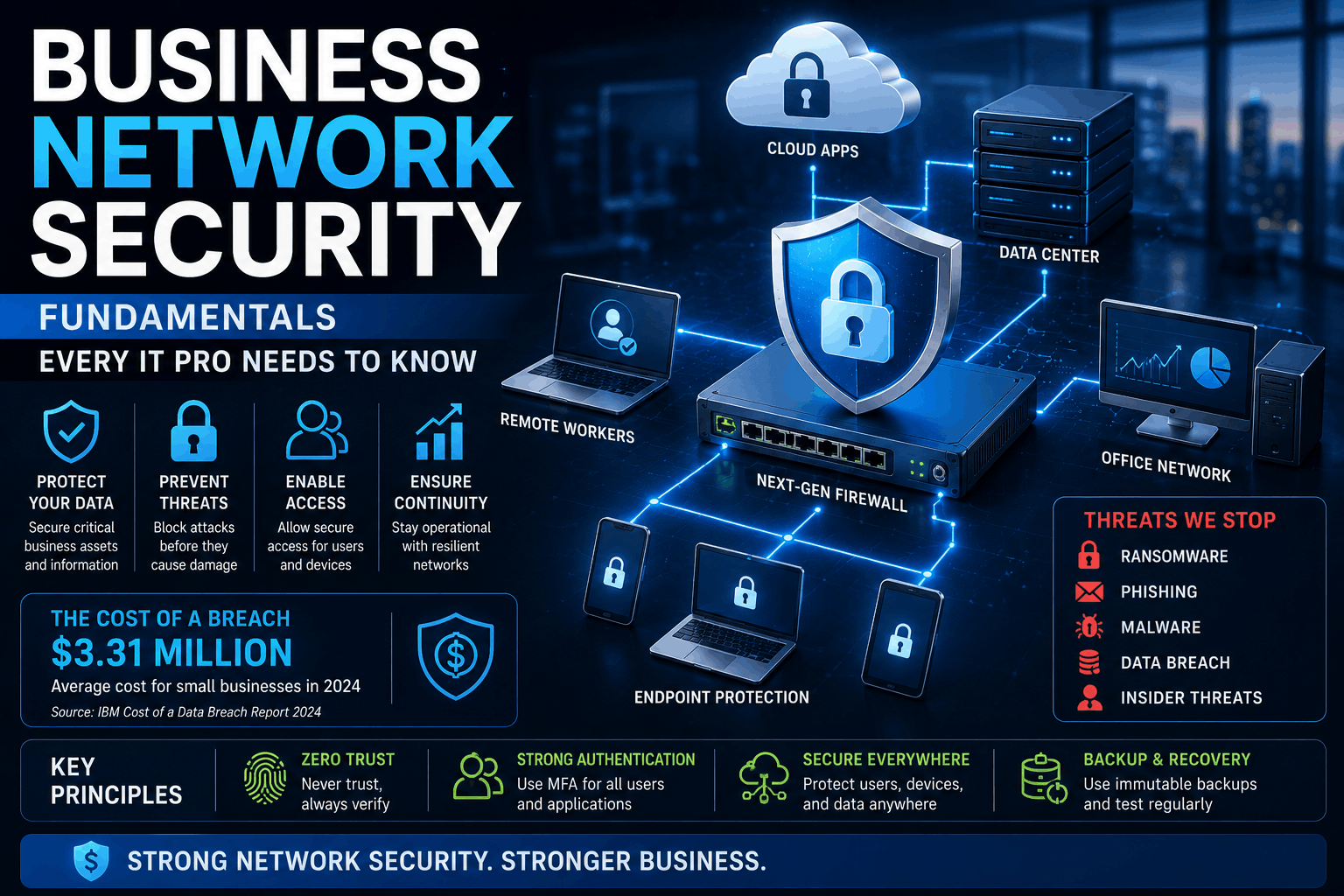
Securing a company network feels like a moving target. You probably know someone who’s dealt with a ransomware scare, which means as far as I know, attackers scan for weaknesses automatically, meaning small teams face the same automated threats as Fortune 500 companies. Read that again if you need to. That’s not a small shift.
By most accounts, if you think about it. This can be hit or miss without strict policies.
TL; DR
- Business network security now relies on Zero Trust principles, verifying every user and device instead of assuming safety inside the perimeter.
- The average data breach for small businesses costs $3.31 million, making preventative measures like immutable backups and MFA mandatory.
- Modern stacks blend SASE architecture with hardware firewalls from vendors like Fortinet to protect hybrid workers without slowing workflows.
Key Point
- Zero Trust replaces “trust but verify” with strict “never trust, always verify” rules for every single login.
- Small businesses are often targeted as pivot points into larger supply chains, not just for their own data.
- Cyber insurers now demand EDR and MFA on every endpoint or they refuse coverage entirely.
- As of 2026, expect to pay $500 to $1,500 for entry-level firewall hardware plus annual subscription fees.
Table of Contents
- What is Business Network Security?
- Why Business Network Security Matters Now
- Key Components of a Modern Security Stack
- Implementing Zero Trust in Your Organization
- Common Business Network Security Mistakes
- People Also Ask
- Moving Forward with Confidence
What is Business Network Security?
Business network security is the combination of hardware, software, and policies designed to protect a company’s digital infrastructure from unauthorized access and cyber threats. It moves beyond classic perimeter defenses to verify every user. Device attempting to connect to company resources.
In the past, IT teams built a strong outer wall, and trusted everything inside.
That model collapsed when cloud apps and remote work became standard. Now, business network security revolves around identity. You’ve to treat every connection as hostile until proven otherwise.
How does identity change the security perimeter?
By most accounts, most likely and location before granting access, meaning the network itself is no longer the trust boundary.
The key lesson is simple: blocksep matters. For the average user, according to NIST Special Publication 800-207. That changes the picture quite a bit. The perimeter is no longer a physical wall.
You might find that the data speaks for itself. The thing is, it’s the identity of the user, and the health of their device. In reality, this shifts the focus from blocking IP addresses to authenticating people. A server in your local data center.
A cloud app in AWS need the same level of scrutiny.
Why Business Network Security Matters Now
Strong security measures matter seeing as a single breach can destroy a small company (which works out well in practice) financially and reputationally. 31 million in 2024…which means kind of surprising, right? One incident is potentially fatal for smaller organizations.
Many owners assume hackers only target massive corporations. Actually, let me put that differently; which is why attackers target small businesses because they often serve as pivot points into larger supply chains.
How does that play out? A CISA Security Lead noted that small businesses are frequently targeted not for their own data, but as a weak link to reach bigger targets. If you process invoices for a larger partner, you’re a target.
5 million across all business sizes — which is why if you lack immutable backups, you’ve no choice but to negotiate with criminals, so the financial risk is simply too high to ignore.
Key Components of a Modern Security Stack
A modern security stack combines firewalls. The key here is that cloud access tools. Endpoint protection, and strict authentication protocols. This blend protects remote and on-site workers. While filtering malicious traffic before it reaches sensitive data.
Hardware-based firewalls remain tied to but are gradually augmented. Or replaced by Secure Access Service Edge (SASE) to protect hybrid workers.
Naturally, vendors like Palo Alto, and Fortinet offer enterprise-grade firewalls. Though entry-level hardware costs $500 to $1,500 plus annual subscription fees. Which means you get what you pay for.
Naturally, to make sense of the alphabet soup of security. Looks at how these answers work together. Set uping AI network security can help automate threat detection.
| Feature | Traditional Firewall | SASE | Zero Trust |
|---|---|---|---|
| Location | On-premise only | Cloud and on-premise | Identity-based |
| Remote Work | Requires VPN | Built-in | Built-in |
| Traffic Routing | Backhauls to data center | Direct to cloud | Direct to cloud |
| Trust Model | Trust inside network | Trust inside network | Never trust |
Are hardware firewalls still necessary?
From a broader view, hardware firewalls remain necessary for on-premise networks to block malicious traffic. I mean, at the edge, though they’re no longer enough on their own. They must work alongside cloud-based SASE tools to secure remote workers who bypass the physical office network.
Modern SD-WAN improves network performance through traffic prioritization. Which keeps business apps running smoothly even when background scans run.
Implementing Zero Trust in Your Organization
From a practical standpoint, set uping Zero Trust calls for mapping data flows. Verifying user identities continuously, and enforcing least privilege access across all systems. It shifts the focus from defending a single; or at least. Stats confirm it. Network boundary to authenticating every person access ask for.
Adopting this structure means accepting that breaches will happen. You design systems to limit the blast radius. When I started looking into network security strategies, I realized that legacy VPNs gave anyone on the platform way too much access, and they connect to the whole network instead of just the app they need.
This method aligns with the CISA Zero Trust Maturity Model. It takes time. You can’t just flip a switch.
Common Business Network Security Mistakes
Mostly, ignoring backup immutability, and underestimating the skill gap in IT teams. These oversights leave networks vulnerable to automated attacks and ransomware extortion.
You could say attackers spam push notifications to useees until they accidentally click Approve. Just because you enabled MFA doesn’t mean you’re safe, and let me tell you, you need number-matching or biometric factors to stop these attacks. Relying on basic cybersecurity software isn’t enough if policies are weak.
This is exactly what that first point lead to. Another massive mistake involves cyber insurance. A common frustration on IT forums is that providers now demand EDR, and MFA on every single endpoint. Or they refuse coverage entirely. Small business owners all the time feel overwhelmed by the alphabet soup of security (EDR.
MDR, SASE, XDR) and struggle to find clear ROI. Plus, the severe shortage of skilled IT security professionals makes managing complex stacks a pain for small teams.
People Also Ask
How much does cyber insurance cost for a small business?
As of 2026. Cyber insurance for a SMB usually costs $1,500 to $5,500 annually based on industry risk. Insurers mandate strict controls like EDR, and MFA before issuing a policy.
How fast should critical vulnerabilities be patched?
Which means delaying patches gives attackers a wide window to scan. And compromise unpatched systems.
What is the difference between SASE and SD-WAN?
And sure enough, building on that earlier point, and sure enough, sASE combines SD-WAN capabilities with cloud security functions like SWG — and CASB into a single cloud-delivered service. SD-WAN only focuses on intelligent routing and network performance.
Why do hackers target small businesses?
Hackers target small businesses because they often lack enterprise-grade security. And serve as pivot points into larger supply chains — breaching a small vendor is often the easiest way to reach a massive corporate target.
Moving Forward with Confidence
In most scenarios, naturally, building a tough security posture takes time and continuous effort. You must adapt to new threats instead of relying on outdated perimeter defenses. The numbers confirm this. By focusing on identity verification and immutable backups. You (which completely makes sense logically) drastically reduce your attack surface.
- Enable number-matching MFA — Prevent MFA fatigue attacks by requiring users to enter a code from their screen into their authenticator app.
- Implement immutable backups — Configure storage that cannot be modified or deleted for a set retention period to survive ransomware encryption.
- Audit vendor access — Review which third-party partners have credentials to your network and enforce least privilege access for them.
- Review your insurance policy — Check your cyber insurance requirements to ensure your EDR and MFA deployments meet their coverage criteria.
To build on this foundation. Agreed. Weighs following a structured cybersecurity roadmap for your team, so you can also set up these cybersecurity tips immediately to protect everyday operations.
Security is a continuous journey.
🔍 Research Sources
Verified high-authority references used for this article
Share This Network Security Guide
Help IT professionals, network engineers, and students strengthen their cyber defense.
Zubayer Hasan
LinkedIn Profile →Md Zubayer AL Hasan is the lead cybersecurity platform architect and security researcher at SafeNetworkHub. Dedicated to zero-knowledge cryptography, infrastructure vulnerability auditing, and building accessible privacy tools.
0 Comments
No comments yet
Have a question or insight about this network security guide? Be the first to share your thoughts!
Write the first comment →