
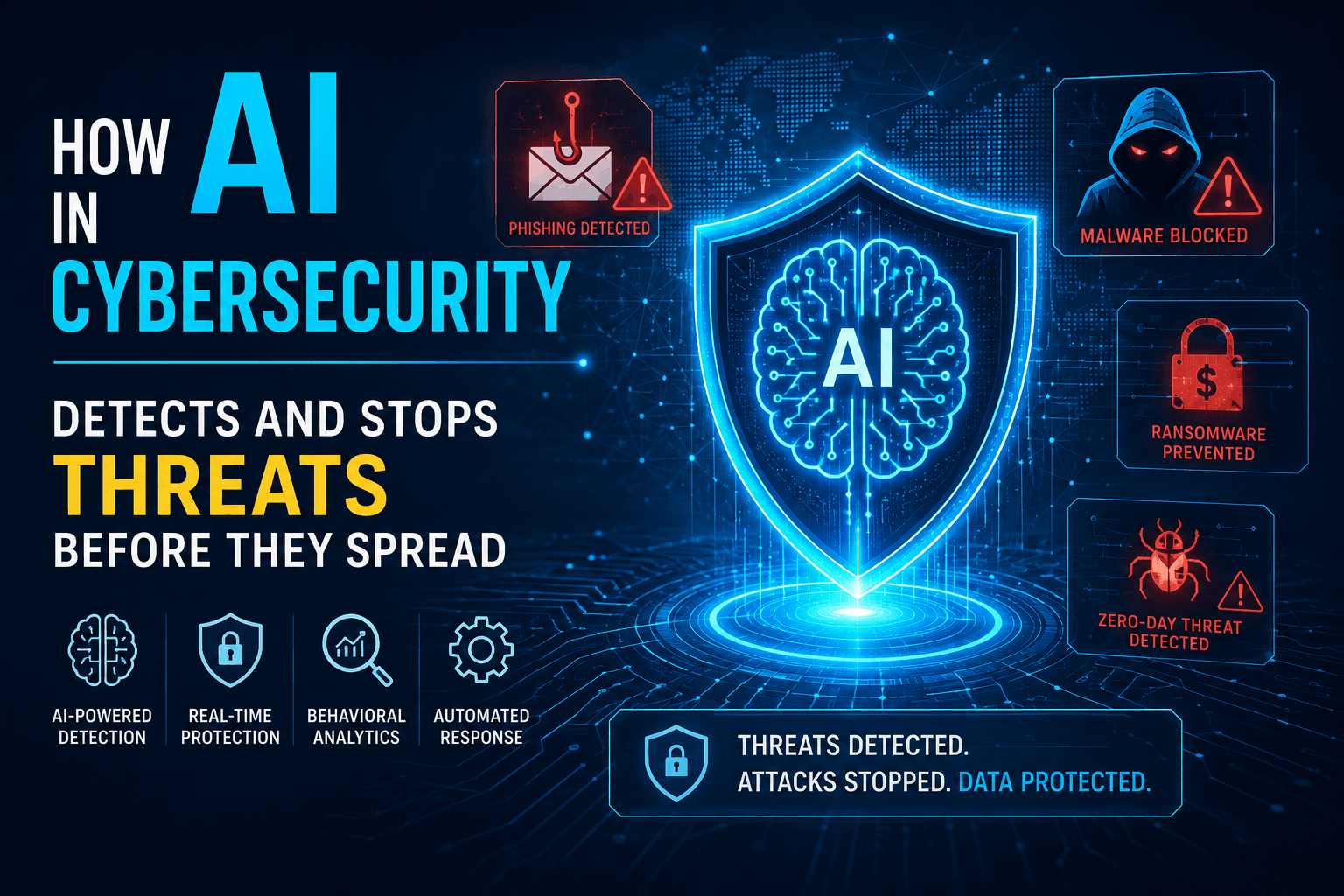
Security teams are losing sleep. It’s not just mostly. The evidence is there. Since of the sheer volume of alerts flooding their dashboards around 37 times a minute. The real gut-punch is that the attacks themselves are getting smarter.
You probably know someone who’s dealt with a breach that started from a single, perfectly crafted email that no spam filter caught. In loads of cases. The moment an incident response lead realizes the phishing email was written by a generative AI tool is the exact moment the old playbook goes out the window. No grammar mistakes.
Real names of internal projects, which means the kind of personalization that would’ve taken a human attacker two weeks of reconnaissance; the AI cranked it out in 90 seconds.
TL; DR
- AI in cybersecurity uses machine learning to spot abnormal behavior in networks, cutting incident response time by as much as 70% in high-risk environments.
- Around 45% of organizations already embed AI or ML in their security stack, mostly for intrusion and malware detection.
- The biggest threat isn’t just smarter attacks, it’s the democratization of those attacks—low-skill actors now launch high-volume, AI-crafted campaigns that overwhelm static defenses.
Main points
- Attackers now automate the entire kill chain using generative AI, so signature-based tools are effectively blind to about 62% of novel threats.
- AI-powered behavioral analytics (UEBA) can flag a zero-day exploit by noticing that a printer suddenly started scanning the HR database at 3 a.m.
- The very same AI that defends your network needs constant model retraining; stale data leads to false negatives that look like a green dashboard but are actually open windows.
- Traditional cybersecurity principles still apply, but the execution layer has shifted from rule-based to context-aware, self-adjusting engines.
Table of Contents
- The Modern Threat Landscape Has Gone Exponential
- Why Traditional Defenses Are Falling Behind
- How AI in Cybersecurity Has Completely Flipped the Script
- Key AI-Driven Cybersecurity Defenses You Can Actually Use
- What Are the Downside and Risks of AI in Cybersecurity?
- FAQs & Conclusion
The Modern Threat Landscape Has Gone Exponential
Sure enough, attack volumes used to grow linearly. That changed. In 2026, you’re looking at an environment. It specifically.
Where a single script can launch thousands of polymorphic attacks that change their code signature every time they run. Palo Alto Networks captured the shift bluntly: “The single biggest threat is the democratization.
Within this context, think about that for a second, and a threat group doesn’t need to recruit a single expert anymore.
They can feed a large language model a target company’s press releases, useee LinkedIn profiles, and recent SEC filings, then in under three minutes generate a spear-phishing campaign that mirrors the CEO’s writing voice. Here’s the other side of it.
Industry reports now show that about 1 in 4 successful breaches in the energy sector last year began with AI-generated content that slipped right past legacy secure email gateways.
Why Traditional Defenses Are Falling Behind
” That logic collapses. When every attack is a one-of-a-kind mutation generated in real time. This holds true. According to recent analysis from Harvard Extension’s cybersecurity program, 45% of organizations have already incorporated AI. The data speaks for itself, and machine learning into their cybersecurity structures precisely because their established signature databases couldn’t keep up.
I remember walking a manufacturing client through a post-incident review. 7% of incoming traffic. 3% that passed a rule written three years earlier for a different compliance need, which means hard to ignore those numbers. That jumped out at me too. The attackers didn’t break the rule. They just engineered a payload that the rule almost never considered, that’s the fundamental flaw. Overall, static defenses assume the enemy plays by yesterday’s patterns.
The speed at which these attacks propagate makes manual triage impossible. A well-resourced SOC might take 20 minutes to validate, and contain a single alert. Curiously enough.
When an AI-powered campaign generates 200 variations in that same window, the math breaks. Security teams tell me they spend more time closing false alarms and shuffling tickets than actually hunting threats.
The irony stings. The more alerts a tool generates without context. The less secure the organization becomes.
How AI in Cybersecurity Has Completely Flipped the Script
Instead of searching for known signatures. AI-powered security platforms learn what “normal” looks like for every user, device, and server (and rightly so) on your network. When something drifts, even a fraction of a (and rightly so) percent, the system flags it.
That shift, from pattern-matching to behavioral anomaly detection, is the single most consequential change. Since the introduction of the firewall 30 years ago. Actually, it’s more accurate to say the firewall itselfis being reinvented. As Palo Alto Networks put it, “AI won’t make firewalls obsolete.
Worth considering.
As far as I know, a next-gen firewall with an AI engine can inspect encrypted — actually, hold on, traffic without full decryption, looking at packet timing and entropy patterns to spot command-and-control communication. Using a protocol it’s never used. The data speaks for itself. Before, it blocks the flow and isolates the host in under 200 milliseconds.
No rule update needed.
Generative AI also supercharges red team exercises. In many cases, escalating privileges. Hard to ignore those numbers — and exfiltrating fake data—so that blue teams can practice against the exact tactics criminals are deploying this week.
Those simulations discover misconfigurations that static vulnerability scanners miss nearly every time.
Key AI-Driven Cybersecurity Defenses You Can Actually Use
UEBA: When Your Own Network Tells the Truth
Sure enough, user, and Entity Behavior Analytics sets up a baseline for every account and device. That’s only part of it, though. From a VPN exit node in a country, and honestly, where nobody travels, UEBA spikes the risk score and can trigger an automated account lockout in less than a second.
What does that mean for you? This catches zero-day exploits that antivirus will miss mainly because. To be more precise, there’s no malicious file to detect, just behavior that doesn’t fit.
- Conduct an AI readiness audit — map every data source (logs, endpoints, cloud APIs) that a behavioral engine would need to build an accurate baseline.
- Deploy UEBA with a defined playbook — so that high-fidelity anomalies trigger automated containment, not just another ticket in the queue.
- Retrain detection models weekly — using the latest threat intelligence and your own telemetry to keep the false-positive rate low.
- Run monthly AI-assisted red team simulations — and feed the findings directly back into your detection rules and firewall policies.
Context-Aware Firewalls That Block Without Signatures
The old model. A firewall looks at IP, port, and protocol. The new model: a firewall understands that a finance application server suddenly communicating with a newly registered domain using a self-signed certificate is malicious.
Even if the domain isn’t on any blacklist. Adaptive micro-segmentation then isolates that server from the rest of the subnet, so the threat can’t move laterally.
AI in SIEM: Cutting Through the Noise
From a broader view, ” Instead of 47 alerts, the analyst sees one with a confidence score of 96%. Read that again if you need to. Incident response time drops by around 70% in those scenarios. A number confirmed across energy grid operators that have deployed AI-improved SOCs.
What Are the Downside and Risks of AI in Cybersecurity?
AI defense isn’t a silver bullet. The same adaptive algorithms that protect you can be poisoned, so an attacker who gains write access to a training pipeline can inject subtly malicious samples that teach the model that certain attack patterns are benign.
that’s the point. Deloitte’s research highlights that agentic AI, systems that make decisions without human oversight—can take automated actions that cascade into physical world failures. If a manual kill switch isn’t built in.
Then there’s the data quality problem. AI models are only as impressive as the logs they train on. If your endpoint detection telemetry is incomplete, say. 14% of laptops not once report process events. That’s a significant gap. That’s a significant gap.
Naturally, arguably at one manufacturer I worked with, the AI flagged zero threats for three weeks straight, and that wasn’t a secure network; it was a broken log collector. A human analyst eventually noticed the silence.
| Proven Benefit of AI in Cybersecurity | Corresponding Risk or Weakness |
|---|---|
| Detects novel threats at 98% accuracy in ideal conditions | Accuracy plunges when training data is stale or poisoned |
| Cuts incident response time by ~70% through automated triage | Over-automation can trigger containment actions that halt legitimate business processes |
| Enables dynamic micro-segmentation in real time | Misconfigured AI policies can lock out privileged users and knock applications offline |
| Amplifies red team realism | Adversaries weaponize the same generative AI tools to build better attack simulations against you |
Honestly, I’m less worried about the technology failing than, or rather, about organizations treating it as a “set and forget” upgrade. You still need a human-led incident response plan that can override an automated decision (and rightly so) in under 90 seconds.
The real question is — does it work? No model, no matter how sharp. During month-end close is probably just the finance team.
FAQs & Conclusion
What exactly is AI in cybersecurity?
On closer inspection, aI in cybersecurity is the application of machine learning. Deep learning, and generative models to detect threats, analyze behavior, and automate responses. Instead of relying on known virus signatures. These systems learn what normal network activity looks like, and flag deviations, regularly stopping attacks before they execute.
How does AI actually improve threat detection accuracy?
Pay attention to this part. By building behavioral baselines for every user. And device, AI spots anomalies that signature engines miss. Real-world energy sector deployments show a 98% detection rate for advanced threats. What this means is with false positives reduced enough that SOC teams can focus on genuine incidents instead of chasing noise.
Can AI stop zero-day attacks?
So naturally, building on that earlier point, yes, often. Because zero-days have no known signature, AI shines by noticing that a process is acting unexpectedly. Like a calculator app suddenly spawning a command shell and reaching out to an external IP. Funny enough enough. That behavioral pivot triggers an alert long before damage spreads.
What are the biggest risks of relying too much on AI for security?
You’ve probably found that model poisoning, shadow AI tools, and over-automation without human override. Attackers can corrupt training data so that the AI learns to ignore certain attacks. While unsupervised agentic AI may start containment actions that disrupt operations if a manual kill switch isn’t tested regularly.
Will AI security tools replace human analysts?
No. They shift the analyst into a higher-value role. Instead of staring at dashboards and triaging alerts, security professionals now tune models.
Investigate the something like 2% of incidents AI can’t classify. That changes the picture quite a bit. And design proactive defense strategies. Let that sink in for a second.
How are attackers using AI against businesses right now?
Still, attackers use generative AI to write hyper-personalized phishing emails, automate vulnerability discovery. And create malware that morphs its code with every execution. More importantly, the attack lifecycle—from reconnaissance to exfiltration, can now be completely automated. The thing is, enabling a single threat actor to run campaigns at a (which works out well in practice) scale once reserved for nation-states.
Ready to get moving? Start by treating AI as a capability layer that asks for continuous feeding. Oversight, not a product you install once. Pull together your network, endpoint, and cloud logs into a clean data pipeline.
Generally speaking, the defenses that worked in 2023 won’t keep you safe in 2026. The good news?
The apps to match today’s threat speed are already here, you just need to use them, and let me tell you, before the attackers do.
🔍 Research Sources
Verified high-authority references used for this article
Share This Network Security Guide
Help IT professionals, network engineers, and students strengthen their cyber defense.
Zubayer Hasan
LinkedIn Profile →Md Zubayer AL Hasan is the lead cybersecurity platform architect and security researcher at SafeNetworkHub. Dedicated to zero-knowledge cryptography, infrastructure vulnerability auditing, and building accessible privacy tools.
0 Comments
No comments yet
Have a question or insight about this network security guide? Be the first to share your thoughts!
Write the first comment →