If you want to monitor brand references in ChatGPT live, checking one prompt and saving a screenshot is not enough. You need a repeatable way to see whether ChatGPT mentions your brand, recommends it, cites your website, associates it with the right problems, or gives users inaccurate information.
There is also an important limitation to understand from the start: current public OpenAI documentation provides ways to understand ChatGPT Search visibility, citations, crawler access, and referral traffic, but it does not provide marketers with a universal dashboard showing every private ChatGPT conversation that mentions a brand.
So useful brand monitoring is built around repeatable observations, not the promise of seeing every conversation.
This guide shows you exactly what to monitor, how to build a benchmark, which monitoring method fits different situations, how to interpret the signals correctly, and what to do when your brand is missing or misrepresented.
What Does “Monitor Brand References in ChatGPT Live” Actually Mean?
It means repeatedly testing the questions your customers are likely to ask and recording how ChatGPT represents your brand over time.
The word live can be misleading.
ChatGPT can search the web for current information, and search-enabled responses may contain citations that users can open and review. OpenAI also warns that search results and citations can sometimes be incomplete, outdated, or incorrect. You can review the current OpenAI guidance on searching the web with ChatGPT.
For marketers, this means a realistic monitoring system should answer questions such as:
- Does ChatGPT mention our company for relevant unbranded questions?
- Does it mention our individual products?
- Which competitors appear when we do not?
- Does it recommend us or merely name us?
- Does it cite our website?
- Which third-party websites are being cited?
- Is the information about us accurate?
- Is our visibility becoming stronger or weaker across comparable tests?
The goal is not to collect more screenshots. The goal is to understand patterns.
The Five Signals You Should Never Mix Together
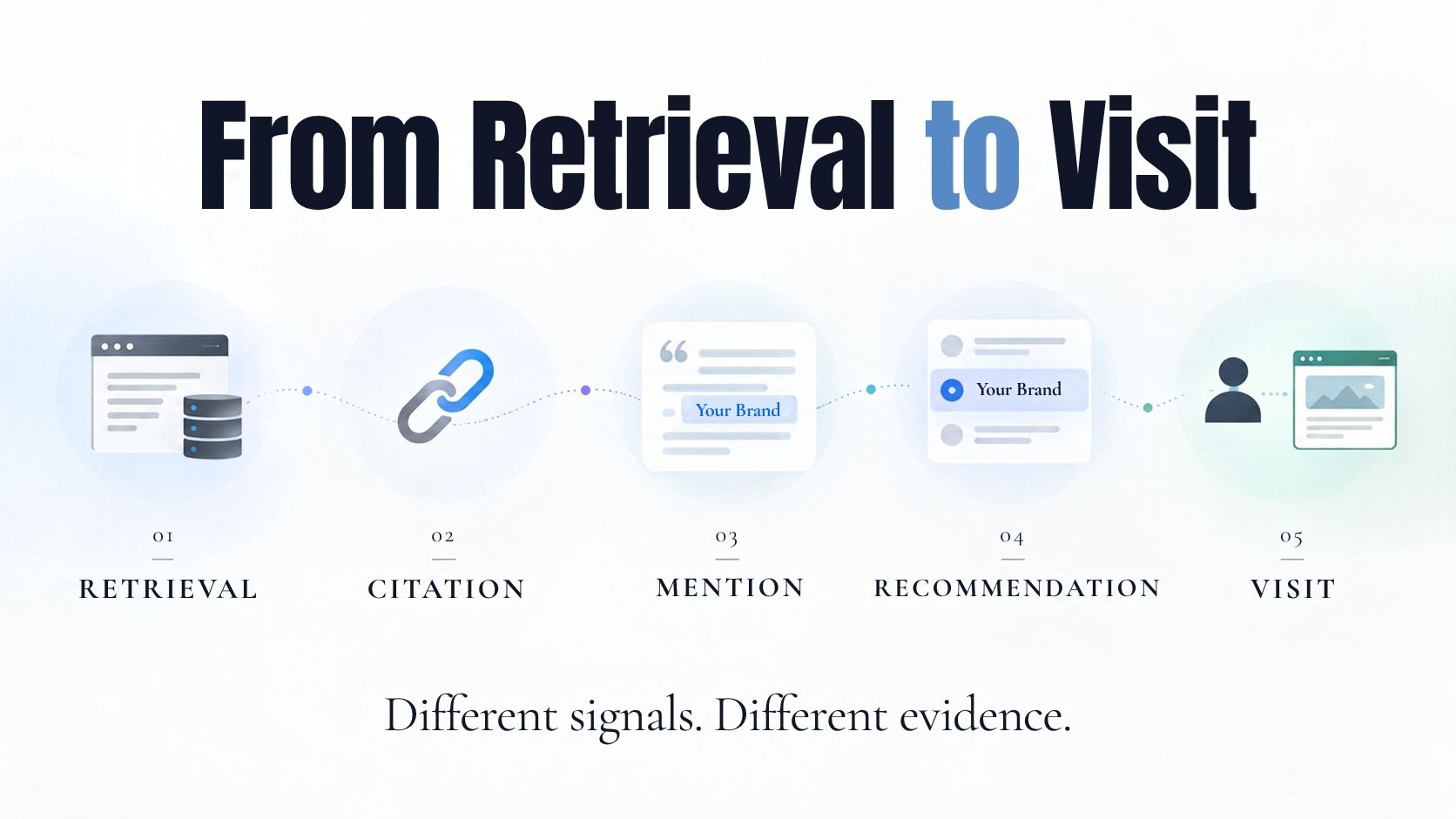
The easiest way to misread ChatGPT visibility is to treat every AI-related signal as if it means the same thing.
It does not.
| Signal | What Happened | What You Can Reasonably Conclude |
|---|---|---|
| Retrieval | An AI-related crawler or user agent requested a page | The page was accessed |
| Citation | Your page appeared as a source | Your content was visibly referenced |
| Mention | Your brand appeared in the answer | The generated response included your brand |
| Recommendation | Your brand was presented as a relevant option | ChatGPT associated you with the user’s need |
| Visit | A user reached your website | You received actual referral traffic |
This distinction is important because each signal answers a different question.
A crawler visiting your site does not prove that a user saw your brand.
A visible citation does not necessarily mean ChatGPT recommended your company.
A recommendation does not necessarily produce a click.
And a website visit cannot tell you everything the person read inside ChatGPT before arriving.
Which ChatGPT Brand Monitoring Method Should You Use?
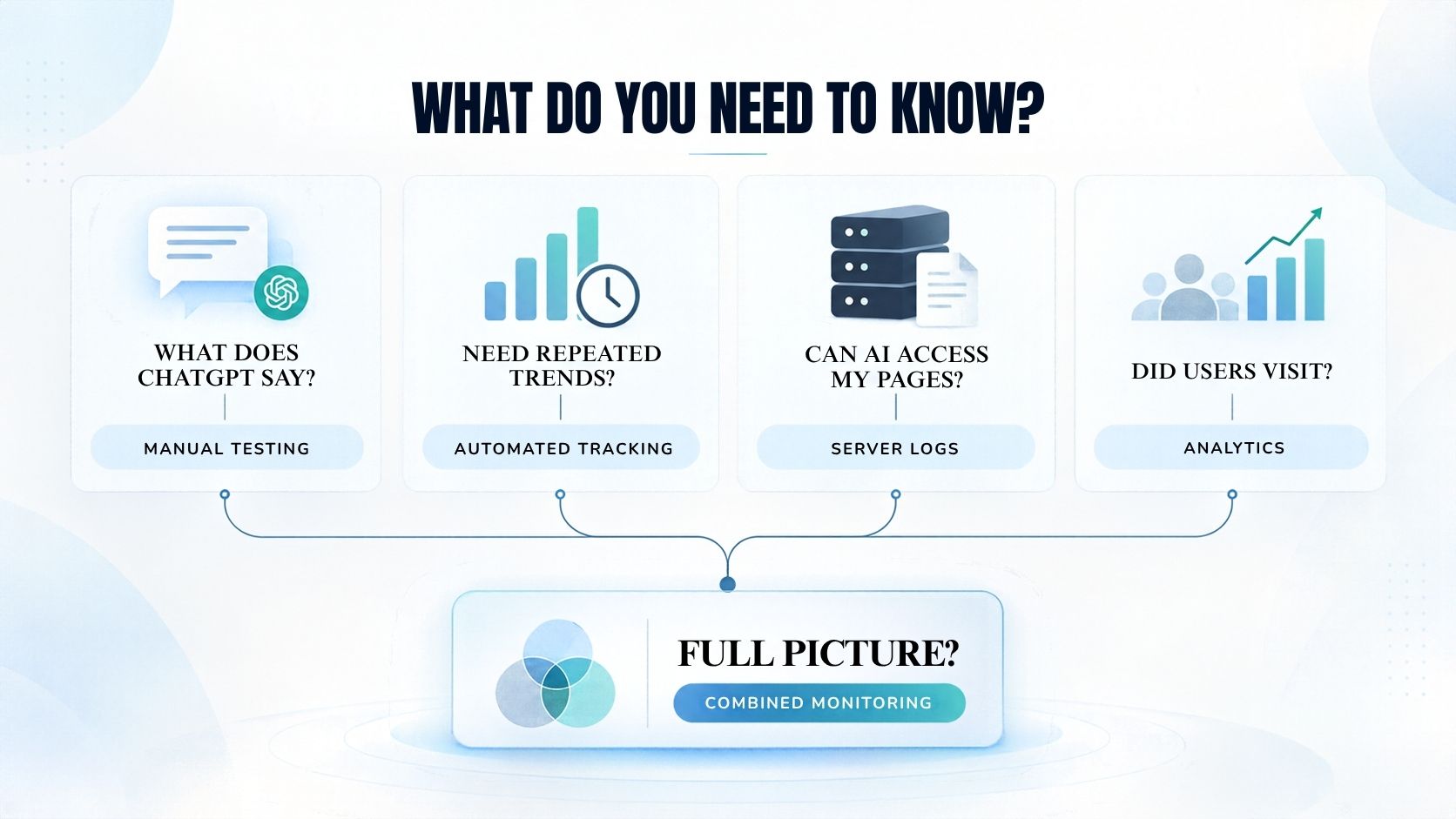
The best method depends on what you are trying to learn.
| Monitoring Method | Best For | Strength | Main Limitation |
|---|---|---|---|
| Manual prompt testing | Small brands, initial research, small prompt sets | Lets you read every response closely | Time-consuming at scale |
| Automated AI visibility tracking | Agencies, competitors, larger prompt sets | Makes repeated testing and trend tracking practical | Quality depends on methodology |
| Server-log analysis | Technical troubleshooting | Shows identifiable crawler/request activity | Cannot prove a visible mention |
| Web analytics | Measuring actual ChatGPT traffic | Shows visits and landing pages | Does not reveal every non-clicked mention |
| Combined monitoring | Mature programs | Connects visibility, retrieval and traffic | More setup and interpretation |
Choose Manual Monitoring When…
You are starting from zero and want to understand how ChatGPT currently represents your brand.
You can learn a surprising amount from 20–30 carefully selected prompts before paying for a large tracking platform.
Choose Automated Tracking When…
You need to repeat hundreds of prompts, monitor multiple competitors, compare markets, or produce recurring reports.
Automation solves a scale problem.
It does not eliminate the need to inspect the underlying responses.
Use Server Logs When…
Your question is technical:
“Is an OpenAI crawler requesting this page?”
Logs can help answer that.
They cannot independently answer:
“Did ChatGPT recommend our company to a customer?”
Use Analytics When…
You want evidence of actual traffic.
OpenAI currently says referral URLs from ChatGPT search automatically include utm_source=chatgpt.com, allowing publishers to identify inbound ChatGPT search traffic in analytics tools such as Google Analytics.
That gives you a much stronger signal for visits than trying to infer traffic from crawler logs.
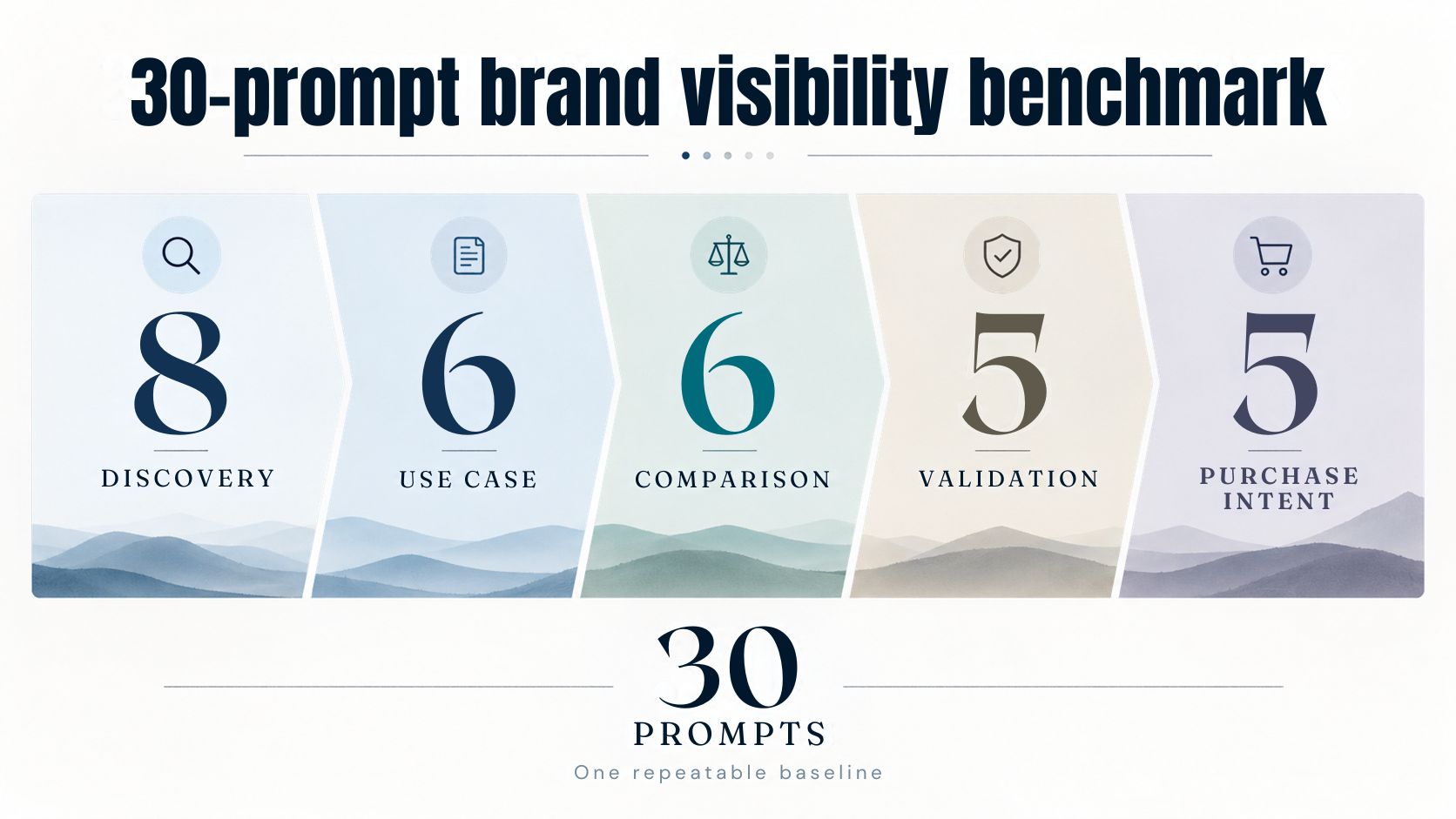
Start With a 30-Prompt Benchmark
You do not need thousands of prompts to build a useful first benchmark.
A practical starting set is:
| Prompt Type | Prompts | Purpose |
|---|---|---|
| Category discovery | 8 | Can ChatGPT discover you without seeing your name? |
| Problem/use case | 6 | Does it connect you with problems you genuinely solve? |
| Competitor/comparison | 6 | Which brands does it associate with you? |
| Brand validation | 5 | Does it understand your company correctly? |
| Purchase intent | 5 | Do you appear close to a buying decision? |
| Total | 30 | Initial monitoring baseline |
Thirty is not a statistically representative sample of all ChatGPT activity.
That is not the point.
It is a manageable benchmark that you can inspect carefully and repeat consistently.
How Should You Choose the Prompts?
Start with customer decisions rather than SEO keywords.
Suppose you sell project-management software.
This prompt tells you relatively little:
“What is AcmePM?”
You already supplied the entity.
A more useful discovery question would be:
“Which project management tools work well for a 10-person creative agency?”
Now ChatGPT must decide which brands belong in the answer.
That difference matters.
Discovery Prompts
Use questions where the customer understands the category but may not know your company.
For example:
“What are good tools for managing remote design projects?”
Problem Prompts
Tie the query to a real challenge.
For example:
“Which CRM is suitable for a small B2B team that relies heavily on email outreach?”
Comparison Prompts
Test both:
“Brand A vs Brand B”
and:
“What are the best alternatives to Brand B?”
The second test is particularly valuable because your brand is not being supplied automatically.
Validation Prompts
Test facts that could damage trust if ChatGPT gets them wrong.
Examples include:
- Pricing model
- Supported integrations
- Locations served
- Product capabilities
- Target customer
- Privacy/security characteristics
Purchase-Intent Prompts
These are the questions closest to a commercial shortlist.
Examples include:
“Best accounting platform for a US freelancer.”
“Which cybersecurity provider should a 50-person company consider?”
“Best email platform for Shopify automation.”
Run Important Prompts More Than Once
One response should not become a business KPI.
Generative answers can change.
Prompt wording can also change the response.
For commercially important prompts, test several comparable variations and preserve the results rather than selecting the response you like best.
You are looking for patterns:
- Does your brand appear consistently?
- Does it disappear when the wording changes slightly?
- Does one competitor appear much more reliably?
- Does the same incorrect claim keep returning?
- Does ChatGPT understand your product name but not your company name?
The useful unit of analysis is not the screenshot. It is the pattern across repeatable observations.
How Do You Calculate ChatGPT Brand Visibility?
Avoid creating a mysterious score nobody can audit.
Start with measurements people can understand.
Mention Rate
Mention Rate = Responses Mentioning Your Brand ÷ Eligible Responses × 100
Suppose your brand appears in 18 of 30 monitored answers.
Your sample mention rate is:
18 ÷ 30 × 100 = 60%
That means:
Your brand appeared in 60% of this monitored prompt sample.
It does not mean:
Your brand appears in 60% of all ChatGPT conversations.
That distinction should be visible in reports.
Citation Rate
When search-grounded responses contain citations, track whether your domain is among them.
Citation Rate = Eligible Responses Citing Your Domain ÷ Eligible Search Responses × 100
Do not combine citation rate with mention rate.
ChatGPT can mention your brand without citing your site.
It can also cite one of your pages while discussing a broader topic without explicitly recommending you.
Recommendation Coverage
Record whether the response actually presents the brand as a relevant option.
This helps separate:
“Acme is one company operating in this market.”
from:
“Acme is a suitable option for teams that need X.”
Those statements have very different commercial significance.
Factual Error Rate
Monitor incorrect information independently.
Factual Error Rate = Brand-Mentioning Responses With Material Errors ÷ Brand-Mentioning Responses × 100
Material errors could include incorrect:
- Prices
- Features
- Availability
- Locations
- Integrations
- Product names
- Company relationships
A highly visible brand with persistent factual errors does not necessarily have a healthy AI presence.
A Practical Example
Consider a fictional company called Northstar CRM.
The following example is illustrative. It is not presented as real first-hand market data.
Northstar runs the 30-prompt benchmark.
| Observation | Result |
|---|---|
| Brand mentions | 14 |
| Recommendations | 8 |
| Domain citations | 5 |
| Material factual errors | 2 |
| Prompts without brand mention | 16 |
A weak analysis would stop here and report:
“46.7% AI visibility.”
A useful analysis asks what happened inside those results.
Suppose 10 of the 16 misses are enterprise-integration questions.
Northstar may have a positioning or evidence problem around enterprise integrations.
Suppose the two factual errors both quote an old price.
Now the company has a separate factual-consistency problem.
The percentage tells you where to investigate. The individual prompts tell you what to fix.
What Is a ChatGPT Best Lists Study?
A ChatGPT best lists study measures whether your brand appears in recommendation questions where you have not already supplied its name.
Examples include:
- “Best CRM for SaaS startups.”
- “Best privacy tools for small businesses.”
- “Best project management platform for agencies.”
- “Best network security monitoring tools.”
These questions test category association.
When reviewing the answers, look beyond list position.
Ask:
- Why was each brand included?
- Which capabilities are associated with the competitor?
- Which sources support the answer?
- Does your brand appear for one customer segment but disappear for another?
- Does ChatGPT describe your brand differently from the way you position it yourself?
That turns a “best list” experiment into useful market research.
Why Does ChatGPT Mention a Competitor but Not Your Brand?
There may be several explanations, and you should diagnose the pattern before changing anything.
A competitor may have stronger public association with the specific problem.
Independent sources may discuss it more frequently.
Its documentation may be clearer.
Its product may genuinely be a better fit for that prompt.
Your product may be better known by a sub-brand.
Or the difference may disappear after repeated observations.
Instead of asking:
“How do we force ChatGPT to mention us?”
ask:
“What evidence makes the competitor easier to understand or justify for this question?”
That leads to better decisions.
What Should You Do When Your Brand Is Missing?
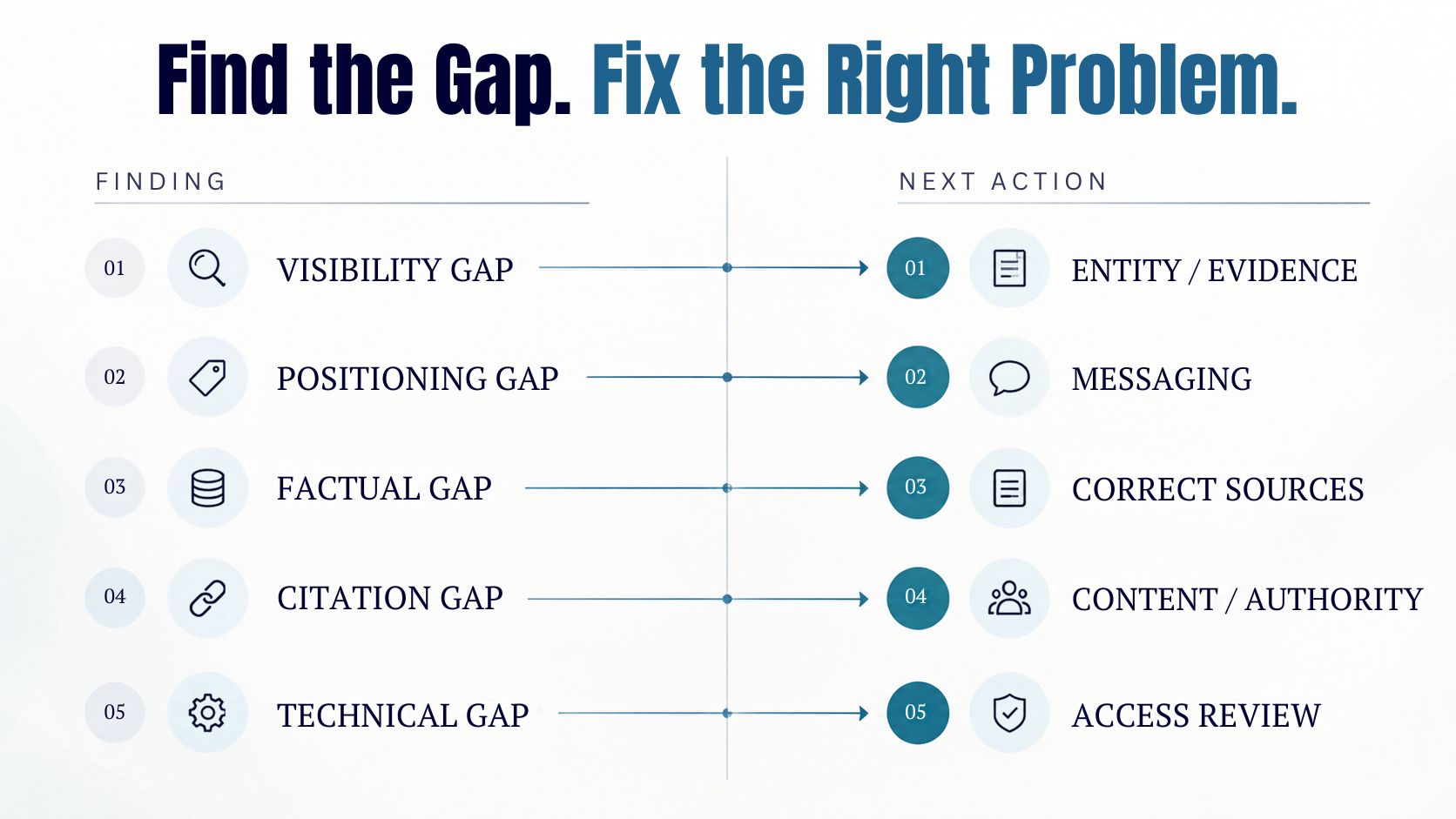
Classify the problem before trying to solve it.
Visibility Gap
Your brand has a legitimate reason to appear but repeatedly does not.
Investigate entity recognition, public coverage and category relevance.
Positioning Gap
Your brand appears, but ChatGPT associates it with the wrong audience or value proposition.
Review your first-party messaging and external descriptions.
Evidence Gap
Competitors are repeatedly supported by credible independent sources while your brand has little external evidence.
The answer may involve better PR, original research, useful tools, expert participation, customer stories or legitimate independent coverage—not simply adding more keywords.
Factual Gap
Your brand appears, but the information is outdated or incorrect.
Fix the underlying public information.
Technical Gap
Relevant pages are difficult for search systems to retrieve.
Investigate website accessibility, crawler controls and infrastructure.
This classification is useful because each problem belongs to a different team. Content cannot solve every technical problem. Engineering cannot solve every positioning problem.
What If ChatGPT Gets Your Brand Wrong?
Record the exact error before changing anything.
- Prompt
- Answer
- Date
- Incorrect claim
- Visible citations, if available
Then inspect first-party information.
Old PDFs, abandoned pricing pages, outdated documentation and contradictory feature pages can all create confusing public signals.
If search citations are present, inspect the cited sources too.
OpenAI itself advises users to review sources because search results and citations may be incomplete, outdated or incorrect.
Fix information you control first.
If an independent third-party page contains a genuine factual error, request a legitimate correction rather than trying to manipulate the publisher.
What Do OpenAI Crawlers Actually Tell You?
Crawler activity provides technical evidence—not proof of recommendation.
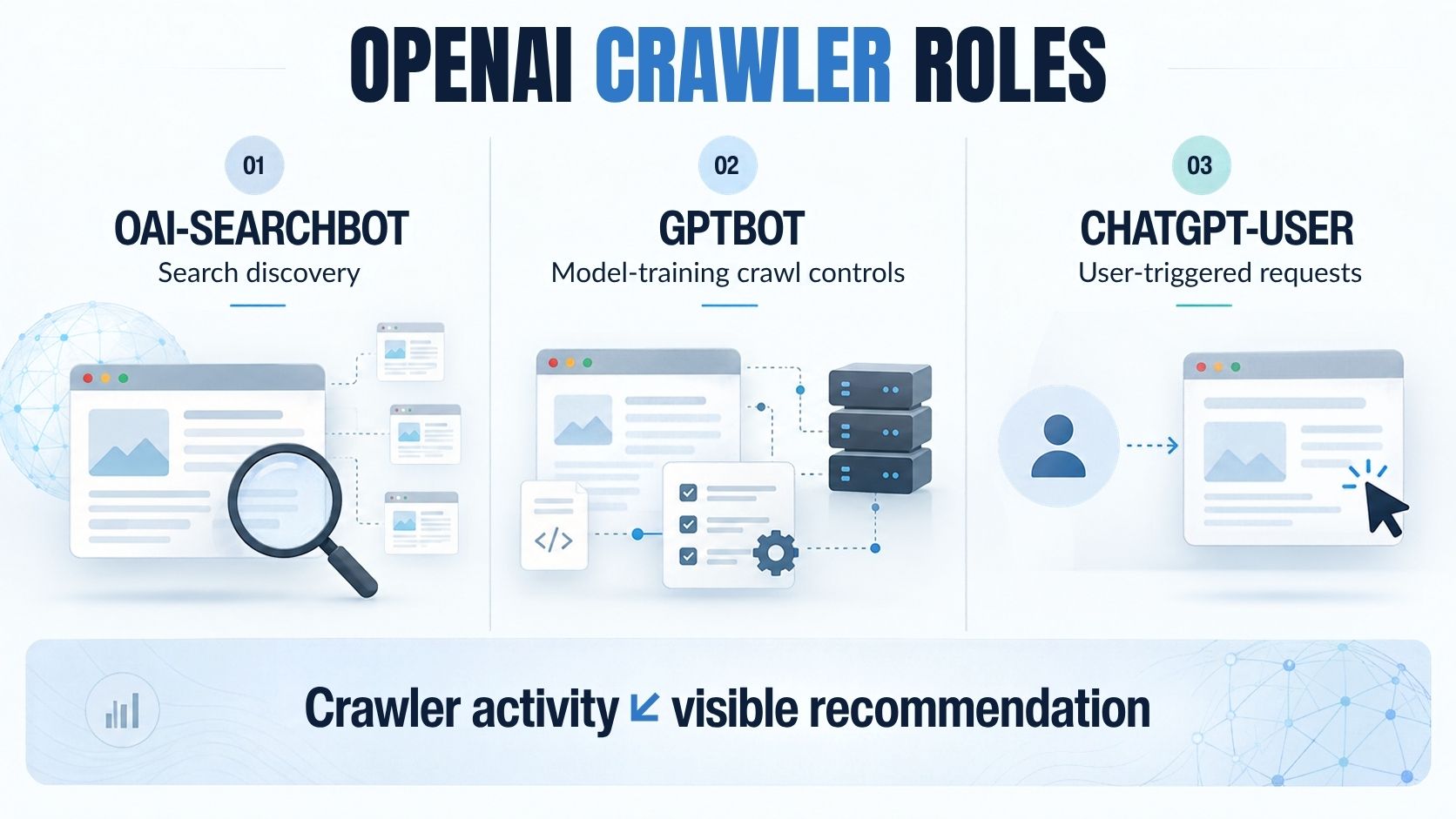
OpenAI currently documents different agents for different purposes.
OAI-SearchBot
OAI-SearchBot is used to surface websites in ChatGPT search features.
OpenAI says sites that opt out of OAI-SearchBot will not be shown in ChatGPT search answers, although navigational links may still occur.
GPTBot
GPTBot relates to crawling content that may be used to improve OpenAI’s generative AI foundation models.
Its controls are independent from OAI-SearchBot. A website can allow search crawling while choosing different training-related crawler settings.
ChatGPT-User
ChatGPT-User is associated with certain user-triggered visits.
That is different from the automatic search crawler.
OpenAI’s documentation therefore supports an important rule: Crawler activity should be reported as crawler activity—not as a guaranteed mention, citation, recommendation or impression.
See the current OpenAI crawler documentation.
Does Allowing OAI-SearchBot Guarantee ChatGPT Visibility?
No.
OpenAI states that making a site crawlable can make it eligible for ChatGPT Search inclusion, but placement is not guaranteed.
This is another reason not to treat crawler configuration as an optimization shortcut.
Allowing legitimate access removes a potential technical barrier.
It does not make weak information authoritative or relevant.
OpenAI’s crawler documentation also notes that robots.txt changes may take roughly 24 hours to be reflected in its systems.
How Do You Troubleshoot Technical Access?
If a page you expect to be accessible is not being retrieved properly, separate technical troubleshooting from content optimization.
Start with basic public website health.
SafeNetworkHub’s Network Security Monitoring Tool can inspect externally observable HTTPS, TLS, certificate, redirect and security-header signals.
Use the Security Headers Checker when you need to inspect CSP, HSTS, Referrer-Policy and other returned security headers.
The Website Security Checklist Tool provides a broader defensive configuration review without pretending to be a penetration test.
For a wider externally observable posture review, the Network Security Assessment can help organize HTTPS, certificate, header, redirect and DNS checks.
Organizations reviewing their wider defensive program can use the Security Controls Assessment to evaluate implementation and effectiveness across broader security controls.
These tools answer technical and security questions.
They do not claim to tell you whether ChatGPT recommended your brand.
That distinction keeps the monitoring methodology honest.
Can You Track Actual Visits From ChatGPT?
Yes, when a user follows a ChatGPT referral to your website and that referral information is available to your analytics setup.
OpenAI currently states that ChatGPT search referral URLs include:
This allows publishers to identify inbound ChatGPT search traffic using analytics platforms such as Google Analytics.
This makes referral sessions an important fifth signal in your monitoring model.
For example:
Mention without visit tells you the brand appeared, but the user may not have clicked.
Visit without a visible brand-monitoring observation tells you that your prompt sample does not capture every possible journey.
The two datasets complement each other.
How Should You Track Sentiment?
Treat automatic positive/neutral/negative classification as a sorting mechanism, not a complete interpretation.
Consider these two descriptions:
“Powerful but expensive.”
and:
“Affordable but limited for advanced teams.”
Both contain positive and negative ideas.
But the business implications are completely different.
Instead of tracking only sentiment, record recurring framing themes such as:
- Easy to use
- Expensive
- Enterprise-focused
- Beginner-friendly
- Strong privacy
- Limited integrations
- Good support
- Technically complex
Over time, framing can tell you far more about your AI-era positioning than a simple sentiment score.
How Should You Protect Privacy While Monitoring AI Visibility?
Most brand-monitoring workflows do not need real customer records.
Do not make prompts “more realistic” by pasting private information into them.
Use synthetic or redacted examples whenever possible.
Before reusing exported prompt logs, SafeNetworkHub’s privacy tools can support a safer workflow.
The Privacy Tools Hub / Privacy Checker provides access to SafeNetworkHub’s broader privacy toolset and inspects publicly observable website privacy indicators.
The Data Privacy & Security Assessment evaluates privacy governance and security controls across multiple organizational domains.
For a new AI-related processing workflow, the Privacy Impact Assessment Tool can help structure an evaluation of inherent and residual privacy risks.
If your organization handles personal information, the PII Compliance Checker provides a structured review of PII governance practices.
For broader privacy-governance readiness, the Data Compliance Assessment evaluates multiple data-protection domains and produces a remediation-oriented readiness view.
Again, these tools do not improve AI visibility directly.
They help prevent a monitoring project from creating an unnecessary privacy or governance problem.
How Often Should You Monitor ChatGPT Brand References?
Use a frequency that matches how quickly meaningful information changes.
A weekly benchmark is a sensible starting point for many businesses.
More frequent testing may be useful during:
- A product launch
- A major pricing change
- A rebrand
- A reputation issue
- A significant competitor launch
- Correction of an important factual error
Less frequent monitoring can work for stable categories where little changes from week to week.
Running the same prompt every hour does not automatically produce better insight.
Consistency is more important than volume.
What Should You Save From Every Monitoring Run?
Do not save only the final percentage.
Keep enough information for another person to audit the result later.
| Field | Example |
|---|---|
| Date | 2026-10-01 |
| Prompt ID | DISC-04 |
| Prompt family | Discovery |
| Prompt | Best CRM for a 10-person B2B sales team |
| Brand mentioned | Yes |
| Recommended | No |
| Competitors | Brand A, Brand B |
| Your domain cited | No |
| Framing | Strong automation, enterprise-focused |
| Factual error | No |
| Raw response | Saved |
| Notes | Brand mentioned but not included in shortlist |
This may look less exciting than a dashboard.
That is a good thing.
Good evidence should be understandable.
Common Mistakes That Make ChatGPT Visibility Reports Misleading
Treating One Answer as a Ranking
ChatGPT responses are not a fixed ten-blue-links search results page.
One observation is not enough.
Testing Only Branded Prompts
If every question contains your company name, you are testing recognition rather than discovery.
Changing the Benchmark Every Week
You cannot measure a trend when the measurement itself keeps changing.
Maintain a stable core prompt set.
Combining Mentions and Citations
These signals should be reported separately.
Calling Crawler Requests “AI Impressions”
A request shows retrieval activity.
It does not prove that a human saw your company inside ChatGPT.
Ignoring Product Names
ChatGPT may recognize your flagship product even when the corporate entity is weakly associated with the category.
Ignoring Factual Errors
An inaccurate recommendation can create a larger business problem than no recommendation.
Optimizing the Score Instead of the Problem
If visibility changes, inspect the underlying responses before deciding what to do.
What Should You Do After Each Monitoring Cycle?
The result should lead to a decision.
Use this simple framework:
| Finding | Likely Next Step |
|---|---|
| Missing from relevant category prompts | Investigate entity and evidence gaps |
| Competitor repeatedly preferred | Study positioning, evidence and use-case fit |
| Incorrect information | Correct first-party facts and investigate cited sources |
| No citations to your site | Review useful source content and crawl accessibility |
| Crawler access problems | Investigate robots.txt, CDN, WAF and server configuration |
| Good mentions but no traffic | Review whether the mention includes a useful path to your site |
| Strong visibility in only one topic | Expand legitimate evidence around adjacent relevant use cases |
This is where monitoring becomes useful.
The purpose of the dashboard is not to make a chart move upward.
It is to tell you what deserves investigation.
Our Perspective: Monitor Evidence, Not Hype
The question marketers often ask is:
“Do we rank in ChatGPT?”
That question is usually too simple.
A better set of questions is:
- Does ChatGPT understand what our company does?
- Does it associate us with problems we genuinely solve?
- Can it discover us without being given our name?
- Which competitors appear when we do not?
- Which sources support those answers?
- Are the facts accurate?
- Do people actually reach our website from ChatGPT?
- And are those patterns changing over time?
Once you can answer those questions consistently, monitoring brand references in ChatGPT live becomes useful business intelligence rather than an AI marketing vanity metric.
Start with a manageable benchmark.
Keep the raw evidence.
Separate retrieval, citations, mentions, recommendations and visits.
Then fix the specific problem the evidence reveals.
Frequently Asked Questions
Can I monitor every time someone mentions my brand in ChatGPT?
Current public OpenAI documentation does not provide marketers with a universal analytics feed for every private ChatGPT conversation. Practical brand monitoring therefore relies on controlled prompt observations, citations, referral analytics and technical evidence available to your organization.
What is the best way to monitor brand references in ChatGPT live?
Start with a stable set of commercially relevant prompts, repeat the important ones, preserve the original answers, track mentions and citations separately, include competitors and compare the same benchmark over time.
Can I monitor ChatGPT brand mentions for free?
Yes. A manual prompt benchmark and spreadsheet can provide a useful baseline before you need automated monitoring.
How many prompts should I monitor?
There is no universal number. Thirty carefully chosen prompts provide a practical initial benchmark, but that number is a workflow recommendation—not a statistically representative sample of all ChatGPT conversations.
Should I monitor product names as well as the company name?
Yes. Include important product names and legitimate name variations when customers may use them independently of the corporate brand.
Is a ChatGPT citation the same as a brand mention?
No. A citation references a source. A brand mention occurs in the generated answer. Either can occur without the other.
Does an OAI-SearchBot request mean ChatGPT mentioned my brand?
No. It proves retrieval activity, not a visible mention or recommendation.
Which crawler is used for ChatGPT Search?
OpenAI currently identifies OAI-SearchBot as the crawler used to surface websites in ChatGPT’s search features. GPTBot and ChatGPT-User have different documented purposes.
Does allowing OAI-SearchBot guarantee ChatGPT visibility?
No. OpenAI says crawler access can make content eligible for inclusion, but placement is not guaranteed.
Can I track visitors arriving from ChatGPT?
OpenAI currently says ChatGPT search referral URLs include utm_source=chatgpt.com, which can help publishers identify inbound traffic in analytics tools.
Why does a competitor appear when my company does not?
Possible causes include stronger category association, clearer public information, better independent evidence, different use-case fit, stronger product recognition or normal response variation. Repeated observations are more useful than conclusions based on one answer.
What should I do if ChatGPT gives incorrect information about my company?
Save the prompt and response, identify the incorrect claim, review first-party information, inspect visible citations when available, update stale information you control and request legitimate corrections from independent publishers when necessary.
Is ChatGPT brand monitoring the same as social listening?
No. Traditional social listening usually monitors publicly accessible conversations and posts. ChatGPT visibility monitoring normally relies on controlled observations and signals available to the brand rather than a universal feed of private conversations.
Is ChatGPT brand monitoring part of SEO, AEO or GEO?
It overlaps with all three. The practical work involves entity clarity, useful content, technical accessibility, credible sources, accurate information and repeatable measurement.
Final Takeaway
Do not begin by chasing a proprietary AI visibility score.
Begin with the questions your customers actually ask.
Run them.
Save the evidence.
See where your company appears, where it disappears, which competitors replace it, which sources influence the answer and whether the information is accurate.
Then repeat the same benchmark.
That process gives you something far more useful than a single ChatGPT screenshot:
a defensible way to understand how AI systems currently represent your brand.
If you already monitor your brand in ChatGPT, share your experience in the comments. Which prompts, metrics or unexpected answers have given you the most useful insight?
Share This Network Security Guide
Help IT professionals, network engineers, and students strengthen their cyber defense.
Zubayer Hasan
LinkedIn Profile →Md Zubayer AL Hasan is the lead cybersecurity platform architect and security researcher at SafeNetworkHub. Dedicated to zero-knowledge cryptography, infrastructure vulnerability auditing, and building accessible privacy tools.
0 Comments
No comments yet
Have a question or insight about this network security guide? Be the first to share your thoughts!
Write the first comment →