
Searching for a free OTP email service API in Syria brings up an awkward mix of results. Some pages are about email verification. Others are really selling SMS gateways for Syrian +963 numbers. Those are not the same problem, and choosing the wrong type of service can leave you integrating an API that never solves your actual requirement.
The simplest way to approach it is this: if you are verifying an email address, use an email delivery API. If you are verifying a Syrian phone number, you need an SMS provider with a current Syria route.
This guide helps you choose between those two paths, compare realistic options, understand what “free” actually means, and avoid outdated Syria OTP recommendations.
Quick Answer: Which OTP Service Should You Choose?
Choose based on what you need to verify—not which provider appears first in Google.
| Your requirement | Best direction |
|---|---|
| Verify an email address | Transactional email API |
| Verify a Syrian +963 number | Syria-capable SMS OTP provider |
| Android email OTP | App → backend → email provider |
| Android SMS OTP | App → backend → Syria SMS provider |
| Small development project | Start with a legitimate free allowance or trial |
| Production authentication | Test real delivery before committing |
| High-security authentication | Consider passkeys/authenticator-based MFA as well |
That distinction eliminates most of the confusion around this keyword.
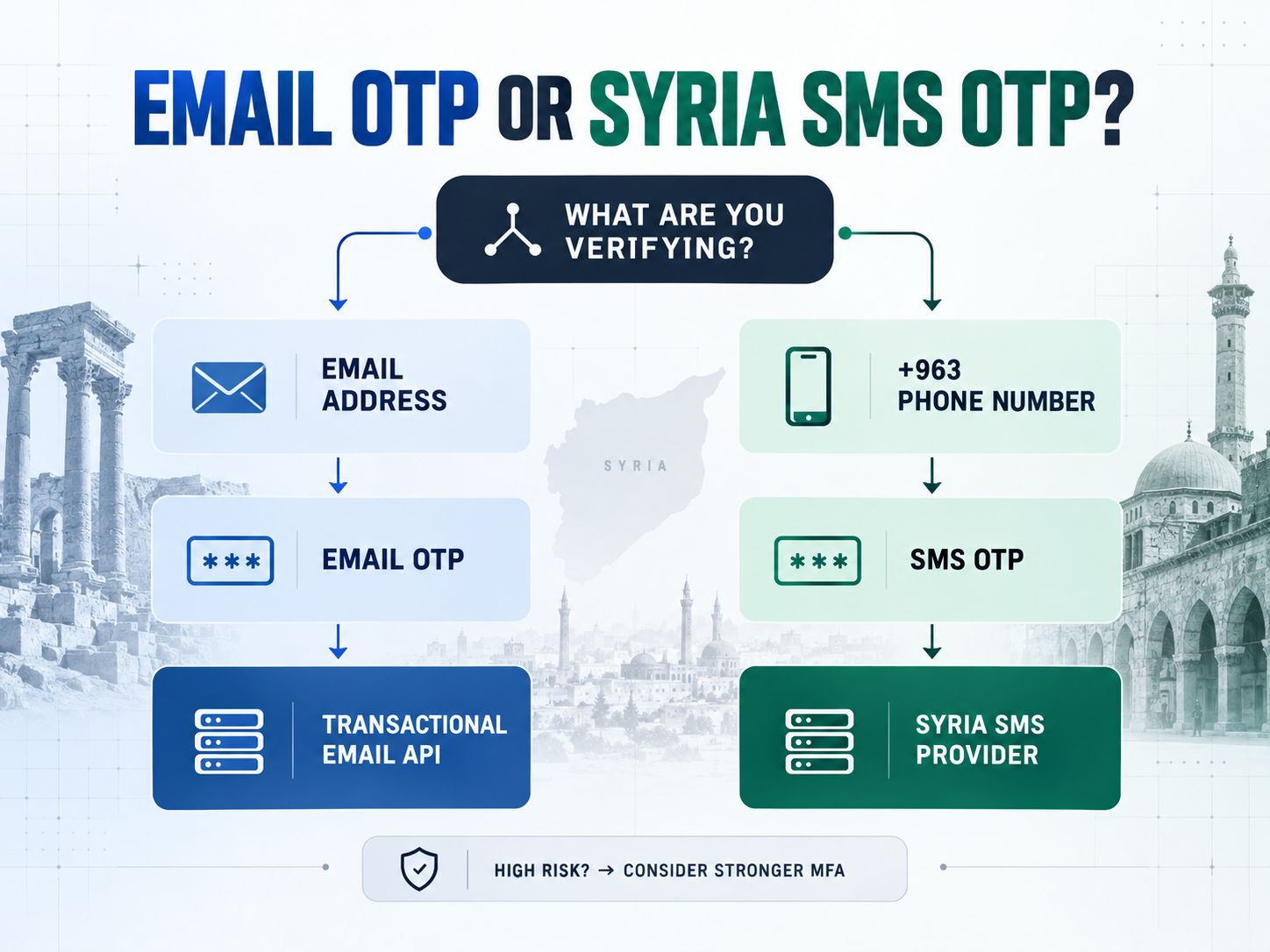
Email OTP vs. Syria SMS OTP
Email OTP verifies access to an inbox. SMS OTP verifies access to a telephone number.
If a user signs up with [email protected], your application needs an email provider capable of delivering transactional authentication messages.
If the user signs up with a Syrian mobile number beginning with +963, your application needs access to a messaging route that currently reaches Syrian networks.
A provider that is excellent at email delivery cannot automatically verify Syrian phone ownership. Likewise, a Syria SMS gateway is unnecessary if all you need to confirm is an email address.
Use email OTP when:
- Email ownership is what matters.
- You don’t need to confirm a mobile number.
- Cost needs to remain low.
- International telecom routing would add unnecessary complexity.
Use SMS OTP when:
- The phone number itself must be verified.
- Phone-based login is part of your application.
- Users depend on mobile verification.
- Your product has a legitimate reason to bind accounts to phone numbers.
This is also a good point to evaluate your broader authentication design with SafeNetworkHub’s Application Security Best-Practices Checker .
Best Free Options for Email OTP
For actual email OTP, a transactional email service with a free allowance is normally more relevant than a Syria-specific gateway.
Current free transactional-email comparisons include services such as SMTP2GO, SendPulse, Brevo, Mailtrap, Maileroo, MailerSend, Mailjet and Postmark.
Examples of currently reported free allowances include:
| Provider | Current reported free allowance* |
|---|---|
| SMTP2GO | 1,000 emails/month |
| SendPulse | 12,000 emails/month |
| Mailtrap | 4,000 emails/month |
| Maileroo | 3,000 emails/month |
| MailerSend | 500 emails/month |
| Brevo | 300 emails/day |
| Postmark | 100 emails/month |
*Free tiers change. Confirm the provider’s current plan before designing your production budget.
These figures come from EmailToolTester’s August 2026 transactional-email comparison , which is one of the two external references used in this article.
For OTP specifically, quota is only part of the decision. You also need:
- Fast transactional delivery
- API or SMTP access
- Domain authentication
- Useful delivery logs
- Acceptable account/use-case policies
- Reasonable retry behavior
- Protection against abuse
Before sending production authentication emails, check your domain’s SPF, DMARC, MX and supported transport controls with the Email Security Checker and, for a deeper review, the Email Security Protocol Assessment .
Can You Build the OTP Logic Yourself?
Yes. The OTP engine and the message-delivery provider do not have to be the same service.
Your backend can generate a code, track its expiration and verification state, and then hand the email to an SMTP/API provider.
A simple flow looks like this:
- User requests verification.
- Server validates the request.
- Server creates a cryptographically secure OTP.
- Server stores only the verification information it needs.
- Email provider delivers the message.
- User submits the code.
- Server validates it.
- Code is invalidated after successful use.
This architecture gives you control, but that control comes with responsibility.
You must handle expiry, replay prevention, request throttling, guessing attempts and secure storage correctly. The Interactive App Security Checklist is useful for reviewing the authentication and secrets-management side of that implementation.
What If You Actually Need SMS OTP in Syria?
Then country-specific route availability becomes the main issue.
Several providers currently publish Syria-specific SMS or OTP information. Based on information available on October 4, 2026, this is the shortlist I would investigate first:
| Provider | Current public Syria signal | Free/test entry | My reason for considering it |
|---|---|---|---|
| EasySendSMS | Dedicated Syria gateway and OTP support | 15 trial SMS credits advertised | Straightforward first route test |
| UniMatrix | Syria OTP support and published pricing | Test-message option | Most transparent pricing of this group |
| SMS.to | Syria messaging/API page | Trial advertised | Developer-oriented SMS API |
| Messaggio | Syria carrier pricing and OTP use case | Free account | Worth comparing where multi-channel tools matter |
| Rasel | Syria-focused SMS/OTP material | Account/trial dependent | Interesting for multi-channel verification |
| Twilio | Syria SMS blocked | Not applicable for +963 SMS | Exclude from current Syria SMS shortlist |
This table does not rank delivery quality. We have not independently measured delivery across Syrian carriers.
That’s intentional.
A provider’s country page tells us that the company currently advertises the route. It does not prove what percentage of OTPs will reach your specific users or how quickly they will arrive.
EasySendSMS: Best Starting Point for a Small Route Test
EasySendSMS is useful because it currently advertises both Syria OTP messaging and 15 free SMS trial credits.
That makes it practical for an initial integration test before purchasing a larger balance.
Its current Syria material covers OTP, notifications, transactional messaging, delivery reporting and API access.
For authentication, I would test the provider’s premium/time-sensitive route rather than assuming the cheapest route is suitable.
A cheap OTP that arrives after the user has abandoned the login screen has little practical value.
UniMatrix: Best for Transparent Published Pricing
UniMatrix is currently the easiest provider in this group to price before creating a larger test.
Its Syria page lists:
US$0.1128 per SMS
and currently shows the same published transactional price for Syriatel, MTN, Syrian Telecom and an “Others” category.
The service explicitly lists OTP SMS among its supported Syria message types.
That does not make it automatically better than every competitor. It simply gives you clearer information before testing.
Pricing can change, so check the live provider page before budgeting significant volume.
What About SMS.to, Messaggio and Rasel?
They are better treated as additional candidates than automatic winners.
SMS.to publishes Syria-related SMS API material and advertises a trial.
Messaggio currently lists OTP as one of its Syria messaging use cases. Its published estimated pricing is considerably higher than UniMatrix’s current advertised figure, with separate prices shown for MTN and Syriatel.
Rasel is interesting if you expect to combine multiple verification channels rather than relying entirely on SMS.
Instead of repeating essentially the same provider description five times, the better approach is to test the candidates against the same criteria.
Does Twilio Currently Work for Syria SMS OTP?
No. Twilio currently says SMS messages to Syrian recipients are blocked.
This is the most important outdated recommendation to watch for.
Twilio states that it stopped supporting SMS delivery to Syria effective September 15, 2025 and that subsequent Syria SMS traffic is blocked.
You can verify that directly in Twilio’s current Syria SMS guidelines .
That means a tutorial published before September 2025 may still contain technically correct Twilio code while being operationally useless for a Syrian destination today.
Never treat an old API tutorial as proof of current country availability.
Didn’t U.S. Policy Toward Syria Change?
Yes, but legal policy and an individual provider’s availability are two different questions.
The U.S. Treasury says the broad Syria sanctions program ceased effective July 1, 2025, while separate targeted restrictions remain applicable to certain actors and activities.
That change does not require every communications company to open or reopen Syria.
Twilio’s continued Syria block illustrates the difference clearly.
So for a production project, ask two separate questions:
Is my proposed use legally and contractually permitted?
Does my chosen provider actually support the destination today?
For security and governance around a production application, the Security Controls Assessment can help you examine whether the surrounding controls are actually implemented rather than assumed.
Free OTP Email Service API Syria for Android
For Android, keep reusable provider credentials on your server—not inside the APK.
A safer architecture is:
Android App → Your Backend → Email/SMS Provider → User
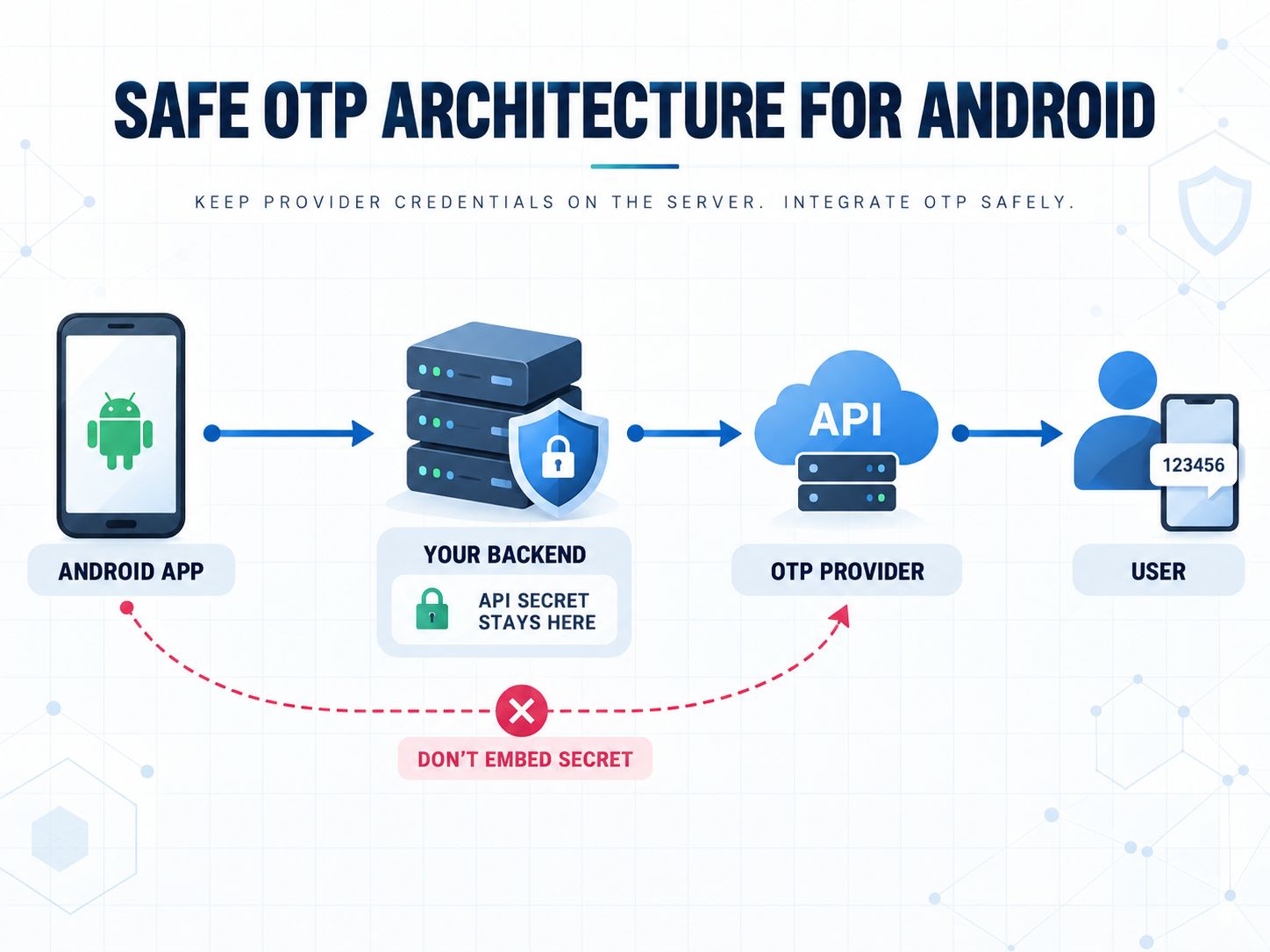
Your Android application sends a request to your backend. Your backend handles sensitive provider credentials and decides whether a verification attempt is valid.
A practical flow is:
- User enters an email or phone number.
- App sends the identifier to your API.
- Server validates and rate-limits the request.
- Server generates an OTP or calls a managed verification service.
- Delivery provider sends the message.
- User enters the code.
- App submits the code to your backend.
- Server verifies it.
- Successful OTP is invalidated.
Do not let the client application decide whether verification succeeded.
If you are designing the wider mobile/API security policy, the Application Security Policy Generator provides a structured starting point, while the OWASP Top 10 Web Security Audit Checklist can help check common application-layer weaknesses.
What Security Controls Does an OTP System Need?
A six-digit code is not a security system by itself.
The surrounding controls determine whether OTP verification meaningfully improves security.
At minimum, consider:
- Cryptographically secure OTP generation
- Short expiration
- One-time use
- Verification-attempt limits
- Request rate limiting
- Resend cooldowns
- Replay prevention
- Server-side verification
- Secure secret storage
- Generic failure messages where enumeration is a risk
- Abuse monitoring
- Carefully designed recovery paths
One subtle bug is especially common: allowing several recently generated OTPs to remain valid simultaneously.
Suppose the user presses Resend three times.
Are all three codes still usable?
If so, you’ve unintentionally increased the attacker’s guessing window.
A better design normally establishes a clear policy for whether issuing a new code invalidates the previous one.
For a broader security check, use the Security Best-Practices Checker .
Passwords and OTPs Solve Different Problems
An OTP does not make weak or reused passwords harmless.
If your product still supports password authentication, encourage users to create unique credentials. SafeNetworkHub’s Password Generator creates random passwords locally in the browser, while the Password Strength Checker evaluates common weaknesses without transmitting the entered password.
For higher-value accounts, consider whether passkeys or authenticator-based MFA would provide stronger protection than relying on SMS alone.
What Does “Free” Actually Mean?
For this market, “free” usually describes the entry point—not unlimited production delivery.
It may mean:
- Free account registration
- Trial balance
- Several test SMS messages
- A recurring free email allowance
- Development sandbox
- Free API access with paid delivery
- Open-source OTP software
Email providers can sustainably offer relatively generous free tiers because the economics differ from international SMS termination.
SMS sent to a real mobile network has real downstream costs.
That is why the useful business metric is not:
“How many messages are free?”
It is:
“How much does one successful verification cost me?”
If Provider A charges less per SMS but frequently delivers after your OTP expires, the nominally cheaper provider may produce the higher real acquisition or login cost.
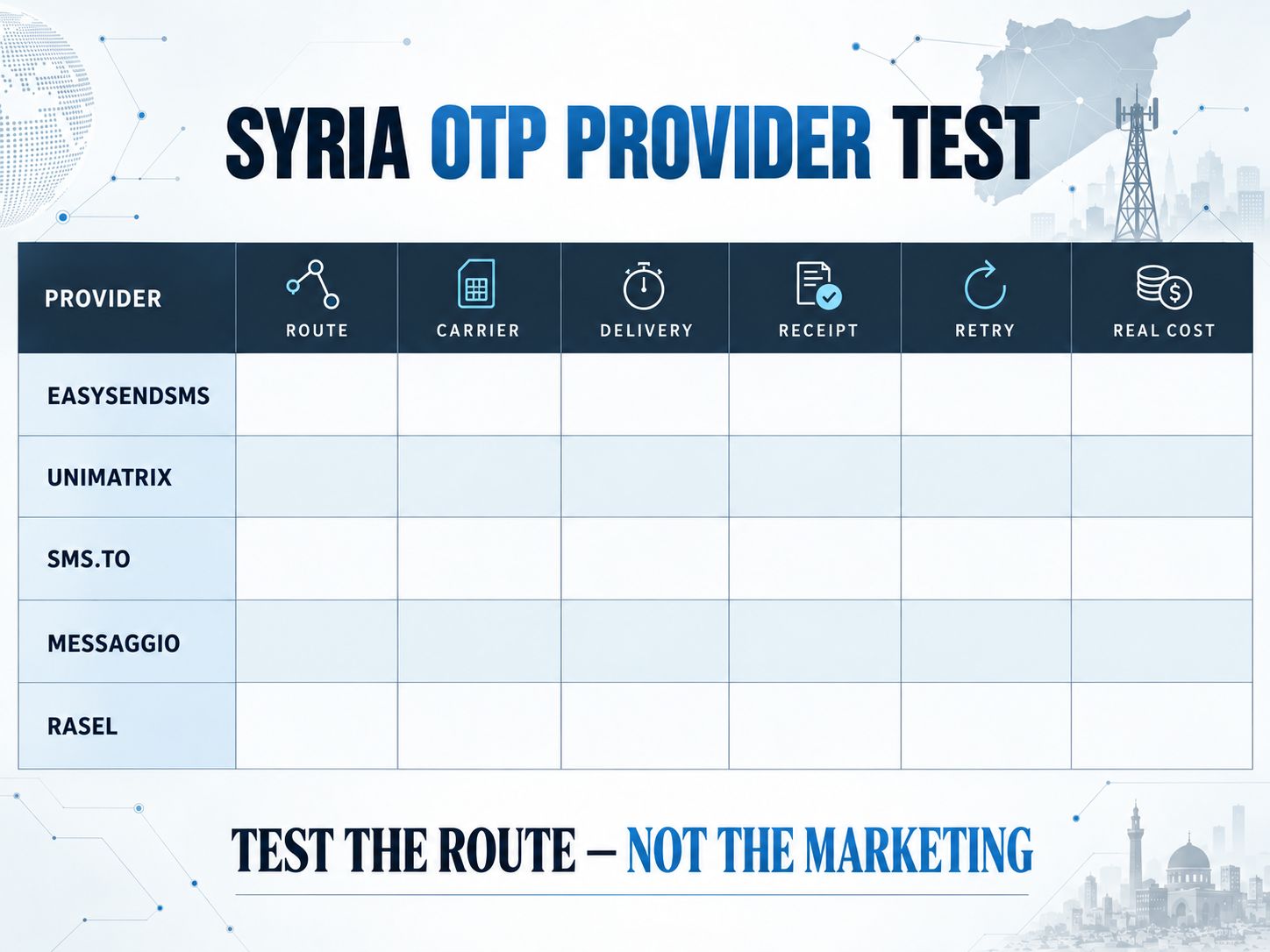
How I Would Test a Syria OTP Provider
I would not approve a provider after one successful test message.
Use a repeatable test sheet and record the result rather than relying on memory.
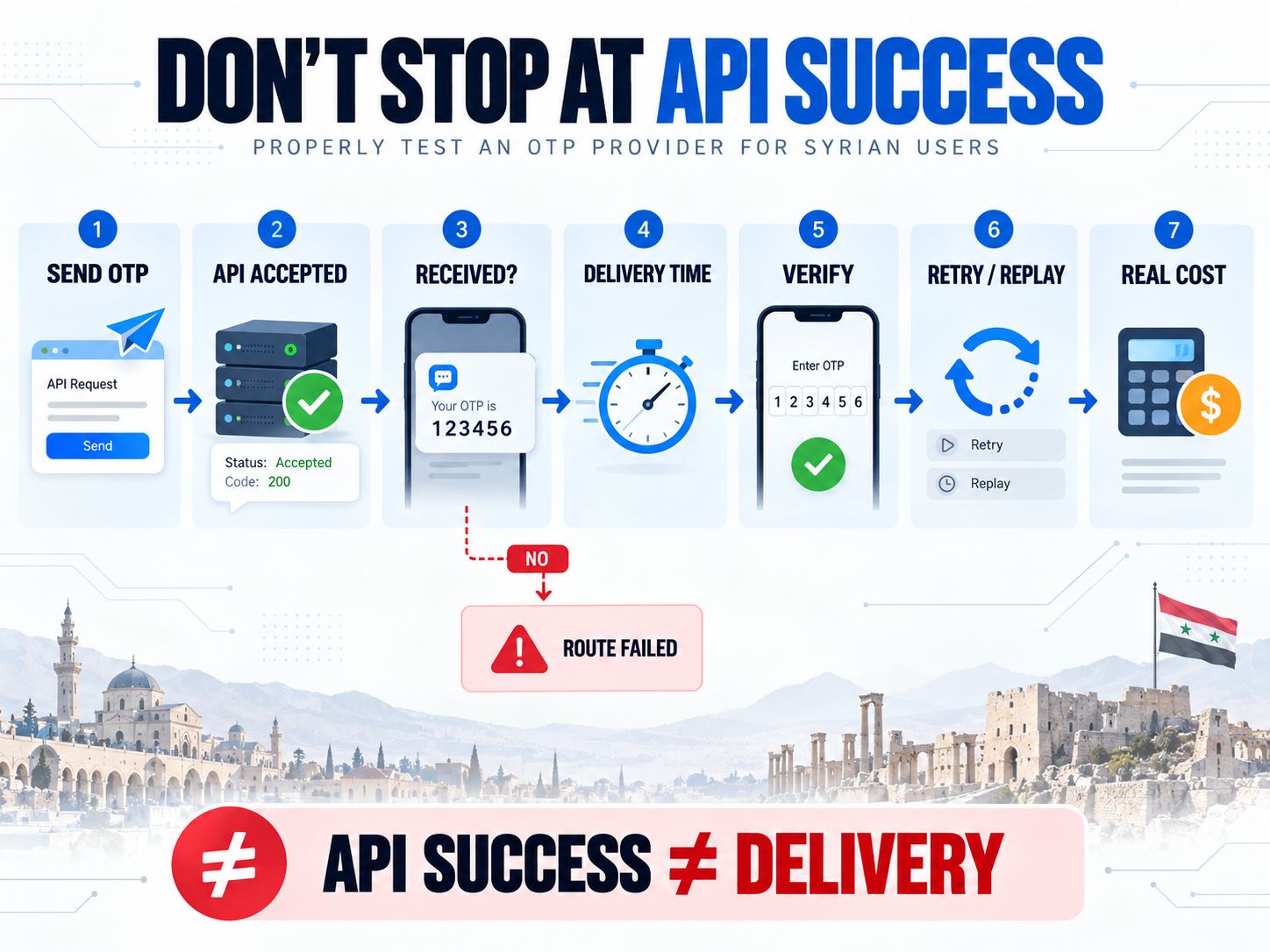
| Check | Question to answer |
|---|---|
| API acceptance | Did the API accept the request? |
| Real delivery | Did the handset actually receive it? |
| Latency | How long did it take? |
| Carrier | Which network was tested? |
| Delivery receipt | Did the provider’s status match reality? |
| Expiry | Was an expired OTP rejected? |
| Resend | Did issuing a new OTP affect the old one correctly? |
| Replay | Was a used OTP rejected? |
| Abuse control | Were excessive attempts throttled? |
| Actual cost | What did a successful verification really cost? |
Repeat the test at different times and, where legitimately available to you, across the networks your audience actually uses.
A successful API response is not the same thing as successful delivery.
That one distinction can prevent a lot of bad provider decisions.
Our Decision Framework
Instead of naming one universal “best” provider, use these three questions.
1. What are you verifying?
Email address → choose a transactional email/API service.
Syrian phone number → choose a provider with a current +963 route.
2. Are you testing or operating at production scale?
Testing → prioritize free allowance, easy integration and observability.
Production → prioritize real delivery results, latency, support, predictable pricing and fallback planning.
3. How costly is authentication failure?
For a low-risk newsletter account, email verification may be entirely adequate.
For a higher-risk application, you may need stronger MFA or phishing-resistant authentication rather than treating SMS OTP as the final security layer.
That is the decision I would make before comparing provider dashboards.
What We Verified—and What We Didn’t
For this article, current provider and regulatory pages were checked again on October 4, 2026.
We verified that:
- Twilio still documents Syria SMS as blocked.
- UniMatrix currently publishes Syria OTP availability and US$0.1128 SMS pricing.
- EasySendSMS currently advertises Syria OTP messaging and 15 trial SMS credits.
- Messaggio currently advertises Syria OTP use cases and publishes estimated operator pricing.
- Free transactional-email allowances still exist across several providers.
We did not independently send OTPs through every service to Syrian handsets.
For that reason, this article does not claim that one provider has the highest delivery rate, fastest latency or best Syrian carrier coverage.
Those are exactly the facts you should establish with your own controlled test before production.
Which Option Would I Choose?
For email OTP, I would begin by testing a reputable transactional email provider with a recurring free allowance and good delivery visibility. SMTP2GO, SendPulse and Mailtrap are reasonable names to include in that initial comparison.
For Syrian SMS OTP, I would begin testing EasySendSMS and UniMatrix because their current public information makes initial evaluation relatively straightforward. I would then compare SMS.to, Rasel and Messaggio if pricing, routes, support or multi-channel requirements justify it.
I would not choose Twilio for Syria SMS today , because its own documentation says Syrian destinations are blocked.
The final provider decision should come from your test sheet—not this article, a marketing claim, or a provider’s homepage.
FAQ
What is the best free OTP email service API for Syria?
If you literally need email OTP, use a transactional email API with a suitable free allowance. A Syria-specific telecom provider is generally relevant only when you are sending OTPs to Syrian phone numbers.
Is there an unlimited free Syria SMS OTP API?
I found no credible basis for treating unlimited production SMS delivery to Syria as genuinely free. Expect trials, credits or test messages rather than unlimited carrier delivery.
Does EasySendSMS support OTP in Syria?
Its current Syria page advertises OTP messaging and 15 free SMS credits for testing.
What is the current UniMatrix Syria SMS price?
On October 4, 2026, its public Syria pricing page listed US$0.1128 per SMS across the displayed Syrian carrier categories. Check live pricing before deployment.
Does Twilio work for SMS OTP in Syria?
No, according to Twilio’s current documentation. It stopped supporting Syria SMS delivery effective September 15, 2025.
Can I send email OTP to users in Syria?
Email OTP does not depend on Syrian mobile-carrier routing in the way SMS does. You still need to verify that your chosen email provider permits your account, audience and use case.
Can I use an OTP API in an Android app?
Yes, but reusable provider secrets should generally remain on your backend. Let the Android client request verification through your server.
Is SMS OTP secure enough?
That depends on the risk level. SMS OTP can provide useful verification, but it has known limitations. Higher-value accounts may benefit from stronger phishing-resistant authentication.
How long should an OTP remain valid?
There is no universal number that fits every system. Keep the window short, measure actual delivery time, and balance usability against the risk of a longer attack window.
What should I test before choosing a Syria SMS provider?
At minimum: delivery to the relevant carriers, latency, delivery receipts, retry behavior, OTP expiry, replay protection, rate limits and actual cost per successful verification.
Final Takeaway
The hardest part of finding a free OTP email service API for Syria is not writing the API call.
It is identifying the correct problem.
If you’re verifying an email address, compare transactional email providers.
If you’re verifying a Syrian +963 phone number, test providers that currently advertise an active Syria route.
And if authentication matters enough to protect something valuable, don’t stop at whether the provider successfully accepted your API request. Test whether users actually receive the code, whether expired and reused codes fail correctly, and whether your application can withstand repeated verification attempts.
That is the difference between an OTP feature that exists and an authentication system you can actually trust.
Written by: Md Zubayer Al Hasan
Have you recently tested email or SMS OTP delivery for Syrian users? Share the provider, channel and what you observed in the comments. Real delivery experience is more useful to other developers than another marketing claim.
Share This Network Security Guide
Help IT professionals, network engineers, and students strengthen their cyber defense.
Zubayer Hasan
LinkedIn Profile →Md Zubayer AL Hasan is the lead cybersecurity platform architect and security researcher at SafeNetworkHub. Dedicated to zero-knowledge cryptography, infrastructure vulnerability auditing, and building accessible privacy tools.
0 Comments
No comments yet
Have a question or insight about this network security guide? Be the first to share your thoughts!
Write the first comment →