
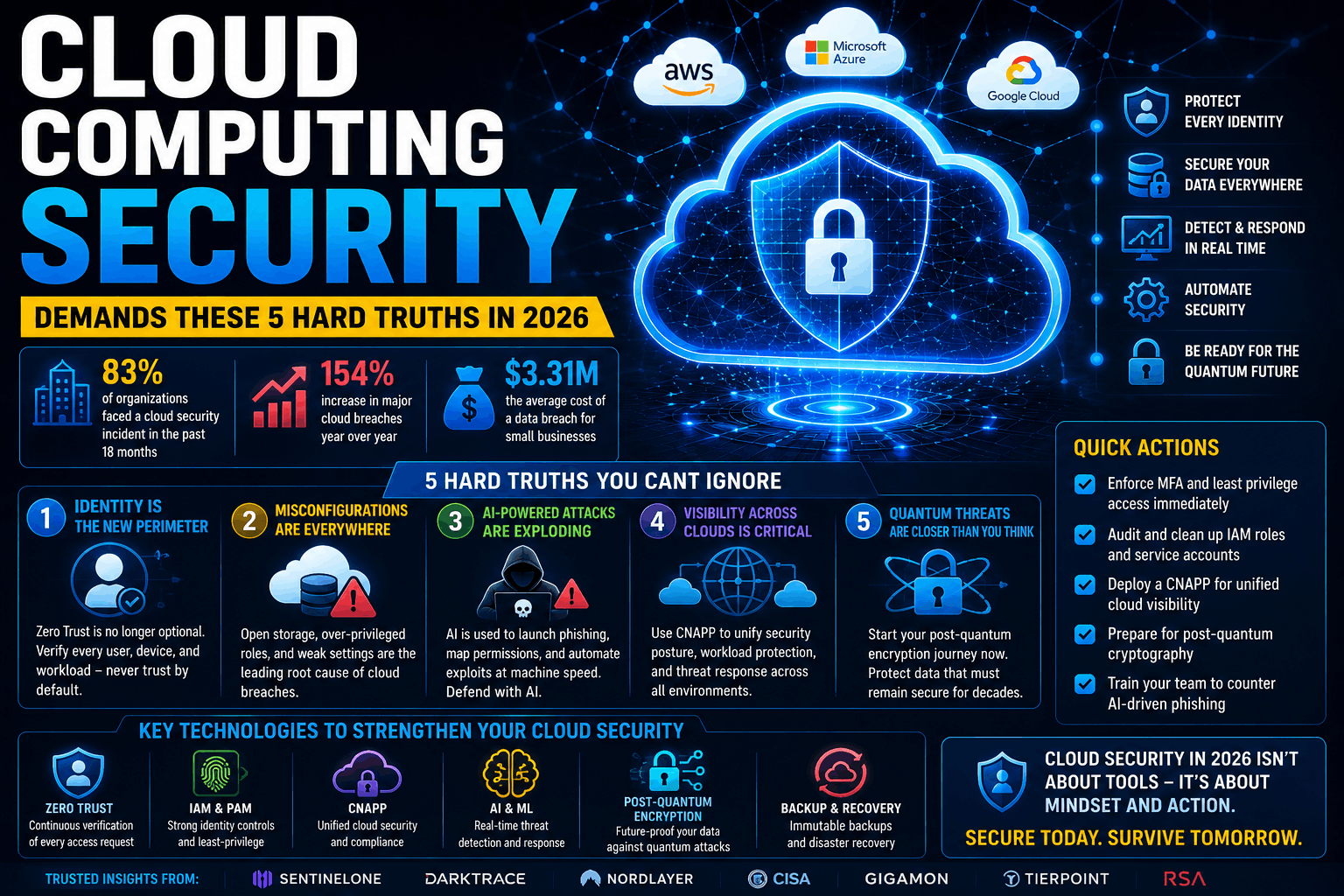
Here’s a stat that stops most IT leaders in their tracks. Somewhere around 83% of organizations faced at least one cloud security incident in the past 18 months, with major breaches skyrocketing 154% year over year. Worth pausing on that one. If you think your cloud environment is safe mainly because you migrated to; hmm, let me put it differently, a reputable provider, you might be living with a false sense of security.
Cloud computing security isn’t just about checking a compliance box. It’s about confronting a wave of misconfigurations. More constantly than not, i’ve spent the last few years helping companies tighten their cloud defenses, and the one pattern I’ve seen repeat itself is this. Organizations that treat cloud security as an extension of their on-premise tools get burned. Hard.
The upcoming truths might sting. They’ll give you a roadmap to a genuinely hardened posture.
Quick Action–Move to identity-first security — stop relying on network perimeters. If you do nothing else, enforce MFA and privilege least-access right now.
- Audit your IAM roles ruthlessly. I’ve seen organizations with 10,000+ service accounts that nobody has reviewed in years. That’s a disaster waiting to happen.
- Deploy a cloud-native security platform (CNAPP) that unifies visibility across all your cloud accounts. Industry figures point to a 40% boost in threat visibility when you embed security into infrastructure.
- Begin your post-quantum cryptography transition plan. Financial and healthcare sectors are already swapping RSA for lattice-based algorithms. Don’t be the last one holding decryptable data.
- Retrain your team to think about AI as both defensive and offensive. Your phishing simulation program must account for AI-generated spear-phishing that’s indistinguishable from human writing.
TL; DR
- 83% of organizations reported cloud breaches recently; big incidents surged 154%, with IAM misconfigurations and AI-powered phishing driving the spike.
- Zero Trust, CNAPP, and post-quantum encryption have become non-negotiable; identity-first controls and unified visibility reduce risk dramatically.
- You can protect your environment by enforcing least-privilege access, deploying AI-driven detection, and preparing for quantum threats now.
Table of Contents
- What Is Cloud Computing Security in 2026?
- The Data That Should Keep You Up at Night
- Identity Chaos and AI-Powered Attacks: The Double Threat
- How Zero Trust, CNAPP, and Quantum-Safe Encryption Fix the Foundations
- People Also Ask
- Conclusion
What Is Cloud Computing Security in 2026?
Cloud computing security in 2026 is the integrated set of controls, policies. Worth pausing on that one. Technologies designed to protect cloud-based workloads, data, and identities from unauthorized access, breaches, and misuse. Unlike older perimeter-focused models, it now revolves around continuous authentication. Automated threat detection, and encryption that can withstand future quantum attacks.
The shift is enormous. It’s catching quite a bit of teams off guard. Stick with me here; this pays off.
Then again, i remember walking into a client’s war room — which is why after a S3 bucket had been publicly accessible for about six months.
Still, no one noticed until a third-party researcher flagged it. That kind of misconfiguration still accounts for. I mean, a huge share of incidents, according to Darktrace. Clean and simple, and it’s the easiest vulnerability to address, yet the hardest to keep fixed at scale.
What’s changed in 2026 is that we can no longer treat cloud security as a static checklist. It’s a living, breathing discipline that must evolve with every new API, container, and serverless function.
Why has cloud security become so much harder than traditional on-premise security?
Within this context, because the attack surface exploded. In a standard data center. You owned the hardware, the hypervisors, and the network gear.
As it turns out, in the cloud, you’re juggling dozens of services from multiple providers — each with its own IAM grammar, logging format, and default settings.
About 88% of organizations now run in hybrid. Or multi-cloud setups, so the complexity multiplies rapid. Worth pausing on that one. You’re not just securing a perimeter; you’re securing identities. APIs, and data flows that span continents and cloud providers.
That leads us to the raw data that should make every stakeholder lean in.
The Data That Should Keep You Up at Night
From 2024 to 2025, the percentage of organizations reporting big breaches jumped from 24% to — well, actually, 61%, and that’s not a gradual uptick; that’s a close to 154% surge in one year. Puts things in perspective, and across an 18-month window. 83% experienced at least one (more on that later) cloud security incident. Not exactly what you’d expect, and the numbers come from SentinelOne’s extensive survey, and they paint a clear picture: the assumption that cloud providers handle all security is a dangerous dream.
What’s actually causing these breaches? Misconfigurations.
They remain the single most common entry point. Think S3 buckets left open, overprivileged IAM roles. Or API endpoints exposed without authentication.
Going back a bit, it sounds trivial, but when you manage thousands of cloud materials across AWS, Azure, and GCP, the volume of settings is inhuman. A single forgotten checkbox can expose an entire customer database.
That’s the reality 70% of organizations face: they rate identity and access management as their top risk mostly since an overprivileged account is a ticking time bomb.
Still, bottom line on that: blocksep matters. In practice, and the attacks are no longer just about data theft.
Yet, ransomware campaigns have morphed into multi-stage operations that exfiltrate data first. Then encrypt, then threaten to leak.
Attackers use AI to map permission paths, and automate vulnerability discovery. It’s a far cry from the spray-and-pray tactics of five years ago.
Across the board, but here’s the part that genuinely worries me: the convergence of IAM chaos, and AI-powered attacks is creating a new class of threats that most organizations aren’t yet equipped to handle.
Identity Chaos and AI-Powered Attacks: The Double Threat
Identity sprawl has gotten completely out of control… i’ve audited environments where 60% of service accounts hadn’t been rotated in three years.
Temporary credentials were anything but temporary. Nine times out of ten, the attack surface is no longer just user accounts; it’s machine identities. Kind of surprising, right? In the end, cI/CD pipelines, and serverless functions that inherit permissions in ways nobody through and through documented.
You’ll want to remember this for what’s coming next.
Now, now layer AI on top. By the end of 2026, AI-powered phishing is projected to exceed 42% of all global intrusions, so generative models can craft personalized spear-phishing emails that mimic a colleague’s writing style down to the punctuation. That’s a significant gap. I recently saw a simulation… as it turns out, where an AI-generated message from ‘the CFO’ convinced three-quarters of a test group to (and rightly so) approve a wire transfer.
In many cases. What this means is attackers also use AI to map AWS IAM trust relationships in seconds. Identifying the one overprivileged role that gives them a path to the crown jewels.
What makes AI-powered cloud attacks so different from traditional hacking?
They scale mercilessly. A human attacker might test a hundred misconfigurations in a day.
An AI-powered script can test tens of thousands in an hour. Learning from each try. This velocity compresses the window between breach.
Impact from days to minutes. Conventional SIEMs can’t keep up, which is why, so many security teams are drowning in false positives while real alerts slip through.
Going back to what was covered earlier, actually, let’s put that more precisely. Legacy security tools generate an alert every time a new user accesses a S3 bucket, but they can’t distinguish between a legitimate data scientist and a malicious actor who’s already pwned a session token. That contextual blindness is the root of alert fatigue.
It’s exactly what modern cloud-native security platforms is built to fix.
The solution isn’t to abandon cloud, and it’s not to (depending entirely on the context) buy more point pieces. It’s to rebuild your security architecture around a few foundational shifts.
How Zero Trust, CNAPP, and Quantum-Safe Encryption Fix the Foundations
*Zero Trust architecture has gone from buzzword to boardroom mandate. But the pattern holds more often than not. What this means is as SentinelOne notes, because it replaces the brittle perimeter model with identity-first controls that continuously authenticate every single interaction. No more implicit trust just because a device is on the office network. Yet, every API call, every database query, every user login is challenged.
Now, a practical first step is deploying a CNAPP (Cloud-Native Application Protection Platform). Now flip that around. Now flip that around. It unifies workload protection, posture management.
Under normal conditions, and runtime defense across AWS, Azure, GCP, and on-premise environments. Organizations that embed cloud-native security into their infrastructure see up to 40% higher threat visibility. Not exactly what you’d expect. That jumped out at me too.
According to NordLayer’s 2026 analysis. Make of that what you will. That’s not a marginal gain. It’s the difference between catching a crypto miner in three minutes instead of three months.
Even the best identity controls and visibility won’t help. If the encryption used to protect your data today can be broken tomorrow.
But here’s the thing – that’s where post-quantum cryptography enters the picture. Financial and healthcare regulators are already pushing firms to migrate to — you know what, lattice-based (at least in many practical scenarios) protocols that resist quantum decryption.
What this means is the so-called “harvest now. Decrypt later” threat is real: an adversary captures encrypted data now. You could say if you’re in a sector with regulated data, 2026 is the year to start your PQC proof of concept.
Which cloud security framework gives the best return on investment right now?
A unified platform approach, usually combining SSE (Security Service Edge). And SASE (Secure Access Service Edge). Hang on – there’s more — delivers the strongest ROI because it slashes tool sprawl and delivers consistent policy (a detail often overlooked) enforcement across hybrid environments.
Instead of managing five different dashboards for firewall, CASB. ZTNA, DLP, and SWG, you consolidate under one roof. Yet, this is especially critical for the at least 88% of organizations juggling hybrid or multi-cloud setups, simplicity reduces misconfigurations, and that alone can cut breach risk dramatically.
- Enforce phishing-resistant MFA everywhere — ditch SMS-based codes and deploy FIDO2 hardware keys or biometrics for all privileged accounts.
- Implement continuous IAM audits — use automated tools to revoke unused permissions daily; treat overprivileged roles as critical vulnerabilities.
- Deploy a CNAPP with runtime visibility — integrate it into your CI/CD pipeline so misconfigurations are caught before production, not after.
- Launch a post-quantum cryptography pilot — start with data classification, then test lattice-based algorithms on a low-risk internal application.
- Simulate AI-driven attacks — retool your red team exercises to include generative phishing and automated permission mapping scenarios.
Now, let’s address the questions I hear most constantly; when I talk to IT teams about cloud security.
People Also Ask
What percentage of cloud breaches are caused by misconfigurations?
While exact figures vary. Industry consensus puts misconfigurations as the, or, better put, leading cause, far ahead of software vulnerabilities. Around 70% of organizations cite IAM misconfigurations as their top risk. Worth pausing on that one. And a 2025-2026 survey showed that nearly 83% of organizations experienced a cloud incident, with the majority traced back to settings errors like public storage buckets. It’s the silent epidemic.
Is Zero Trust really necessary for small and midsize businesses?
Yes, arguably more so. Smaller teams regularly lack dedicated security staff, so an identity-first model that assumes breach and verifies every ask for can automate protection that a perimeter can’t offer. It might sound familiar. From what we can tell, and Zero Trust architecture scales down better than bulky appliance stacks.
How does AI improve cloud security without adding more alerts?
AI-powered platforms analyze cloud telemetry to spot behavioral anomalies, like a service account suddenly accessing a database it never touched. Before, so they correlate events across logs, reducing false positives and enabling automatic remediation. This cuts alert fatigue bigly. Performance speaks. Turning a flood of noise into a few high-signal incidents.
What exactly does CNAPP replace in a traditional security stack?
A CNAPP consolidates cloud workload protection (CWPP), cloud security posture management (CSPM)… and often cloud infrastructure entitlement management (CIEM) into one platform. It replaces the need for separate vulnerability scanners, configuration checkers. And runtime agents that don’t talk to each other, giving a single pane of glass across multi-cloud environments.
Are quantum computers really going to break our encryption anytime soon?
Not tomorrow — but the most credible timeline suggests cryptographically relevant quantum computers could appear within 5-10 years. Nothing overly complex. The “harvest now, decrypt later” attack vector, where global adversaries store encrypted data today. Makes the transition urgent for long-lived sensitive data. Regulators in finance and healthcare are already mandating post-quantum preparedness.
Should I push my vendor for SSE/SASE even if I’m still on-premise heavy?
Without a doubt. The key here is that as your hybrid footprint grows, a SASE structure unifies network and security functions. Delivering consistent policies whether a user is in the office or remote.
Unusual, but true. It reduces operational overhead and closes the gaps that appear.
When you bolt cloud security onto a legacy VPN setup.
Conclusion
If you take away one thing, let it be this: cloud computing security in 2026 isn’t about buying more answers; it’s about adopting a actually different mindset. The data speaks for itself.
Fair enough. To some extent. You’ve got to treat identities as the new perimeter. Assume every account is potentially compromised, and architect defenses that are automated. (which works out well in practice) continuous, and quantum-aware. The hard truths we covered aren’t meant to scare you into paralysis.
They’re meant to give you use with your leadership to fund the right initiatives now.
For the average user, start with identity hygiene, then layer on AI-powered detection, then embed CNAPP, then map out your quantum migration. None of this is optional anymore. The organizations that act decisively in 2026 will be the ones that sleep better at night, and frankly, they’ll be the ones that are still in business three years from now, and go make it happen.
🔍 Research Sources
Verified high-authority references used for this article
Share This Network Security Guide
Help IT professionals, network engineers, and students strengthen their cyber defense.
Zubayer Hasan
LinkedIn Profile →Md Zubayer AL Hasan is the lead cybersecurity platform architect and security researcher at SafeNetworkHub. Dedicated to zero-knowledge cryptography, infrastructure vulnerability auditing, and building accessible privacy tools.
0 Comments
No comments yet
Have a question or insight about this network security guide? Be the first to share your thoughts!
Write the first comment →