Business leaders spent years treating data privacy as a box to check. Then 2026 happened, the floor shifted.
States now enforce complete consumer privacy laws. Connecticut slashed its applicability threshold from 100,000 to 35,000 customers. Too early to call. You could say the EU’s AI Act kicked into full enforcement, which is why australia threw automated choosing transparency mandates (at least based on current observations) into the mix.
Then again, hard to ignore those numbers. You’re not just behind, you’re exposed. If your compliance strategy wasn’t overhauled this year.
” That’s exactly the mindset that gets fined. The game has changed, and the pace is punishing, but there’s a path through.
TL; DR
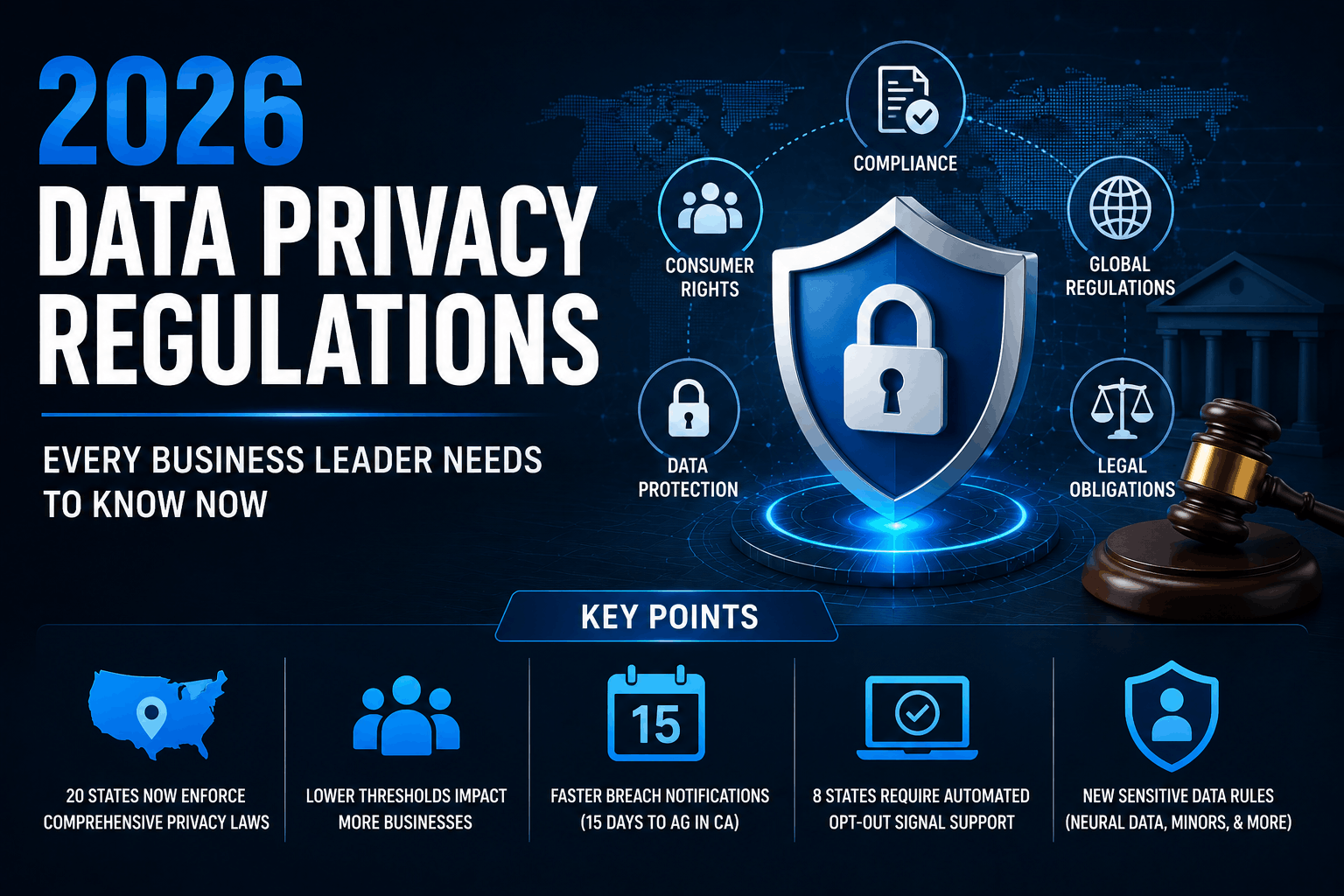
- Twenty states now enforce comprehensive privacy laws, and Connecticut’s lower threshold of 35,000 customers snares mid-size companies that previously thought they were exempt.
- New sensitive data categories (neural data, minors under 16) and compressed breach timelines (15 days to notify Attorney General in California) demand faster, more granular compliance systems.
- Eight states require automated preference signals like Global Privacy Control, while the EU AI Act’s full enforcement and Australia’s transparency rules create new international obligations.
Table of Contents
- What Are Data Privacy Regulations?
- Why 2026 Redefined Compliance Urgency
- How the New Rules Impact Your Day-to-Day
- The Most Expensive Compliance Pitfalls
- International Trends and the Road Ahead
- People Also Ask
What Are Data Privacy Regulations?
Data privacy regulations are laws that govern how organizations collect. Use, store, and share personal information. Arguably the right to opt out of sales, and impose obligations on businesses to be transparent and accountable. Plus, in the United States, there’s no single federal privacy law.
A patchwork of state-level statutes has filled the gap. As of July 2026, twenty states have active complete laws. Many modeled after the Virginia structure, and more are queued up to join.
That patchwork creates complexity. A company doing business in multiple states must work through divergent definitions of sensitive data. Different thresholds for applicability, and varied enforcement mechanisms. The foundational principle is the same.
Respect person autonomy over personal data, but execution details are wildly inconsistent.
Sure enough, understanding the fundamental principles is a prerequisite. Our earlier piece on what data privacy really means today breaks down the evolution and core risks. For now, recognize that these aren’t just IT policies, they’re board-level strategic questions.
Why 2026 Redefined Compliance Urgency
This year didn’t just add a couple more laws, so and let me tell you, it introduced a shift in scope and intensity that caught tons of (which is a critical factor) organizations off guard. The number of states with complete privacy laws jumped to 20, and the nature of those laws tightened.
Circling back for a moment, realistically, from a broader view, the clearest signal is Connecticut, which means on July 1, 2026, it lowered the personal data processing threshold from 100,000 consumers to just 35,000. That one change pulls in thousands of earlier exempt mid-sized companies.
They now must build full privacy programs, risk assessments. Data subject ask for workflows, consent mechanisms, from scratch. The compliance shock is real. Industry data points to that about 73% of affected businesses weren’t totally prepared for the operational load.
California didn’t stand still either. SB 446 imposes a 30-day consumer notice need and a 15-day Attorney General filing deadline for breaches affecting (and the data generally agrees) 500 or more residents. That compressed timeline basically changes incident response planning. Legal and security teams can’t spend weeks investigating; they must move immediately.
For the average user, it’s worth noting that add to that the Delete Act’s centralized data broker deletion system launching August 1. 2026, and you’ve a state that’s forcing systemic change.
Meanwhile, the sensitive data definition expanded across multiple states, and neural data (from brain-computer interfaces), data; wait. Let me rephrase, of minors under 16, and government-issued identifiers now need explicit opt-in consent before collection and processing. Puts things in perspective. Six months ago, these categories scarcely registered on corporate radars. Now they’re hard compliance needs.
How did these changes happen so fast?
The acceleration stems from a mix of public pressure after high-profile breaches, and the simple reality that state legislatures learned from earlier laws. 2026. Following a template that made adoption quicker. Make of that what you’ll. Connecticut’s threshold drop was a legislative amendment.
Not a slow rollout… the speed surprised even veteran compliance professionals, which means the pattern is clear: states are no longer waiting for a federal baseline.
How the New Rules Impact Your Day-to-Day
It’s not just about legal fine print. These rules reshape daily operations. It depends. From how your marketing team runs campaigns to how your IT stack handles data flows. The implications land on multiple departments, and they don’t fit politely.
One thing to note, universal opt-out mechanisms. Eight states now mandate support for Global Privacy Control (GPC) signals. Worth considering. Which brings up an interesting point.
When a user activates a browser-level setting that says “don’t sell my data,” your website must recognize, and honor it automatically. No pop-ups, no manual requests. Miss it, and you’re in violation.
For companies still using basic consent banners. This calls for a backend overhaul.
Mostly, plus, businesses covered by the state’s laws must conduct formal data protection assessments, and for certain entities, independent cybersecurity audits. There’s nuance here, obviously. Think about that. The financial and administrative overhead hits mid-size firms harder than large enterprises.
Then again, Then you have, breach response timelines compress real-world processes. The 15-day AG notification window in California is breathtakingly short. That changes the picture quite a bit. Which is why incident response teams accustomed to a 45-day investigation cycle must now triage (at least in many practical scenarios) and report within two weeks. That jumped out at me too.
That speed demands pre-built playbooks. Dedicated responders, and possibly automated detection tools.
Here, modern AI-driven threat detection systems become must-have for rapid anomaly flagging and immediate containment.
For the average user, fourth. The consent needs for neural data, and minors introduce entirely new categories of personal information to protect. If your company collects any neurotech-related data—or even partners with a wellness app that does, you’re suddenly handling regulated data that most privacy notices didn’t expect. This detail matters more than it might seem right now.
What’s the single biggest operational shift?
Leaders must move from periodic compliance reviews to continuous monitoring. Gone are the days. When you could update your privacy policy once a year. Now, a quarterly or even monthly cadence is necessary to track new state laws. Amendments, and enforcement actions. Build a cross-functional privacy task force that includes legal, IT, marketing, and HR, that’s not a luxury; it’s the only way to catch things like Connecticut’s 35,000 threshold before it bites.
- Audit your customer count — Verify whether you’ve crossed any new state threshold (like Connecticut’s 35,000).
- Deploy GPC support — Update your consent management platform to recognize and honor Global Privacy Control signals.
- Rehearse breach scenarios — Simulate a breach to test your ability to notify consumers within 30 days and AGs within 15 days.
- Map new sensitive data categories — Identify any neural data, minors’ data, or government ID numbers in your systems and classify them.
- Conduct a formal risk assessment — Document data flows and privacy risks, especially for California compliance and upcoming auditing requirements.
The Most Expensive Compliance Pitfalls
By most accounts, real-world experience reveals. Which mistakes cost the most. Not theoretical risks, actual patterns from companies that stumbled.
” Many organizations assume it’s just health or financial information. Now, neural data, precise geolocation, and data of users under 16 fall under that umbrella, which means without dedicated consent flows, you’re processing regulated data illegally. Nine times out of ten. A marketing automation platform that automatically includes minors in behavioral targeting? That’s a lawsuit waiting to happen.
Another risk: treating breach notification deadlines as flexible — in California, the 15-day AG deadline is a pain. That’s not a small shift. Read that again if you need to. Legal teams that treat it as a guideline have already faced penalties.
The solution is clear: automate incident response workflows and maintain pre-drafted notification templates. You also need a solid cloud security framework to cut down on breach likelihood in the first place, especially if your data lives across multiple cloud environments.
Switching focus for a Then there’s, a third, subtler downside. Ignoring the Delete Act’s centralized deletion mechanism. Data brokers, and many companies that don’t think of themselves as brokers—must comply with a one-stop deletion ask for system starting August 1, 2026.
If you buy. Or sell any consumer data, you’re likely covered. Overlooking this can result in noncompliance across thousands of records at once.
“Businesses handling personal data at scale should validate applicability and update notices, rights workflows, and data protection assessment practices,” wrote JD Supra in their January 2026 analysis. The warning still holds.
Is it possible to accidentally violate a new law without knowing?
In most cases, many mid-size firms operate under the assumption that they’re not covered until a threshold is crossed. Connecticut’s 35,000-customer limit means a fast-growing e-commerce brand can become subject to data privacy regulations mid-year without any triggering event other than ordinary growth. Regular applicability scans, at least quarterly, are the only defense.
International Trends and the Road Ahead
What we’ve covered: blocksep matters. States dominated the news.
The rest of the world didn’t stand still. You could say’s not just a tech regulation. It right away ties to data privacy.
You’ll notice that jumped out at me too. The key here is that because AI systems processing personal data must now undergo AI Impact Assessments for high-risk applications. If your company uses AI for hiring, credit scoring, or medical triage, you, actually. Hold on, need to evaluate both privacy and AI risks in a single, integrated assessment.
2026 deadline for transparency in automated decision-making. That changes the picture quite a bit. Any business operating there must explain how algorithms make decisions that affect people. A never-before-seen mandate that echoes GDPR’s right to explanation but with sharper teeth.
This has direct implications for privacy compliance. Because automated decisions constantly rely on personal data profiling.
-based company with shoppers in the EU or Australia must juggle three regulatory regimes that are similar in spirit but diverge in technical needs. Data transfer mechanisms, consent models. And breach notification obligations all layer on top of each other. The cost of fragmentation is high, but the alternative—trying to force a single global standard—often results in gaps. Many multinationals now maintain jurisdiction-precise playbooks.
“The biggest 2026 changes include expanded sensitive-data definitions, neural-data regulation, youth-specific protections, geolocation restrictions, universal opt-out mandates, and new consent UX expectations,” observed Ketch in their state-by-state update. That list alone is a workload indicator.
How do these international rules affect a purely domestic U.S. company?
States. Especially California and Colorado.
The smart move: build privacy. And AI governance structures that expect global norms, not just current local laws; this becomes way more relevant in a moment.
People Also Ask
What’s the difference between data privacy and data security regulations?
Data privacy regulations control how personal information is collected and used (consent. Access rights), while security regulations focus on protecting data from breaches (encryption, access controls). Many modern privacy laws merge both by requiring reasonable security measures and breach notification. Plus, the line has blurred, and compliance now demands both legal and technical controls.
Do all 20 U.S. state laws align with each other?
No. They share common ground—consumer rights to access. And delete, but thresholds, sensitive data definitions, and enforcement diverge… maryland’s strict data minimization need is absent from Florida’s law.
For instance, a national compliance strategy must be modular. And state-precise, not monolithic.
How can a small business cope with so many regulations?
Start with the strictest applicable law (all the time California. Or Connecticut) as a baseline, then layer state-specific addenda. Use automated compliance apps that map needs across jurisdictions. Prioritizing the five states where you’ve the most customers is more effective than trying to master all 20 at once.
Is the EU AI Act really a privacy regulation?
Indirectly, yes. Plus, when an AI system processes personal data, the AI Act’s impact assessment overlaps with GDPR’s Data Protection Impact Assessment. So where does that leave us? Worth considering.
For high-risk AI, you must checked out both. Plus, the practical result is that AI governance is now part of the privacy compliance function in loads of organizations.
What happens if we miss a breach notification deadline?
Penalties vary by state but can include per-violation fines. Mandatory corrective plans, and reputational damage.
Under normal conditions, california’s AG has signaled aggressive enforcement of the 15-day deadline. Backed by research. Beyond monetary risk, delayed disclosure constantly leads to class-action lawsuits and loss of customer trust.
Will there ever be a U.S. federal privacy law?
Discussions continue, but the current political climate makes complete federal legislation unlikely in the near term. So until then, the state patchwork will expand and fragment further. Business leaders should plan for the existing multi-state reality. A major factor. Not wait for a unifying federal solution.
The organizations thriving are the ones that treat data privacy regulations as a continuous operational discipline. Not a seasonal project. They embed compliance into product development. Vendor contracts, and even marketing campaigns.
But does that hold up? The road ahead will demand more of the, wait, let me rephrase, same, more states, more categories of sensitive data, more aggressive enforcement. That’s not fear-mongering; it’s pattern recognition. The pattern says: adapt now or pay later.
🔍 Research Sources
Verified high-authority references used for this article
Share This Network Security Guide
Help IT professionals, network engineers, and students strengthen their cyber defense.
Zubayer Hasan
LinkedIn Profile →Md Zubayer AL Hasan is the lead cybersecurity platform architect and security researcher at SafeNetworkHub. Dedicated to zero-knowledge cryptography, infrastructure vulnerability auditing, and building accessible privacy tools.
0 Comments
No comments yet
Have a question or insight about this network security guide? Be the first to share your thoughts!
Write the first comment →