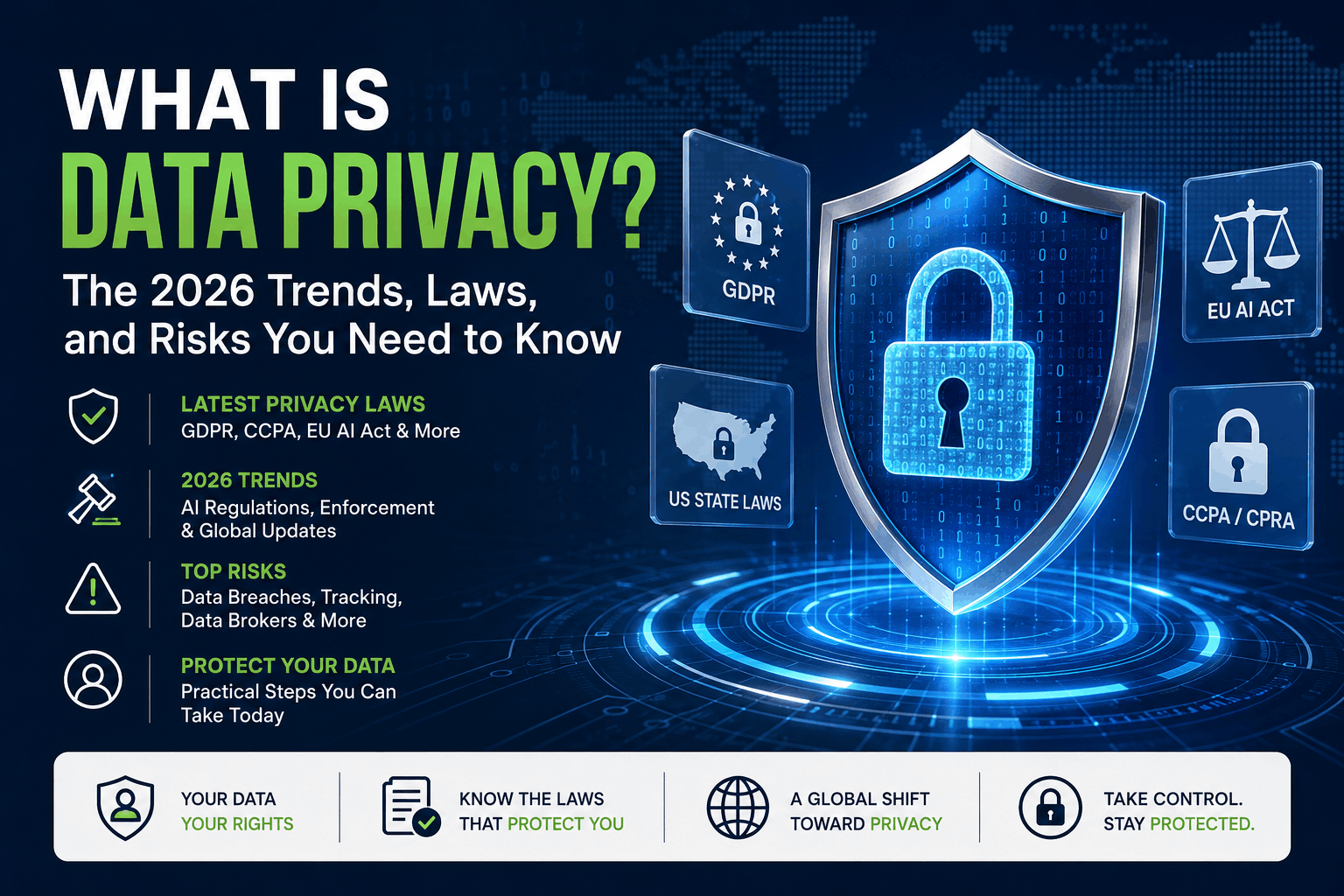
If you’ve ever felt uneasy about how much the internet seems to know about you, you’re not alone. Fair enough. About 82% of internet anyone on the platform express real concern over how their personal data is collected. Make of that what you will. Make of that what you’ll. Probably in the past year alone. Regulatory fines for mishandling data topped €5 billion, and daily breach notifications now exceed 400.
Data privacy, once a niche concern. Has become probably the most big consumer rights battles of our time.
The ways companies gather, store, and use your information are changing rapid. The laws scrambling to keep up are evolving even faster, so this article unpacks exactly what data privacy means in 2026, why it matters to you personally, and what you can do to protect what’s yours.
TL; DR
- Data privacy means you have control over how your personal information gets collected, shared, and used by organizations, backed by a growing patchwork of state, federal, and global laws.
- In 2026, 20 US states have complete privacy legislation, the EU AI Act becomes fully binding, and enforcement actions are accelerating, making privacy not just an ethical choice but a massive compliance mandate.
- Taking a few practical steps, like reviewing app permissions, using server-side tracking controls, and understanding your rights under your local law, can dramatically reduce your exposure to data misuse.
Key Point
- You don’t need to be a legal expert to regain control over your personal data. Start by understanding what data privacy actually means.
- Around 48% of consumers now base purchasing decisions on a company’s privacy practices, so businesses are paying attention, and that leverage is yours to use.
- Knowing which laws apply to you, even as they shift, gives you the power to demand more from every service you interact with.
Table of Contents
- What Is Data Privacy?
- Why Data Privacy Matters More Than Ever in 2026
- How Data Privacy Laws Are Evolving Globally
- Common Misconceptions About Data Privacy
- Practical Steps to Protect Your Data
- The Future of Data Privacy: AI, Enforcement, and Trust
- People Also Ask
- Where Do We Go From Here?
What Is Data Privacy?
Data privacy is the principle that people should, actually. That’s not quite right, decide what personal information about them is collected. For what purposes, and with whom it’s shared. In practice, it means you’ve the right to know. When a website drops a cookie on your browser.
Here’s the thing – how a health app uses your location logs, and whether a data broker can sell your home address to advertisers — which is why wait, there’s more to it. It’s distinct from data security, which focuses on keeping that information safe from breaches; privacy is about control. Which is why a company can have perfect security and still violate your privacy by tracking you without meaningful consent.
The distinction matters mainly because laws like the GDPR and CPRA (more on that later) aren’t just about firewalls. They’re about requiring organizations to be transparent, and to give you genuine choices over your digital self.
Helping think of data privacy as a range of rights. No absolute guarantees. Not a single on/off switch, it. On one end, you’ve the ability to deny collection entirely. On the other, you might allow anonymized sharing for research.
Most of us live somewhere in the middle. Handing over personal details in exchange for services we value. The challenge is that, until recently.
More importantly, we seldom got a real say in the trade-off. The wave of legislation hitting in 2026 is made to rebalance that equation. Not exactly what you’d expect. From the EU’s AI Act to California’s expanded protections for minors.
The legal ground is shifting under the assumption that you deserve to know what’s happening and, when possible, to opt out. In my own work consulting with smaller tech outfits. I’ve seen how many companies had no idea how vast their data collection, or. Better put, practices were until a compliance audit forced them to map every single tracking pixel. That’s the level of detail privacy asks for now.
Why Data Privacy Matters More Than Ever in 2026
Enforcement is no longer a distant threat. It’s the daily reality for thousands of organizations.
GDPR fines surpassed €5 billion in 2025 for the first time; that changes the picture quite a bit.
A achievement that sent a clear signal: regulators have the budget and the will to act. Meanwhile, over 1,970 federal data privacy lawsuits were filed in the US in 2025, you know what. Hard to ignore those numbers. Many of them challenging the use of website tracking technologies that operate without explicit consent.
That’s not a small shift, which means the financial stakes are enormous, but the real reason privacy matters in 2026 is the sheer volume of personal data now being captured by AI systems.
Smart devices, and advertising networks that most the majority scarcely wrap your head around. Without strong privacy protections, you lose not just anonymity, but the ability to make free choices uninfluenced by hidden persuasion algorithms.
In real-world terms, according to a 2026 Station X report, about 82% of internet everyone now say they’re worried about data collection, yet most still click “Accept All” on cookie banners without reading a word. That jumped out at me too. That’s a significant gap. That gap between concern and action is exactly what lawmakers are trying to close. The Protecting Americans’ Data from Foreign Adversaries Act (PADFA), for case in point.
Keep that in mind. Bans data brokers from selling sensitive personal information to countries like China, Russia, and Iran.
That’s a national security measure, but it reflects a broader truth: your browsing habits. It is debatable. Location history, and pick up records can be weaponized. If they fall into the wrong hands. Privacy isn’t just about avoiding nuisance ads anymore; it’s about preventing real harm.
7 times compared to earlier figures. Powered largely by AI-related compliance requirements.
This spending boom reflects a new reality: privacy is no longer a checkbox exercise. It demands technical overhauls, like server-side tagging and data minimization architectures, that at the root change how data flows through a business.
For you as an person. That shift means companies are finally being forced to build systems that respect your preferences by design, not as an afterthought.
How does the EU AI Act change privacy for everyday users?
The EU AI Act, reaching full applicability in August 2026; in most cases, for you, that means AI systems that process your personal data, like automated hiring resources or credit-scoring algorithms. Must now meet strict transparency and risk-management standards, and you’ll have clearer ways to challenge decisions made about you.
Because the Act categorizes AI applications by risk, high-risk systems that could affect your fundamental rights face the toughest oversight. If an AI model denies you a loan. Or flags your behavior as suspicious. The company deploying it must explain the logic in plain terms and offer a pathway for human review.
This is a massive shift from the black-box era. Where algorithms operated with near-total opacity. Now, combined with GDPR’s existing rights, the AI Act gives you a stronger hand when dealing with automated decisions that shape your life.
How Data Privacy Laws Are Evolving Globally
You’ll quickly feel like you’re drinking from a firehose. If you try to track every data privacy law across the world. In 2026, 20 US states now have complete privacy laws.
With eight new state laws dependable by the end of 2025, including Delaware, Iowa, Nebraska, New Hampshire, and New Jersey. Consider this: the result is a complex, fragmented regulatory scene where the rules depend heavily on where you live, where that company is based; and the particular type of data involved.
As far as I know, tighter restrictions on sharing sensitive information, and a clear push toward mandatory transparency.
Probably the most big recent shifts comes from the CCPA amendments that took effect in January 2026. The data speaks for itself. Kind of surprising, right? They classify data of people under 16 as automatically sensitive.
Then again, meaning it gets the highest level of protection. Combined with California’s forthcoming 2027 Digital Age Assurance Act requiring age verification. Hard to ignore those numbers. The state is properly building a digital fence around minors’ information.
If you’re a parent, this means the apps your kids use must start treating their data like toxic material. Handling it with extreme care and with documented consent.
For businesses, it’s a headache, but for families, it’s a long overdue guardrail.
Pay attention to this part. For the most part, and imposing stricter rules around sensitive data, like precise geolocation and biometrics. You’ve probably wondered the same thing.
That tells you. Now, where the regulatory trend is heading: fewer loopholes, not more. Plus, actually, let me put that more precisely: the era of direct carve-outs for political campaigns, small nonprofits, and legacy industries is closing fast.
The legislative philosophy is shifting toward universal protections that don’t evaporate based on the type (at least in many practical scenarios) of organization holding your data.
What’s the catch with all these new state privacy laws in the US?
The catch is fragmentation. Because there’s no single overriding federal privacy law, you get a patchwork where your rights change as you cross state lines, and companies spend enormous resources just figuring out which rules apply, which can slow down real privacy improvements.
A business operating in 20 regulated states might need to (and that implies quite a bit) offer different opt-out mechanisms. As far as I know, so for consumers, that means the same app could supplies solid privacy controls in California, but offer almost none in a state without a law. It’s confusing and inefficient.
It’s one reason why calls for — okay. More accurately, a complete federal bill grow louder each year. Meanwhile, the Federal Trade Commission has ramped up enforcement using its general authority.
Where does that leave us? Federal privacy lawsuits have exploded, with over 1,970 filed in 2025, and honestly, that legal pressure, while messy, is gradually forcing companies to adopt the highest common denominator just to stay out of court.
Common Misconceptions About Data Privacy
What does that mean in practice? A lot of everyone believe once they’ve clicked “Reject All” on a cookie banner. Their data is protected.
That’s dangerously incomplete. Rejecting cookies stops some forms of tracking; but plenty of website technologies, like fingerprinting and server-side data collection, can still (which works out well in practice) identify you with surprising precision.
Another widespread myth is that privacy laws give you a button to wipe your entire digital history. The right to deletion under GDPR. Or CCPA is real, but it’s carve-outs. It needs observation. Companies can keep data needed for legal obligations. Fraud prevention, or internal analytics that don’t impact you individually. It’s not a magic eraser.
There’s also a persistent belief that privacy is only for people who have something to hide. That framing misses the point wholly. Privacy is about maintaining autonomy over your own life — and without it; you lose the ability to explore ideas, speak confidentially, or even shop without being manipulated.
When 48% of internet users now make purchasing decisions based on a company’s privacy practices. Kind of surprising, right?
It’s clear that the market itself is rewarding transparency. If you think about it, choosing a service seeing as it respects your privacy is no different than choosing a restaurant. Because it follows health codes; it’s a basic quality signal.
Practical Steps to Protect Your Data
You don’t need to go off the grid to (though exceptions exist. Naturally) meaningfully improve your data privacy. From what we can tell, start by auditing the permissions you’ve granted to mobile apps: location access.
Contacts, and microphone settings are often left on long after they’re needed. Next, get comfortable with your browser’s privacy controls. Most modern browsers let you block third-party cookies by default, and some, like Brave or Firefox Focus, go further by blocking fingerprinting scripts altogether.
If you manage a website, even a small one, set uping server-side tagging can help you control what data flows to third parties while still measuring performance, a technique that’s gaining serious momentum in 2026.
From a broader view. Another effective step is to take advantage of the data portability rights many laws now grant. You can ask for a copy of your data from services like Google. Or Facebook and then move it to a more privacy-conscious provider. This not only gives you visibility but also encourages competition.
Because companies that lock you in with data silos lose their (a detail often overlooked) grip when switching becomes easy. The EU Data Act, applicable seeing as September 2025.
Sure enough, as it turns out enough. Strengthens this by mandating simpler cloud provider switching. Which (which is a critical factor) trickles down to consumer services. Realistically, not every company makes the process smooth.
Every ask for sends a signal that everyone care.
- Review app permissions monthly — Turn off location, camera, and microphone access for apps that don’t need them daily.
- Enable browser privacy protections — Switch to a browser that blocks trackers by default and regularly clear third-party cookies.
- Submit a data access request — Use your state’s or GDPR’s right of access to see what companies hold on you, then request deletion where possible.
- Opt out of data broker sales — Many states require data brokers to provide a simple opt-out link; exercise that right annually.
- Use server-side tracking if you run a site — Move tag management to your own server to restrict what third parties collect about your visitors.
Is server-side tagging really something a normal person should care about?
Yes, because it directly affects how much of your browsing behavior gets shared with advertisers without your knowledge, but even if you don’t run a website, understanding that server-side tagging exists explains why some sites seem to know you, and before you’ve logged in, and why your data keeps popping up in unexpected places. This becomes way more relevant in a moment.
From a practical standpoint. Server-side tagging shifts data processing from your browser to the website’s own server. Reducing the information that gets sent to third parties like Google or Meta.
For you as a visitor, that means less personal data leaking into the ad setup, and honestly, it’s. Well, actually, not a silver bullet, but it’s one of the few technical trends that actually aligns with user interests. When you see a company bragging about its. Or at least, privacy commitments, check whether they mention server-side controls.
It’s a credible signal that they’re doing more than just cosmetic policy updates.
The Future of Data Privacy: AI, Enforcement, and Trust
We’re entering a period. As it turns out, where privacy enforcement will get more aggressive and more automated.
Regulators are using AI to scan websites for compliance violations, and class-action lawyers are building algorithms to flag would-be privacy harms at scale, and honestly, the EU AI Act’s full onset in August 2026 creates a (which is a critical factor) new enforcement vector. The data speaks for itself. Most likely this layered accountability means companies must combine privacy into their AI development lifecycle from day one.
Not bolt it on later.
You’ll see how this ties into the previous point, Meanwhile, the concept of privacy-first marketing is emerging as (and rightly so) a genuine competitive advantage. About 48% of consumers already vote with their wallets based on privacy, and that number is likely to climb as more people deal with data breaches. Or creepy ad targeting. Arguably and user-friendly consent flows, will earn trust that translates directly into loyalty.
From my perspective, having watched this space for years, the businesses still resisting these changes are making a bet that public apathy will continue, and (which works out well in practice) that’s a losing wager.
A senior privacy officer I recently spoke with described the shift this way:
“We used to treat privacy compliance like a tax. Now we treat it like product quality. If we get it right, it’s a feature our customers actually notice and appreciate.”
Under normal conditions, that perspective is becoming mainstream. As enforcement ramps up and consumer awareness grows, the companies that survive, and thrive will be those that treat privacy as a fundamental design principle, not a legal nuisance. The next few years will likely see consolidation around a few strong (at least in loads of practical scenarios) federal or international standards.
The businesses that already have solid privacy programs (depending entirely on the context) will have a head start. Store this one. It ties everything together later.
People Also Ask
What is the difference between data privacy and data security?
Data privacy is about the rights. And expectations surrounding how your personal information is collected, used, — actually, hold on. And shared, so data security is the technical protection of that data from unauthorized access or breaches. You can have airtight security. And still violate privacy by using the data in ways the user never agreed to.
How does the GDPR affect me if I live in the US?
Nine times out of ten, you also benefit because GDPR has forced major platforms to build stronger privacy controls that eventually reach American audiences.
Are free VPNs safe for protecting my data privacy?
Not usually. Many free VPNs monetize by selling your browsing data.
Which defeats the purpose. If you’re serious about protecting your privacy. Use a reputable paid VPN that’s a proven; okay, more accurately, no-logs policy and is transparent about its corporate structure.
What should I do if I get a data breach notice?
Act fast. Change your password on the breached service. And anywhere you reused it. Enable two-factor authentication, monitor your financial accounts for suspicious activity.
And freeze your credit. If sensitive personal info like your Social Security number was exposed. Stick with me here; this pays off.
Can I really get companies to delete all my data?
You can ask for deletion under laws like GDPR and CCPA, but companies; okay. More accurately, can keep data (at least based on current observations) needed for legal compliance. it’s unpredictable.
Fraud detection, or internal business purposes that don’t directly affect you. It’s not a universal wipe. But it seriously $2 your digital footprint.
Why are cookie consent banners still so annoying?
Within this context, because the rules around consent are fragmented, and loads of companies designed banners to get the most from clicks rather than supplies genuine choice. The European Commission’s Digital Omnibus proposal aims to reduce this friction by narrowing; when consent is required, which could lead to less intrusive banners if adopted.
Where Do We Go From Here?
More often than not, technology. And person behavior are colliding in ways that’ll define the next decade of the internet. The critical key lesson is that you’ve more agency than you might think. Plus, the regulatory tide is turning in your favor, and the workarounds to. Or at least, protect your personal information are (which is a critical factor) more accessible than ever.
Start by understanding your rights under the laws that apply to you… take at least one concrete step this week, whether that’s a permissions audit or a data deletion ask for. When enough everyone exercise their rights. The market shifts permanently toward respect and transparency.
The future of data privacy isn’t something that happens to you; it’s something you help shape.
🔍 Research Sources
Verified high-authority references used for this article
Share This Network Security Guide
Help IT professionals, network engineers, and students strengthen their cyber defense.
Zubayer Hasan
LinkedIn Profile →Md Zubayer AL Hasan is the lead cybersecurity platform architect and security researcher at SafeNetworkHub. Dedicated to zero-knowledge cryptography, infrastructure vulnerability auditing, and building accessible privacy tools.
0 Comments
No comments yet
Have a question or insight about this network security guide? Be the first to share your thoughts!
Write the first comment →