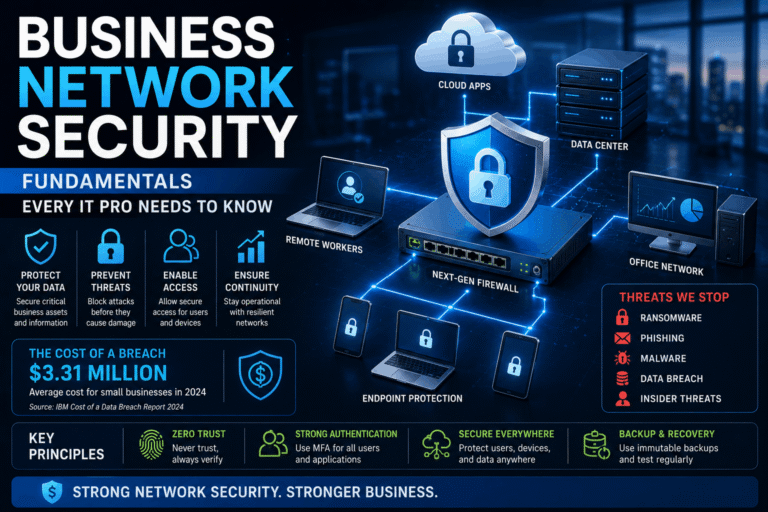
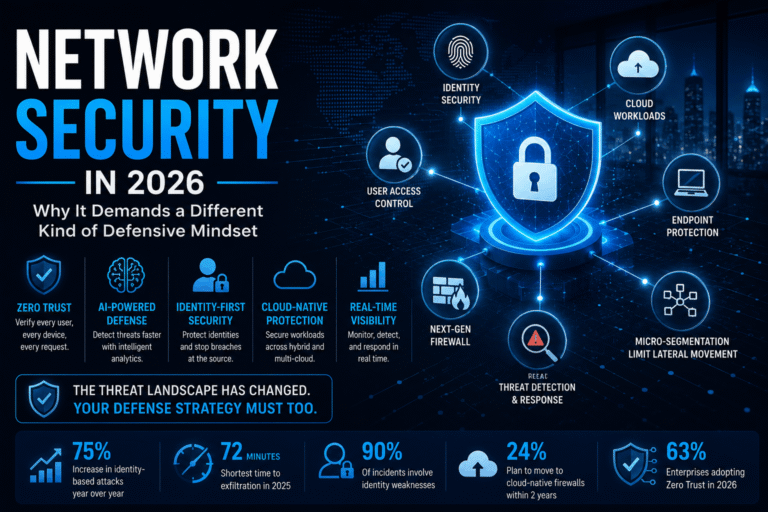
NETWORK SECURITY
Business Network Security Fundamentals Every IT Pro Needs to Know
Learn the fundamentals of business network security, including Zero Trust, SASE, and immutable backups, to protect...
Explore expert security tutorials, diagnostic tools, automated scanners, and step-by-step guides for Network Security.
Free online checkers, analyzers, and calculators for network security.
Assess your business network security across firewalls, Wi-Fi, remote access, segmentation, endpoints, monitoring, backups and incident response.
Create a continuous cybersecurity monitoring checklist covering security reviews, access control, vulnerabilities, systems, users, data protection and operational security tasks.
Evaluate your organization's security monitoring, logging, alerting, detection, investigation and incident-response capabilities.
Find cybersecurity monitoring tools and capabilities based on your environment, security goals and monitoring requirements. Discover solutions for better security visibility.
Check a domain's DKIM record using its selector. Analyze the DKIM public key, record tags, key type, selector configuration, and common DNS issues for free.
Check your domain's DMARC record, policy, alignment settings, reporting addresses, percentage, and common configuration issues with SafeNetworkHub's free DMARC Checker.
Lookup and analyze A, AAAA, MX, TXT, NS, SOA records and verify SPF, DKIM, and DMARC email security configurations.
Look up public DNS records for any domain. Check A, AAAA, MX, TXT, NS, CNAME, SOA, and CAA records with SafeNetworkHub's free DNS Lookup tool.
Check your domain's DNS security configuration including DNSSEC, CAA, nameservers, SPF, DMARC, MX, and other supported DNS security signals.
Check whether a domain publishes DNSSEC-related records such as DS, DNSKEY, and RRSIG, understand the DNSSEC chain of trust, and see whether full cryptographic validation is available.
Check your domain's email-security configuration including SPF, DMARC, MX, MTA-STS, TLS reporting, and other supported public email-security settings.
Assess your email domain security posture across SPF, DKIM, DMARC, DMARC alignment, SMTP TLS, MTA-STS, TLS-RPT, DANE, and BIMI.
Build a structured firewall configuration plan using least privilege, network segmentation, secure defaults, controlled access and security logging.
Evaluate your personal computer security posture with an interactive, privacy-first assessment covering OS updates, firewall, antivirus, disk encryption, MFA, and backups.
Quickly evaluate common cybersecurity protections across your home computers, accounts, Wi-Fi router, passwords, browser, and backups in 3 minutes.
Assess your network monitoring capabilities, identify visibility gaps and improve logging, alerting, performance monitoring and security awareness.
Assess your website's observable security posture. Audit HTTPS, TLS certificates, HTTP security headers, redirects, DNS resolution, and security configuration against defensive best practices.
Evaluate your security monitoring capabilities and identify the tools, telemetry, and processes needed to improve network visibility and threat detection.
Perform a point-in-time external perimeter health check. Inspect HTTPS availability, TLS certificate validity, HTTP security headers, redirects, and response latency from a defensive external perspective.
Assess the effectiveness of your network vulnerability management lifecycle across asset discovery, scanning, risk prioritization, remediation SLAs, verification, exceptions, and metrics.
Check your cybersecurity best practices, identify security improvement areas and get practical recommendations for stronger protection.
Audit your website HTTP response headers against OWASP standards: CSP, HSTS, X-Frame-Options, X-Content-Type-Options, Referrer-Policy, and Permissions-Policy.
Interactive tool recommendation engine. Answer questions about your environment, monitoring goals, and budget to find the best security monitoring tools.
Find cybersecurity tools for vulnerability management, network security, cloud security, SIEM, EDR, IAM, application security and more.
A practical, jargon-free cybersecurity checklist for small businesses to track basic controls across accounts, passwords, MFA, devices, backups, phishing, and cloud security.
Evaluate your small-business network security controls across 15 essential areas to get a practical security score, priority gaps, quick wins, and a 30/60/90-day roadmap.
Assess your small business cybersecurity readiness, identify security gaps and get practical recommendations to improve protection against common cyber risks.
Check your domain's SPF record, mechanisms, qualifiers, includes, DNS lookup count, and common configuration issues with SafeNetworkHub's free SPF Checker.
Check any public website's SSL/TLS certificate, expiration date, issuer, hostname validity, and certificate details with our free online SSL Checker.
Review and verify key activities across governance, asset inventory, scanning, risk prioritization, remediation, verification, exceptions, reporting, and metrics.
Assess vulnerability management maturity across asset discovery, scanning, prioritization, remediation, validation, reporting, automation and continuous improvement.
Generate a comprehensive, customizable Vulnerability Management Plan with discovery scopes, risk prioritization, remediation SLAs, exception handling, and governance frameworks.
Determine whether your organization has the governance, asset inventory, scanning capability, remediation workflows, SLAs, and staffing to operate an effective vulnerability management program.
Check your website's HTTPS, SSL/TLS certificate, security headers, cookies, redirects, and other public security configurations with SafeNetworkHub's free Website Security Checker.
Get tailored, defensive recommendations to harden your Wi-Fi network and router based on encryption mode, firmware, WPS, admin passwords, and IoT segmentation.
Identify and understand Wi-Fi security types (WPA3, WPA2, WEP, Open, Enterprise) with protocol analysis, security ratings, and router hardening guidance.
Design a defensive Zero Trust network segmentation strategy, define trust zones, enforce microsegmentation rules, and generate an actionable implementation roadmap.
Calculate IPv4 network address, broadcast address, subnet mask, wildcard mask, usable host range, CIDR prefix, and total hosts with SafeNetworkHub's free Subnet Calculator.
Enter any public URL to audit HTTP security headers, SSL certificates, DNS hygiene, and security posture in seconds.
Step-by-step cybersecurity documentation and practical tutorials.
NETWORK SECURITY
Learn the fundamentals of business network security, including Zero Trust, SASE, and immutable backups, to protect...
NETWORK SECURITY
Learn how AI network security stops threats in real time with machine learning, 2026 data, and...
NETWORK SECURITY
Network and security are converging around identity, zero trust, and AI-driven defense. Learn why 2026 demands...
Maintaining robust security controls safeguards your web applications, user credentials, and cloud assets against evolving threat vectors. Continuous automated audits ensure early detection of misconfigurations.
Common questions about network security tools & security audits.